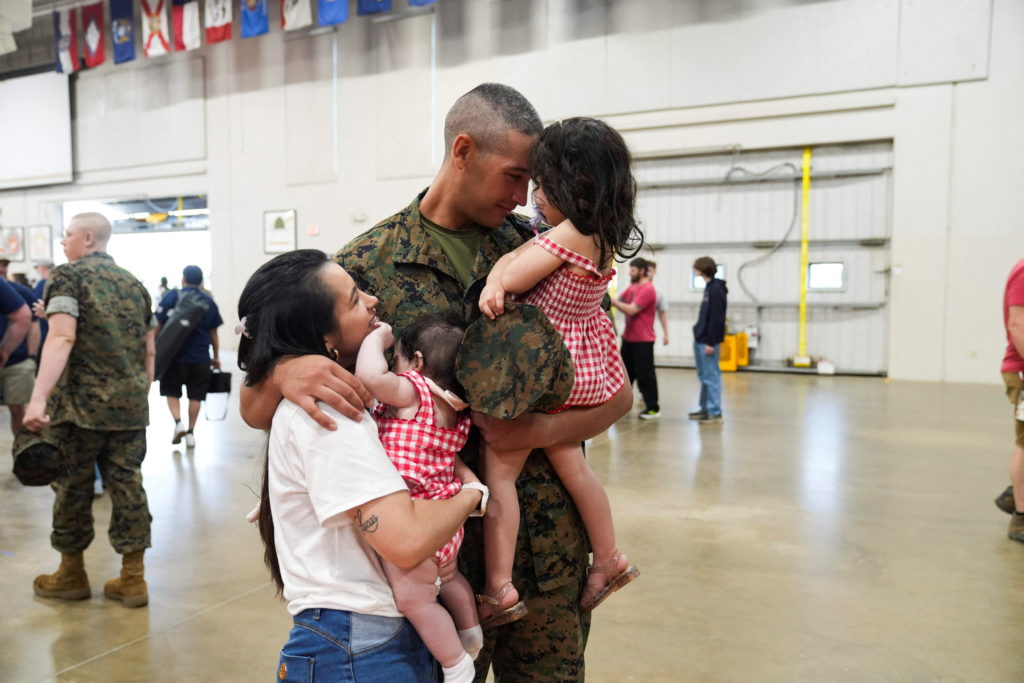
One thing Haley Harman learned quickly as a military spouse stationed overseas is that the commissary "is not the place to go for produce."
She and her husband have been stationed in both South Korea and Japan in their four years of marriage. In both places, "a lot of the items that are sent to the base arrive expired since it's being shipped from the states."
Stand with free and independent journalism. Join Press Pass from PBS News
She learned many seek produce from local farmers off base. But transportation options can be limited; the base where Harman is stationed only authorizes one vehicle per family. And many families, including Harman's, also rely on U.S. food assistance, which isn't redeemable at off-base markets or grocery stores.
"We are on WIC (the USDA's Supplemental Nutrition Program for Women, Infants, and Children). My husband is 10 years into his career and an E6" — a midlevel enlisted position — "and we still qualify," Harman said. "I can't think of any other career where you work for 10 years and you still qualify for food assistance."
Harman is among the more than 1.4 million spouses and dependents of active duty U.S. military service members around the world. Issues with housing, employment, childcare and healthcare can greatly affect quality of life.
These challenges have long been well known within the military community, and while legislative efforts have addressed some of them, spouses interviewed by PBS News say there is more to do to improve quality of life for military families.
In nearly a dozen interviews and more than 230 responses to a callout from PBS News, military spouses highlighted maintaining employment as one of the biggest challenges they've faced, with more than half of all responses referencing the issue. Also cited: challenges navigating the Exceptional Family Members Program, meant to support family members with special medical or educational needs, and the financial burdens of permanent change of station (PCS) moves.
Committees and initiatives focusing on this goal have existed under previous administrations, and President Donald Trump has ordered his own. The President's Military Spouse Commission, created via executive order in August, has started to meet monthly to identify quality of life challenges in key areas, such as employment, education and deployment-related support. A "state of the spouses" report is expected sometime this month.
While this commission is tasked with identifying issues and solutions, new policies would have to be implemented by Trump or Congress. There is skepticism around how much a commission like this can accomplish with only about two years left in Trump's presidency.
"Most commissions produce wonderful summaries of the challenges; few are effective at implementing the results impactfully," said Retired U.S. Navy Rear Adm. Mark Montgomery, now senior fellow at the Foundation for Defense of Democracies.
As the commission kicked off its work, and as a new Congress prepares to take office, PBS News asked military spouses about what issues matter most to them, and what they'd like to see. Here's a closer look at what they said, and what's ahead.
What is the President's Military Spouse Commission?
The President's Military Spouse Commission is a two-year advisory commission chaired by Jennifer Hegseth, Defense Secretary Pete Hegseth's wife. All of its members are spouses of senior leadership from each military branch and the Department of Homeland Security.
Past commissions and advisory boards have fallen under the Pentagon and advised the acting secretary, so "being really proximal to the president and advising directly to the president gives them a visibility and insight that they haven't had before," said Retired Air Force Lt. Col Doug Lindsay, now a deputy editor at Military.com.
WATCH: Families sound alarm on toxic mold in military housing
The commission "explicitly places military spouse and family quality-of-life issues within the broader context of military readiness and retention," he added.
The One Big Beautiful Bill Act designated roughly $9 billion to military quality-of-life issues. However, this commission won't be in control of where that money goes.
"Some of these are policy issues which can be done directly, either through the president or through the other judicial bodies. But some will require resources, which means that these recommendations will then have to flow through Congress for the appropriate funding," Lindsay said.
According to the executive order establishing the commission, each member will serve unpaid, but may receive travel reimbursement.
In a statement to PBS News, a White House spokeswoman reiterated that military spouses "are essential to the strength, readiness, and retention of our military."
"President Trump has rebuilt America's military and is ensuring that the amazing families who support our service members receive the support they deserve," she added.
Montgomery, who ran a federal commission on cybersecurity, is more skeptical about what results the commission can produce.
"The challenge is that changing laws requires congressional buy-in on the front end," he said. "Ours was considered successful and drove a lot of legislation because we actually had four serving congressmen on it."
Montgomery said if recommendations from the commission are implemented, "it might not even have an impact before the current administration is out of office." Increasingly, he added, "administrations seem to ignore what their predecessors had 'in process.'"
Members of the military community have noted that all the spouses on the commission are married to senior-level service members, raising questions about how well they will reflect the experience and needs of the average service member and their family.
"I think there just needs to be due diligence" that recognizes experiences can differ greatly between ranks, Lindsay said.
Junior-grade officers make up about 56% of the officer corps, and junior enlisted personnel make up about 50% of the enlisted workforce.
Harman wants "those on the commission to remember their roots."
"Think back to when every paycheck mattered," she said. "Keep those days in mind because those young people also make up a really large portion of our military, and they're the ones who need support."
Top issues
Lt. Col. Kaylee Bandy, program manager of the Department of the Army Career Engagement Survey, told Stars and Stripes in July that the second-highest reason for soldiers leaving the Army was the effects on family.
"A soldier who may normally want to stay after 10 years but [is] having some issues with the family in terms of employment or employability, that could have a really drastic effect," Lindsay said.
In its latest meeting Nov. 16, the commission shared that employment was the top issue across the hundreds of responses it's received in its online feedback portal, accounting for 45% of the submissions. Childcare and education were also frequently cited.
Employment and healthcare were also top issues in a recent community survey by The National Military Family Association.
When Crystle Ardoin got married just shy of a year into her husband's Army career, she quit her corporate job because they couldn't afford childcare. When she tried to reenter the workforce, she said she hit walls even after obtaining credentials as a school librarian.
When Crystle Ardoin got married just shy of a year into her husband's Army career, she quit her corporate job because they couldn't afford childcare. When she tried to reenter the workforce, she said she hit walls even after obtaining credentials as a school librarian. Photo courtesy of Crystle Ardoin.
"We've moved several times and I've quit multiple jobs in this field to go where the Army tells us to go," said Ardoin, who has been a military spouse for nearly 15 years.
A 2024 federal survey of active duty spouses found that civilian spouses who had made a PCS move within the last year had about a 136% higher chance of being unemployed than those who hadn't.
"When we start to look at 20% of unemployment among military spouses, that's a very direct impact on a military member's ability to serve," Lindsay said. "What initially appears to be a family quality-of-life concern becomes a force readiness consideration," he added.
While these problems have long been known in the military community, Lindsay said he suspects the catalyst for this new commission is the current state of the economy.
"Childcare, it's not cheap, right? Food is not getting any cheaper," he said. "So, when you start to add unemployment and PCSs and all the costs that go along with that, I think it just is becoming much more salient now than it has been in the past."
Brooke Freeman has experienced this firsthand. She is stationed with her husband in Tennessee and has moved five times within their eight years of marriage. The main factor in her decision to leave the workforce and care for her children was the cost of daycare.
Brooke Freeman and her children wait to welcome her husband home. Freeman and her husband have moved five times within their eight years of marriage. Photo courtesy of Brooke Freeman.
After her second child was born, Freeman applied for jobs for two years. "I could not get hired anywhere because I had all these kids at home and I was very open that I was a military spouse, so I'm going to be operating like a single mom," she said. "A lot of people just don't want to take that on as a liability for their business."
Despite climbing the ranks, she said, her husband "makes so little that we still qualify for government assistance like WIC," Freeman told PBS News.
The family has decided to live off base because of the quality of housing on military installations.
She recalled one relocation in which they were offered military housing.
"They did not tell us until we did the walkthrough that there was asbestos and mold confirmed in the house," Freeman said. One of her children has respiratory issues and when Freeman raised this, she was told "it's this or nothing."
Because Freeman and her family live off base, her husband receives a basic allowance for housing (BAH). The monthly allowance is calculated to cover 95% of housing costs based on the service member's rank, the rental market rates at the duty station, including the average cost of utilities, and how many dependents the service member has. Freeman said they pay significantly over their allowance t for off-base housing.
These quality-of-life challenges for spouses extend to the National Guard, too. Chelsea Macias has been married for 14 years to her spouse, in the Texas National Guard. He's an Active Guard Reserve (AGR) soldier, which is a full-time role. They've stayed in Texas throughout his service, but have had to make several PCS moves.
Not all active guard reserve soldiers choose to move when they're restationed within the state or nearby, Macias said. But that can mean some soldiers "are commuting two hours a day. That is normal," because their families do not have the resources to move nor the resources to live closer to work.
In Macias' case, the National Guard unit headquarters is in a large city that's very expensive, she said.
Crystle Ardoin poses with her family in this undated photo. Photo courtesy of Crysle Ardoin.
For people from smaller areas with a lower cost of living, " it doesn't make sense to sell your house and dump all your money into a volatile housing market."
Her family has moved about every three years. Each "was anywhere between $3,000 and $10,000 a move because we personally procured [it]," Macias told PBS News.
This type of move is one of the options the government offers military families for a PCS. This means the family takes on the responsibility of moving their items themselves instead of having government-arranged movers. This also means families pay the costs upfront and are reimbursed later, but only up to a certain point.
"One of our last moves ended up being $15,000 out of pocket and we got $11,250 back," Macias said. "That's like $4,000 that we had to use to move. And does that [equate] out to people in the civilian world? Maybe, but people in the civilian world, when they spend $4,000 to move, they don't do that again."
"Nobody in their right financial mind would do this if it wasn't for the love of what they do," she added.
What's next ?
The commission has held three meetings, the last in November. It did not offer an update on the "state of the spouse" report in its last meeting nor in an emailed request for comment from PBS News.
In the September meeting, Jennifer Hegseth announced that at the commission's urging, the Pentagon would roll out a pilot program in five locations allowing families to use assistance they receive from the Military Child Care in Your Neighborhood program on certain faith-based, licensed-exempt daycares in their communities. Eligible providers must operate under a legally recognized, licensed-exempt status and comply with local health and safety laws. The Pentagon announced Nov. 12 that it was expanding this pilot to include certain school-operated public and private childcare programs.
The commission also announced in its October meeting that it is working with Florida on a toll relief pilot program. Currently, active-duty service members and spouses commuting to MacDill Air Force Base in Tampa receive a 50% discount on tolls. The commission said it is working with the state and toll operators to increase that discount to 100% and use this program as a model nationwide.
In its latest meeting, the commission said it has worked with the Defense Health Agency to overturn their "Mature Minor Policy." Currently, parents lose access to their child's electronic health records and protected health information when they turn 13. Parents can only access their child's health portal to view appointments, messaging, immunizations, and allergy care only. The commission announced that starting Nov.18, minors between the ages of 13 and 17 can give their parents access to their medical records via an online portal, unless state law prevents it otherwise.
The National Military Family Association, which has been working with military families for more than 50 years, said in a statement to PBS News that it is hopeful the committee will lead to "actionable solutions on issues such as spouse employment, childcare, and food insecurity."
It appreciates the effort "to raise awareness of and address some of the many challenges facing military families. Many of the spouses on the commission have experienced military life first hand and we are hopeful that their lived experience will inform the Commission's work."
Military family issues are important and "I'm glad the administration wants to tackle it," Montgomery says. However, if the Trump administration wants the commission to make meaningful changes within the two years it has left, Montgomery said, it needs to readjust "the mission to the timetable they have remaining."
A free press is a cornerstone of a healthy democracy.
Support trusted journalism and civil dialogue.