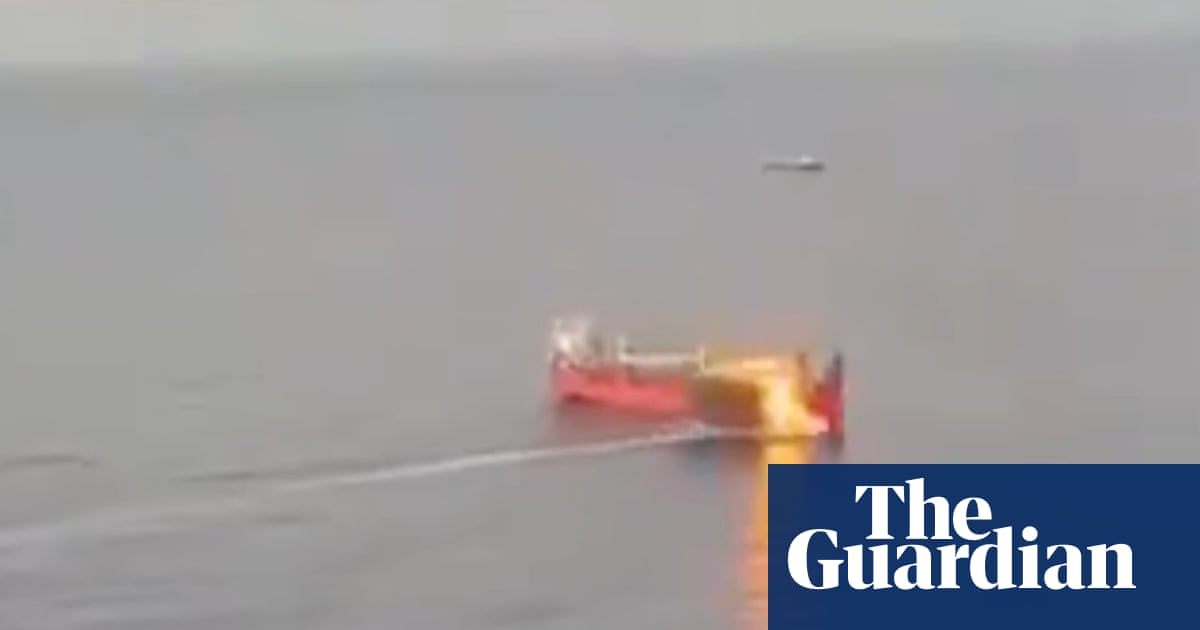
Libya’s foreign ministry condemned an attack on two Russian ships near the eastern city of Benghazi claimed by Ukraine, demanding an explanation from Kyiv. The attacks caused the Russian corvette Merkury to explode and sink at the port of Benghazi, while a dry cargo vessel was also hit. Ukraine said Russia was using it to transport weapons. The Tripoli-based foreign ministry of Libya’s UN-recognised government condemned the “conduct of any foreign military operations within Libyan territory or territorial waters”.
Ukraine confirmed it deployed naval drones in the strikes on the two Russian vessels off Libya, Peter Beaumont reports. Ukraine’s security service, the SBU, said seven domestically made naval drones were launched from a mothership in the operation, which Volodymyr Zelenskyy described as “exemplary”. The Ukrainian president released video footage, filmed by an approaching drone, showing the drones as they smashed into the side of the warship at its berth in the Benghazi naval base, triggering huge explosions that lit up the night sky.
A Guardian analysis of more than 11m Russian death certificates obtained by hacking groups has given the most detailed picture yet of Russia’s losses in Vladimir Putin’s full-scale invasion of Ukraine. The Guardian identified more than 460,000 deaths linked to the war between the start of the invasion in February 2022 and September 2026. War became the leading cause of death in Russian men under 65 last year. The real toll is likely to be higher. The deaths of missing soldiers are often registered months or years later, when bodies are recovered or courts declare men dead, and the records thin out sharply in 2026, even though the fighting has remained exceptionally deadly.
Figures from the cache of certificates reveal more than 1,000 Russian soldiers recorded as having died by suicide since the start of the full-scale invasion. The deaths of a further 885 soldiers in or near Ukraine were recorded as firearm-related injuries of “undetermined intent”, a classification that experts say can conceal suicides and that was used in several cases independently identified by the Guardian as suicides. The data, which analysts say almost certainly underestimates the true number of suicides, offers a rare and previously unreported glimpse of the strain on Russia’s armed forces nearly five years into a war in which heavy losses and harsh discipline have sapped morale.
A Russian unmanned aerial vehicle briefly violated Polish airspace during a nighttime attack on western Ukraine, the Polish armed forces said. An authorisation was given to shoot down the object but after it changed its course to head east, “taking into account the potential threat to civilians and the possible consequences of shooting down the object”, a decision was made to refrain from using weapons, the post on X said. Three Russian Kh-101 missiles landed in Poland on Friday, adding to fears that Russia’s war in Ukraine could spill over into Nato territory.
Britain’s defence secretary has said restrictions on the use of SpaceX’s satellite communications by Ukraine’s military have caused concern among European governments and damaged trust in the company’s services. “This has been a topic of conversation among defence ministers right across Europe: it has really dented confidence and trust,” Wes Streeting said during a visit to Kyiv. Ukraine said earlier this month that its military units had recorded significant disruptions to the Starshield military communication system provided by SpaceX, affecting the entire frontline and Russian-occupied parts of Ukraine. Streeting said: “We are owed a clear explanation about those service interruptions: why and how they happened and why customers should be confident that they will get the service that they pay for.”
The World Food Programme’s executive director, Luke Lindberg, has warned that shipping chokepoints linked to wars in the Middle East and Ukraine could raise the agency’s costs by $727m by mid-2027, threatening food aid for 7.3 million more people. He said constraints on food exports were compounded by climate shocks like El Niño. “It’s an unthinkable scenario, and it could not come at a worse time,” said Lindberg, a former US agriculture official, urging diplomats to focus on trying to find rapid solutions to ensure 10m tons of Ukrainian and Russian grain that were already in silos reached people in need.