After years of being able to hide behind Republicans’ blatant mismanagement and intentional sabotage of the healthcare system, Democrats will now have to put forth their own plan to save our crumbling healthcare infrastructure. Whether the party can agree on what that plan is remains to be seen.
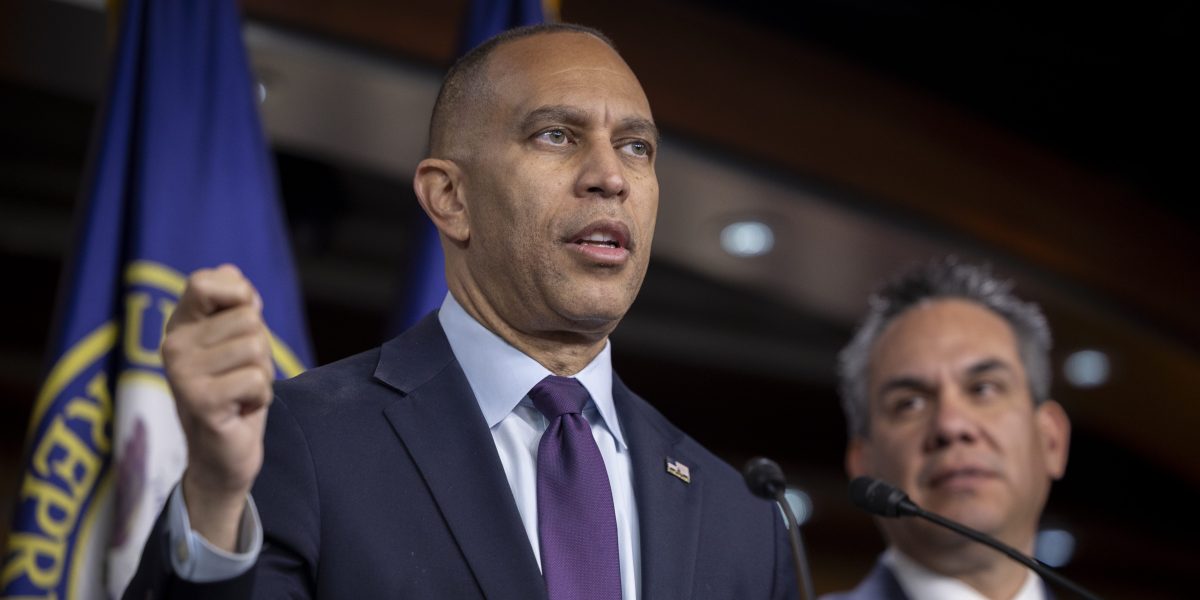
The middle path has been dubbed “Medicare for More.” It’s been framed variously as a first step toward Medicare for All and as a half-measure to relieve the pressure to pass the more expansive healthcare agenda. Now backed by Rep. Hakeem Jeffries, the presumed next speaker of the House, the policy would lower the eligibility age for the public retiree health system; expand dental, vision, and hearing care; and provide universal coverage for children.
“We’re in the wealthiest nation on Earth, and we’re running out of excuses for why Americans don’t have universal healthcare.”
But the plan would maintain the status quo for people ages 26 to 55 — many of whom saw their Affordable Care Act healthcare premiums spike after December 2025, when enhanced subsidies expired for an estimated 22 million people as a result of Republicans’ so-called Big, Beautiful Bill.
“We’re in the wealthiest nation on Earth, and we’re running out of excuses for why Americans don’t have universal healthcare,” Rep. Summer Lee, D-Penn., wrote in a statement to the Intercept. “The mandate from voters is change. The American people literally cannot afford to return to the status quo.”
Progressives have vowed to pass Medicare for All, a sweeping proposal to establish a national public health insurance program sponsored by Sen. Bernie Sanders, I-Vt., and Rep. Pramila Jayapal, D-Wash. Backers of the full Medicare for All package argue that systemwide change is necessary — and that half-measures are not what voters asked the party to do.
Polling suggests broad support for Medicare for All, particularly among Democratic voters. A Kaiser Family Foundation poll found that 94 percent of registered Democrats support the policy — and roughly 79 percent of all adults polled favor the federal government doing more to help provide health insurance.
Despite Medicare for All’s growing popularity, Jeffries, a New York Democrat, remained skeptical of the policy throughout the midterms. In August, he told “Meet the Press” that he did not support it, emphasizing that since joining leadership he has declined to co-sponsor Medicare for All legislation.
Jayapal, who has reintroduced her signature legislation every session since 2019 and plans to do so again in the next Congress, said wins from candidates who ran on Medicare for All in this year’s midterm elections have helped to push leadership on this issue. She specifically cited the success of purple-state candidates like Sen.-elects Abdul El-Sayed in Michigan and Troy Jackson in Maine, who invoked the policy again and again on the campaign trail — and won.
At a meeting of the Congressional Progressive Caucus last week, the Washington congresswoman said that Jeffries agreed to two out of three of the caucus’s requests on Medicare for All. First, he agreed to support the initial phase-in of the Medicare for All Act, which Jayapal says she has been pushing him on for “the last couple of months.” The plan would greatly expand access to healthcare for most Americans by simultaneously lowering the Medicare eligibility age and covering everyone under the age of 18.
Second, he agreed to get a Congressional Budget Office score on the full Medicare for All act. The CBO score estimates the cost of any given legislation, which gives members a chance to weigh the financial impact of a bill before casting their vote.
But Jeffries declined to support their third request: a markup of the full “Medicare for All” bill in committee. Markups allow committees to make amendments to a bill before it gets voted on in front of the full House — making it substantially easier to pass.
Still, Jayapal believes there is a path forward for her bill. She said that she has spoken with both new members and incumbents “who haven’t been on it before” and now say they want to co-sponsor the bill, and she believes that with more of the caucus’s support, Jeffries could support a bill markup in the future.
It appears that attacks on the policy have become less effective with voters over time. Private insurance companies have long supported anti-Medicare for All messaging, Jayapal pointed out.
Opponents of the public healthcare proposal argue it will create longer wait times, raise taxes, and separate people from their preferred doctors. But as the state of healthcare in the United States has degraded and become more dystopian, Jayapal said, “none of those attacks work when people are already experiencing $20,000 in premiums, when they’re already being told they can’t have care by an AI model or by a private insurance company.”
Regardless of what the public wants, and even if Democrats can agree on a vision, the mercurial commander-in-chief remains an obstacle. The Democrats’ 56-seat Senate majority is significant but not veto-proof, and President Donald Trump has previously called Medicare for All a “socialist takeover.” On Saturday, he told Fox News there’s a “chance” he would work with Democrats on healthcare — but it would not be the legislation Democrats “want.”
Jayapal says she’s not holding out much hope for collaboration.
“I don’t think much about Trump in this particular moment,” she said. “I think we just need to do the thing that we know Americans deserve and want, and then let’s send it to his desk. And if he signs it, great. And if he doesn’t, he will be the one that is not allowing Americans to have healthcare, and then we can sign it when we have the trifecta.”