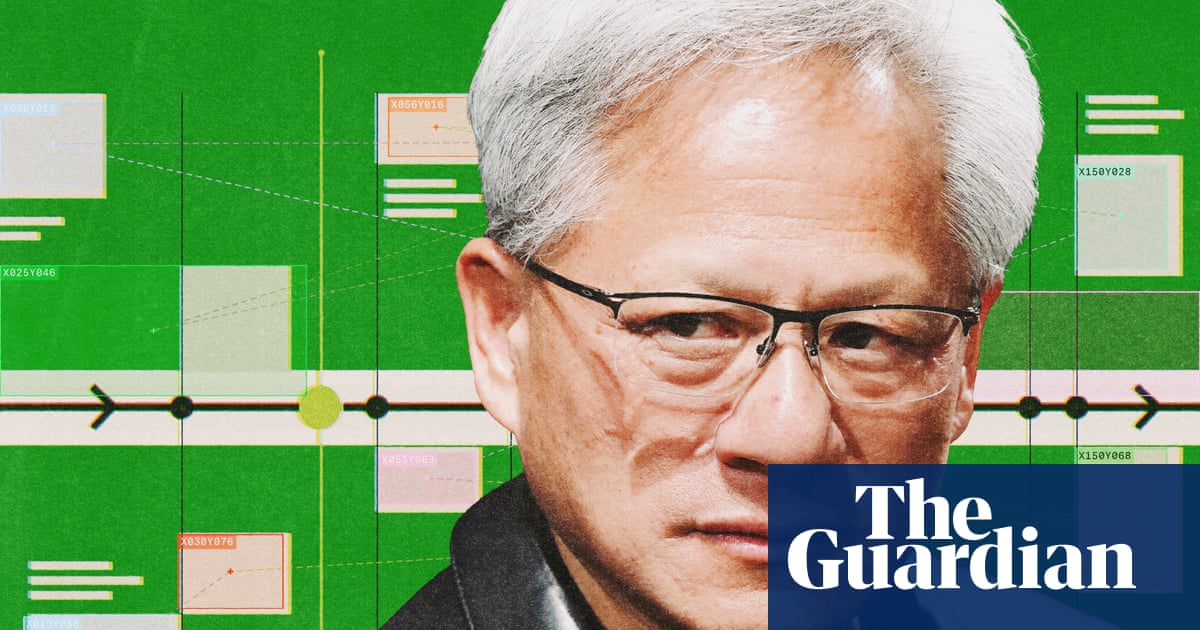
Hello, and welcome to TechScape. I’m your host, Blake Montgomery, writing to you while dreaming of the pear tarte tatin and a potato gratin I’ll be baking for Thanksgiving.
Today in tech, we’re discussing Jensen Huang’s reinstatement as Nvidia CEO and Silicon Valley’s pivot away from Maga after the US midterm elections.
The case against Jensen Huang
Since Jensen Huang’s resignation from Nvidia at what seemed like the height of success, we have learned quite a few damning things about the former CEO’s leadership at the company. Regardless of all of them, he was reinstated as the head of the chip maker yesterday.
The messy details that become public after a scandal often shape the perception of that saga in the media. With Huang, those articles were overwhelmingly negative. His reincarnation as CEO was not something that close watchers were expecting. There was no drumbeat of minor news stories predicting his return. It was a genuine shock after such unflattering stories pointed to his permanent exile.
Let’s take a stroll down memory lane with the details that have emerged since Huang’s resignation on 12 November:
In addition to relationships with Alice Huang and Nvidia’s vice-president of healthcare Kimberly Powell, Huang had an affair with a second Nvidia employee who reported to him, Reuters revealed.
Alice Huang was indeed in touch with the Chinese military about semiconductor chips, according to the New York Times.
Nvidia itself sold billions of dollars’ worth of chips to south-east Asian firms that leased them to Chinese companies, effectively contravening US export controls in a major avenue for its business, according to the Wall Street Journal. Alice Huang’s husband, a leader of Megaspeed alongside her and the person who introduced her to Jensen Huang, operated one of these businesses.
Huang was, according to the New York Times, one hell of a bully during his time as CEO. When he couldn’t motivate his subordinates with money since they were already rich, he reportedly resorted to humiliation, telling underperforming employees he’d rip off their arms and beat their corpses with them and tear open their skulls to pee on their brains.
Read more:
Nvidia’s humiliated board should resign out of embarrassment
A timeline of Jensen Huang’s affair scandal, from quitting Nvidia to his return
What’s next for Nvidia?Nvidia CEO Jensen Huang speaks during the Nvidia Constellation All-Employee Celebration in Taipei, Taiwan, on 27 May. Photograph: Ritchie B Tongo/EPA
Huang returned to the company’s headquarters to a standing ovation Monday, according to videos posted online. But the company at the center of the AI boom still faces serious, likely damaging investigations.
The US Securities and Exchange Commission is probing the company’s accounting. Nvidia has faced serious public criticism over circular financing deals in which it lends money to its own customers to buy its chips.
California’s attorney general has opened an investigation into Nvidia’s alleged circumvention of US export controls by allegedly facilitating China’s purchase of advanced chips.
In addition, congressional hearings and investigations are set to begin as early as next week, which will see Huang grilled by US lawmakers. Democrats and Republicans alike are angry about how Trump seemingly strong-armed Nvidia’s board into bringing Huang back in from the cold. On Monday, Trump said there was no cause to be concerned with the national security implications of Huang’s affairs, and the statement by Nvidia’s board mentioned consultation with high-level national security officials, signaling that members of the Trump administration had been in contact with the board.
Nvidia even faces a steep uphill climb towards re-establishing its credibility with its own investors, previously the happiest people in finance. Nvidia shareholders have filed a lawsuit against the company, alleging they were misled. Recent remarks by the board seem to bolster that case: The company’s board chair told investors last week during an earnings call, the most direct form of communication between a company and its shareholders, that the board would not reinstate Huang. That same board had named an interim CEO, started an internal national security probe, and begun what seemed like an earnest search for a permanent replacement.
How can Nvidia regain the trust of those investors? My colleague Nils Pratley thinks the board has been humiliated beyond repair and that the directors should resign.
Read about Anthropic’s enormous stock market debut and the market crash the next day
Anthropic closes first day of public trading at $1.3tn valuation after largest-ever IPO
Protesters rally against Anthropic in New York and San Francisco after $2tn stock market debut
Who are Anthropic’s seven co-founders, now worth $180bn?
Nasdaq erases all 2026 gains as AI sell-off dampens Anthropic’s second day of trading
Anthropic’s IPO was great for the tech elite – and not so great for the rest of us
Anthropic’s historic stock market debut: key takeaways, and what comes next for the AI industry
skip past newsletter promotion
after newsletter promotion
Silicon Valley has a long history of political pivotsTesla and SpaceX CEO Elon Musk looks on as Donald Trump signs executive orders in the Oval Office of the White House in Washington DC on 11 February 2025. Photograph: Jim Watson/AFP/Getty Images
Jensen Huang isn’t the only Silicon Valley tycoon starting a new chapter. Elon Musk, Palantir’s Alex Karp, and others in Silicon Valley are turning a new leaf politically.
The wisdom among company founders goes that if your product finds no fit in the market, you pivot your company to something else. Try again. Iterate.
Many of Silicon Valley’s leaders treat their politics in much the same way. Strike an alliance, milk it, iterate, pivot.
A significant number of the tech barons were major boosters of Barack Obama’s vision for a liberal global order. Then, after the radicalizing events of Trump’s first election, a worldwide backlash against social media, and the Covid-19 pandemic, they appeared front row at Trump’s inauguration, looking for all the world like loyal Republican acolytes.
Two years later, Silicon Valley’s tycoons are feeling blue. They’re making ham-fisted attempts to reconcile with the same Democrats they so recently rejected.
Will it work? There is a moral dimension to politics. Treating beliefs like app features reads as cynical. A machiavellian perception of tech’s richest barons is one of the major reasons they suffered a significant repudiation in the US midterms several weeks ago. But these mercurial CEOs are vital players in the US economy and national security, however much voters may dislike them personally. Democrats as well as Republicans need Silicon Valley’s companies to grow.
For more on the pivot, read my colleague Johana Bhuiyan’s reporting on Silicon Valley’s latest turn back to liberal politics.
The wider TechScape
Waymo pulls driverless taxis from freeways across the US after California ban
AI is imposing a hidden ‘cognitive tax’ on the lowest-paid workers
‘Little room for error’: what a debt-laden cloud computing company says about the AI boom
Russian national charged with spying on Silicon Valley tech and defense firm