Secretary of Defense Pete Hegseth is imposing new restrictions on the defense relationship between the United States and Canada, according to the Washington Post. In response to the reporting, a Department of Defense spokesman said only that the United States is “taking steps to ensure its engagements with Canada advance tangible U.S. defense objectives and ultimately support a reinvigorated defense relationship.” Intelligence sharing, cooperation through NATO, and the North American Aerospace Defense Command (NORAD) reportedly remain unaffected by the secretary’s new guidance, which remains classified. The limitations appear to affect primarily meetings (including those between general and flag officers), conference attendance, and similar activities, rather than operations. Nevertheless, the directive clearly signals a new era of rocky relations with the Canadian military.
Tensions between the two countries over defense matters have been rising throughout the second Trump term. In January, President Donald Trump told the World Economic Forum that Canada “should be grateful” for his planned Golden Dome missile shield, adding, “Canada lives because of the United States.” In May, DOD paused U.S. participation in the Permanent Joint Board on Defense, a bilateral body established in 1940, citing Canada’s failure to “make credible progress on its defense commitments.” And last month, the Secretary questioned allied contributions to the Afghanistan conflict, joking that the acronym ISAF (the NATO-led International Security Assistance Force) stood for “I saw Americans fighting” and that, by the war’s end, it was “closer to one or two” partners that “were actually involved in kinetic operations.”
If DOD is, in fact, looking for a reinvigorated relationship, then it is pursuing the right objective. But reinvigoration should mean deepening the partnership, not limiting it. After all, strategy aligns ends with the means of achieving them, and allies are among the most important of those means.
The Pentagon’s own 2026 National Defense Strategy (NDS) makes this point expressly. It sets out four lines of effort – defending the U.S. homeland, deterring China in the Indo-Pacific, increasing burden-sharing by allies and partnersm, and “supercharg[ing]” the defense industrial base. The NDS insists that “[o]urs is not a strategy of isolation,” and that allies “have an essential role to play – but not as the dependencies of the last generation.” The document refers to Canada only once. Yet measured against the four lines of effort, Canada is hardly a dependency. It is the kind of ally the strategy envisions. Here I survey the record on which the Canadian-U.S. defense relationship rests, then assess Canada against each line of effort. The conclusion is straightforward: Canada is an indispensable defense partner.
Partnership Architecture
The Canadian-U.S. defense architecture dates to 1940, when the U.S. president and the Canadian prime minister met in Ogdensburg, NY, and agreed to establish the Permanent Joint Board on Defense to “consider in the broad sense the defence of the north half of the Western Hemisphere” (Ogdensburg Agreement). At the time, the United States had not yet joined World War II, but Canada had been fighting for nearly a year. The board survived the war, becoming the two countries’ highest-level bilateral defense forum, at least until DOD paused its participation this year.
Of the subsequent institutional arrangements, three stand out. First, under Article 5 of the 1949 North Atlantic Treaty, the allies agree that an armed attack against one is an attack against all. For the United States, NATO is the principal means of deterring Russia and sharing the cost of European and North American security. Canada, a founding member of NATO, is the only other member state (“Ally”) outside Europe. In nearly eight decades, the alliance has invoked Article 5 only once, on behalf of the United States after 9/11. As will be explained, Canada quickly answered the call.
Second, in 1958, the two countries established NORAD as a binational command with an American commander and a Canadian deputy. Under the arrangement, the commander is equally responsible to the American president and the Canadian prime minister. A 2006 agreement defines NORAD’s mission as providing aerospace warning, aerospace control, and maritime warning for North America (art. I(1)).
Third, the “Five Eyes” partnership links Australia, Canada, New Zealand, the United Kingdom, and the United States in “the world’s longest-standing and closest intelligence-sharing alliance.” It began as a signals intelligence arrangement, with Canada’s role dating to the 1949 CANUSA agreement with the United States. Today, the partners share “a broad range of intelligence,” and their security ministers meet annually.
I hasten to add that defense integration extends to personnel. Hundreds of Canadians are serving with the U.S. military in the United States at any given time. Those on exchange are considered “employed as members of the armed services of the host nation.” For instance, 35 Canadians currently serve with the U.S. Air Force’s 552nd Air Control Wing, which flies the E-3 AWACS. As noted, NORAD’s deputy commander is a Canadian lieutenant general, and Canadian brigadier generals have served as deputy commanding generals in U.S. Army formations, including the 11th Airborne Division, the Army’s Arctic division in Alaska, and I Corps. I might add that over the years, I have worked closely with Canadian officers and Canada’s Judge Advocates General. They are exceptionally professional, talented, dedicated, and superb team players.
Operational Contributions
Canada has not always joined America’s wars. It stayed out of Vietnam and declined to join the 2003 invasion of Iraq. Nor has it participated in the current war with Iran. Still, when the United States has fought for a cause the two nations share, Canadian forces have usually been at its side, often early and at great cost. A selective survey makes that point unmistakably.
Twentieth Century: In World War I, Canada, then a country of fewer than eight million, put more than 650,000 men and women into uniform; over 66,000 died, and over 172,000 were wounded. In World War II, roughly one million Canadians served, with over 45,000 killed. And in Korea, more than 26,000 Canadians served under the U.S.-led United Nations Command; 516 died. At Kapyong in April 1951, for instance, a Canadian battalion held its hill so bravely against a far larger Chinese force that the United States awarded it the Presidential Unit Citation. And during the 1962 Cuban Missile Crisis, Canadian warships and maritime patrol aircraft joined the U.S. Navy in hunting Soviet submarines in the North Atlantic.
After Iraq invaded Kuwait in August of 1990, the Security Council imposed an embargo and called upon states with naval forces in the region to enforce it (SC Res. 661, 665). In the embargo’s first two months, Canadian warships, with only a tenth of the coalition’s forces, conducted more than a quarter of its inspections. When hostilities broke out between the coalition and Iraq in 1991 (Operation Desert Storm), Canadian CF-18s, which had flown combat air patrols since October of the previous year, struck Iraqi land and sea targets. Canadian warships continued to enforce the embargo until 2003 under multiple Security Council resolutions, at times as part of U.S. carrier battle groups (SC Res. 661, 665, 687, 1483).
Operations in the Balkans followed. Canadian warships and patrol aircraft participated in Operation Sharp Guard, which enforced the Security Council’s embargo on the former Yugoslavia from 1993 to 1996 (SC Res. 713, 757, 787, 820). Ashore, almost 40,000 Canadians served in the Balkans with U.N. and NATO forces; 23 died there. And when diplomacy over Kosovo failed in 1999, Canada contributed a squadron of CF-18s flying from Italy to NATO’s air campaign, Operation Allied Force.
Twenty-First Century: Canada’s response to 9/11 demonstrated the country’s selfless willingness to support its neighbor. The morning of the attacks, NORAD’s director of operations was a Canadian major general who shared the watch with NORAD’s American commander as they authorized combat aircraft to launch while the attacks unfolded. The next day, the North Atlantic Council agreed, “if it is determined that this attack was directed from abroad against the United States, it shall be regarded as an action covered by Article 5 of the Washington Treaty, which states that an armed attack against one or more of the Allies in Europe or North America shall be considered an attack against them all.” Among the measures that followed was Operation Eagle Assist, in which NATO AWACS aircraft, with Canadians aboard, patrolled U.S. skies, enabling U.S. AWACS aircraft to support operations overseas.
Canadian forces responded immediately in support of the United States, sending warships to the Arabian Sea to perform escort duties and conduct maritime interdiction. On the ground, Canada’s contribution to NATO’s International Security Assistance Force was especially significant. Indeed, in 2004, a Canadian served as its commander. From 2006 to 2011, Canadian forces fought in Kandahar, the Taliban’s heartland and one of the most dangerous areas in the country, at times with U.S. units under Canadian command. And whatever one thinks about the withdrawal from Afghanistan in 2021, over 500 Canadian personnel participated in the U.S.-led air bridge out of Kabul, evacuating nearly 4,000 people.
Overall, more than 40,000 members of the Canadian Armed Forces deployed to Afghanistan. The losses were severe: 158 died, 635 were wounded in action, and another 1,436 suffered non-battle injuries. A Brown University Costs of War study found that, measured against peak deployment, Canada’s fatality rate of 5.4 percent was the highest among the five largest contingents, compared with 4.7 percent for the United Kingdom and 2.3 percent for the United States. The study noted,
While the U.S. had the largest total number of fatalities, the allies were not mere bystanders, as some believe. Some U.S. military service members, for instance, joked that ISAF stood for “I Saw Americans Fight” because of all the caveats and limits on when and how some allies could engage the enemy. Yet hundreds of allied troops died. The United Kingdom lost 455 service members, Canada lost 158, and France, Germany, and Italy each lost dozens.
Nor have Canada’s contributions been limited to Afghanistan. When Hurricane Katrina struck the Gulf Coast in 2005, some 1,000 Canadian personnel, including three warships and navy divers, deployed to assist the United States in recovery operations. In 2011, a Canadian commanded Operation Unified Protector in Libya, NATO’s operation enforcing Security Council Resolutions 1970 and 1973, while Canadian warships enforced an arms embargo and CF-18s flew strike sorties. Three years later, Canadian fighters joined Operation Inherent Resolve, the campaign against the Islamic State, flying 1,378 sorties over Iraq and Syria. And when NATO launched NATO Mission Iraq, its training and advisory mission, in 2018, Canadian generals commanded for its first two years; the second of them is today Canada’s Chief of Defence Staff, Gen. Jennie Carignan.
Canada and the Four Lines of Effort
A long record of shared sacrifice is reason enough to value the partnership. But the NDS measures allies by what they contribute today. By that standard, Canada delivers across all four lines of effort.
Defending the Homeland: As to the U.S. National Defense Strategy’s first priority, Canada’s contribution is in great part geography, for the shortest routes from Russia to the United States cross the pole and Canadian airspace. This being so, defending the United States begins over Canada. Through NORAD, Canada contributes personnel, fighters on alert around the clock, refuelers, the Arctic radar chain, and northern bases. For instance, intercepts of Russian aircraft are routine, and in 2024 Canadian and American fighters together intercepted Chinese bombers off Alaska for the first time. Canada has also committed in excess of $25 billion over 20 years to modernize these assets.
Reflecting genuine concern about Russian and Chinese activity in the Arctic, the NDS also treats Greenland as “key terrain.” This concern mirrors NATO’s growing emphasis on the Arctic and High North, where seven of the eight Arctic states are Allies. With the Arctic covering roughly 40 percent of its landmass and more than 70 percent of its coastline, Canada plays a key role in addressing this threat. As the United States expands its presence on Greenland under the new U.S.-Denmark-Greenland security agreement, it would be wise to acknowledge that Canada is already defending the very northern approaches it seeks to secure.
As noted above, NORAD has had the mission of warning of missile attacks for decades. Since 2004, that mission has supported U.S. ballistic missile defense. In 2005, Canada declined to join the interceptor system, but since 2025 it has been negotiating a role in Golden Dome, through which the NDS promises to “defend America’s skies.”
Deterring China in the Indo-Pacific: Canada is also active in the Pacific. The Royal Canadian Navy deploys three warships to the region each year, and its warships have transited the Taiwan Strait alongside the U.S. Navy. Canadian ships and aircraft also participate in the multinational effort to monitor North Korean ship-to-ship transfers that attempt to evade Security Council sanctions (SC Res. 2375, 2397). And Canada, a founding participant in the U.S.-hosted RIMPAC exercise, the world’s largest maritime exercise, has taken part in every iteration since 1971; more than 800 Canadian personnel joined this year’s.
Burden-Sharing: U.S. frustration with Canadian defense spending was long justified. In 2014, Canada spent about 1 percent of GDP on defense. But that has changed. In 2025, Canada met NATO’s 2 percent benchmark for the first time since the Cold War. It has also joined other NATO Allies in pledging 5 percent of GDP (3.5 percent on core defense) by 2035.
Operationally, Canada leads NATO’s multinational brigade in Latvia, a unit of about 3,000 troops from 14 nations, including up to 2,200 Canadians. Canada has pledged to maintain that commitment through 2031. The brigade guards a frontier that the United States would otherwise have to address itself. But Canada’s contribution to NATO’s eastern flank extends beyond Latvia. It patrolled Baltic airspace from Lithuania in 2014, has since participated in NATO’s air policing mission over Romania, and sails with the Standing NATO Maritime Group in the Baltic Sea. Additionally, Canada has trained more than 47,000 Ukrainian military personnel and committed nearly $6 billion in military aid to that nation in its war against Russia.
The Defense Industrial Base: Canada has long contributed to the U.S. defense industrial base. Of particular significance is the 1956 Defense Production Sharing Agreement, under which DOD treats Canadian suppliers “as a part of its domestic sources.” U.S. law goes further, defining the “national technology and industrial base,” for which the Secretary of Defense must maintain a strategy, as including Canadian firms. The agreement yields operational and strategic benefits. For example, in August, DOD signed a contract with a Canadian firm for military helicopter engine parts, and in 2024 it funded Canadian firms to build resilience in the critical minerals supply chain. It is clear that Canadian industry is an integral part of the defense industrial base that the U.S. strategy pledges to “supercharge.”
The Way Ahead
Canada’s Plan for a Stronger Canada – National Security for Canadians, released this October, points in the same direction as the NDS. It pledges to “[m]ake Canada a defence partner of choice, meeting our commitments to NORAD and NATO, strengthening partnerships in the Arctic, and demonstrating our ability to contribute to security and stability in the Indo-Pacific, Middle East and elsewhere.” It further plans to “[i]ncrease contributions to the Five Eyes intelligence partnership” and “[b]uild a robust domestic industrial base capable of equipping and sustaining” the Canadian military. Moreover, the Canadian strategy emphasizes, “Canada has long benefited from its geography. Protecting that geography in a contested world, including in the Arctic, is the defining task for the Canadian Armed Forces.” That mission is no less important to the United States, which should actively back each of these aims, not merely as a nod to an ally and neighbor, but in its own security interest.
That encouragement could take numerous forms. The United States should immediately rejoin the Permanent Joint Board on Defense, the forum created for precisely the differences that have emerged. It should also build the Golden Dome through NORAD rather than around it, for Canadian radars and airspace will be essential to any shield over the continent. And it should treat Canada as a full partner in the northern approaches, including Greenland, for Canadian territory is the strategic depth of the American homeland. Our partnership with Canada has served it well for over eight decades. It is a relationship that should be deepened, not marginalized.
Finally, I would remind the Secretary of Defense that the U.S. National Defense Strategy promises to “engage in good faith with our neighbors, from Canada” to Central and South America. Good faith begins with respect, and U.S. officials should speak of Canada’s armed forces with the respect their record has earned. They have been at the U.S. military’s side in the field of battle time and again. When we were attacked in 2001, Canada did not ask what supporting the United States would cost. Without hesitation, it sent its sons and daughters to fight alongside ours. One hundred and fifty-eight of them never came home. To ridicule those who fought and died beside Americans is not leadership; it is an inexcusable failure of leadership.
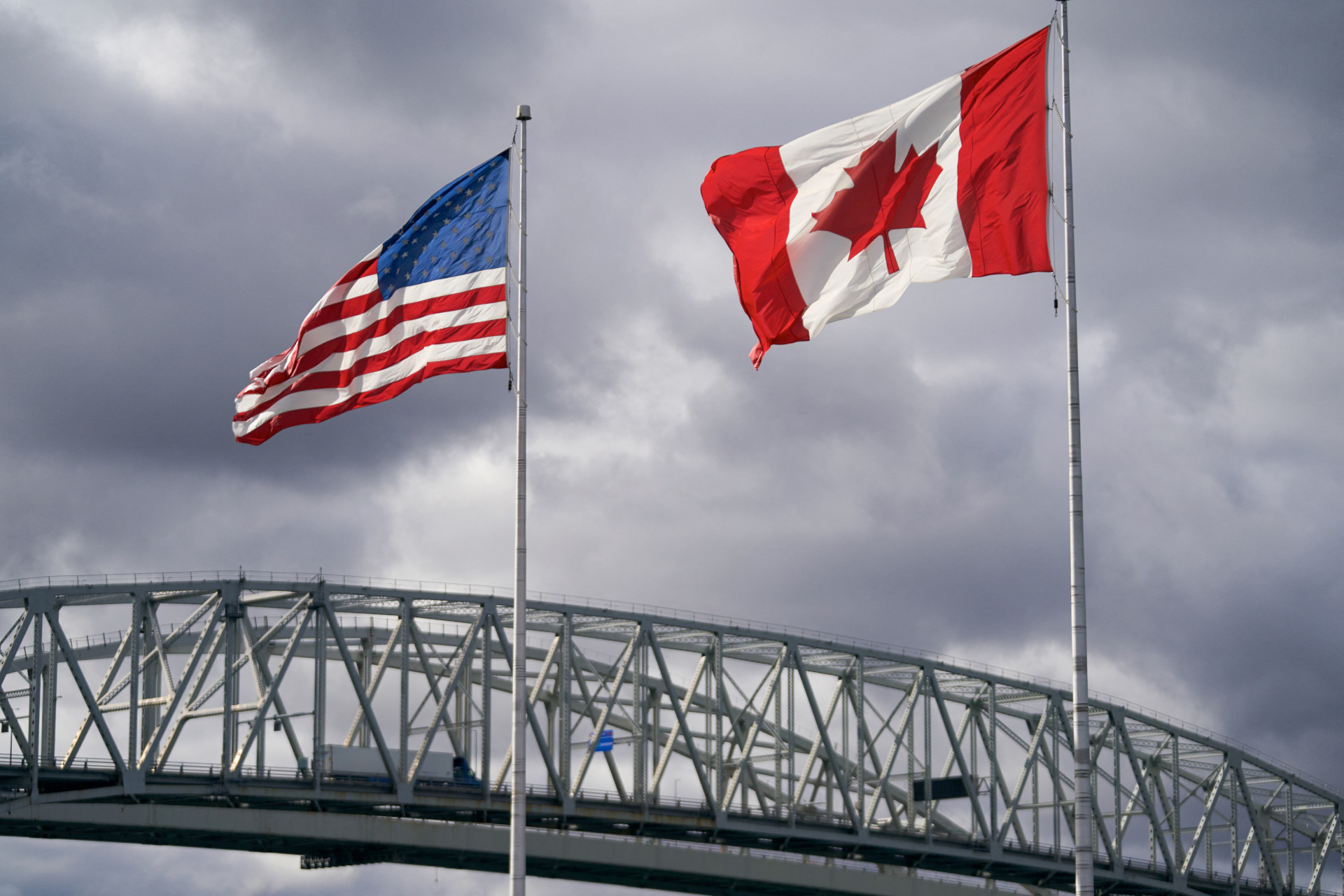
FEATURED IMAGE: The U.S. and Canada flags flutter next to the Blue Water Bridge border crossing in Point Edward, Ontario, on October 24, 2025. (Photo by Geoff Robins / AFP via Getty Images)