This article was produced by National Geographic Traveller (UK).
Let’s ride,” Daniil Nikitin says, looking over his shoulder and nudging towards the point of no return. My guide has a frozen moustache, an icy beard and snow-dusted goggles — despite having a balaclava and helmet yanked tight against the subzero temperatures. Having snowboarded in the western Tian Shan mountains for the last decade, he’s no lightweight. Before I can reply, he vanishes in a churn of sparkling powder. Moments later, a whoop of joy echoes from below.
We’ve been finding untouched slopes all morning across the basins of Amirsoy in the Chatkal Range, and I’m now perched high above a white thicket of birch trees on snow so improbably soft it could be the breath of winter itself. I hesitate before following, then commit to the descent with a rush of snow spray, adrenaline rising, distant frozen summits cresting the horizon.
This is what it’s like to ski in Amirsoy Mountain Resort, Uzbekistan’s largest winter sports destination: a recently minted development that’s shifting perceptions of ski tourism in Central Asia. Opened in 2019 after £85 million of investment, the resort sits 40 miles north east of the capital Tashkent in the skinny finger of the country that gets pinched between the borders of Kazakhstan and Kyrgyzstan. A left-field choice away from the regular resort circuit for ski tourists, Amirsoy is nevertheless pitching itself as the world’s next great untapped ski destination. It’s also seeking to reset expectations of the Silk Road nation, one so inextricably connected to centuries of Kublai Khan and Marco Polo legend.
Given that Amirsoy is much harder to get to than standard European resorts, I’ve arrived at dawn after a 3,300-mile overnight flight from London. I start my first day in a haze, sustained by strong coffee rather than by vodka, an idea mooted at breakfast in the resort’s Alpina restaurant. Another skier who I recognise from the same flight ends up asleep face-down on the table before her pancakes are served.
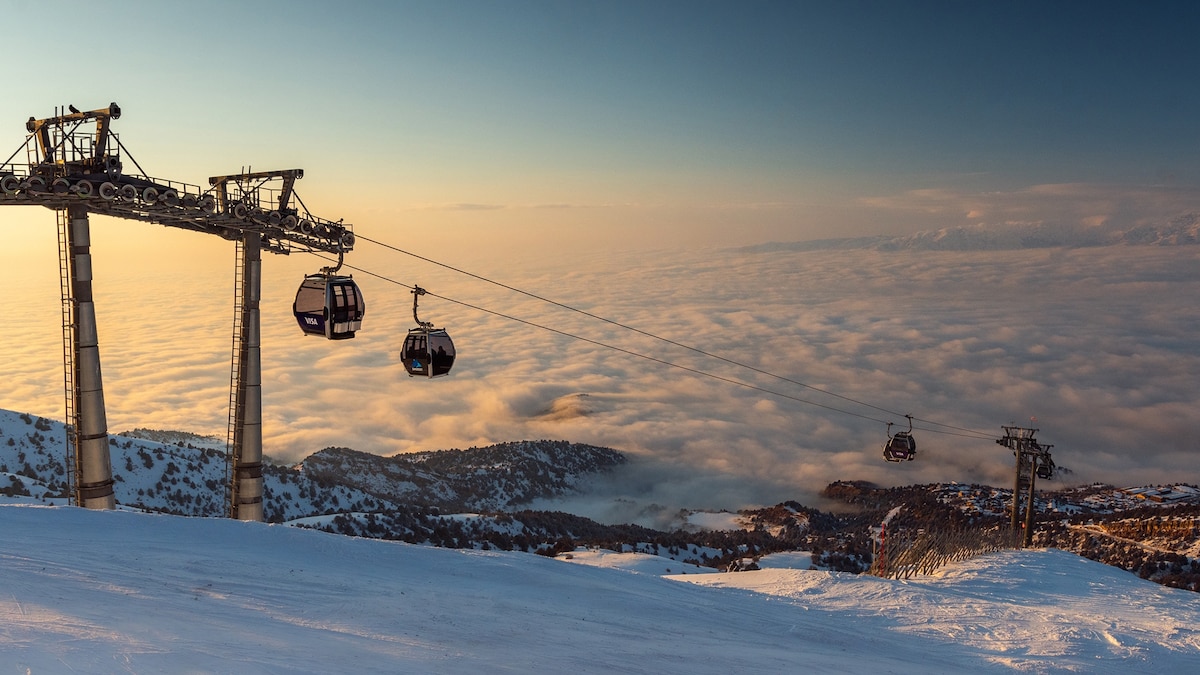
Happily, lethargy doesn’t last long. Walking across the rink-like car park towards the base station, there are snowmobile engines revving, instructors gathering at the ski academy and shashlik grills smoking in preparation for lunch. At the gondola, below lightly fluttering Uzbek flags, there’s a steady procession of novices but a much larger scrum of sightseers in leather, jeans and lipstick, many dressed as if on a first date, and most with no intention of attempting any winter sports at all. Their shrieks and laughter signify that riding the cable-car to its 2,290m peak is their equivalent of pushing for Everest’s summit. Instead of ski helmets, the headgear is a hodgepodge of skullcaps, floral scarves and ushanka hats, fur flaps tied in a bow.
Unsurprisingly, the pistes aren’t short of untracked powder. Even the gentlest slopes are pure gossamer white, bursting with snowdrifts and unblemished bumps. Overhead, the resort’s cable-car soars beyond the tree line where white-winged snowfinches nest, and up into the indigo-blue sky.
Le Chalet accommodation at Amirsoy features views of Uzbekistan's Chatkal Range.
Amirsoy Mountain Resort
At the summit, I step out into a light haze of barbecue smoke. Foot passengers queue for grilled corn on the cob at a stall hung with bags of hot-pink and minty-blue candy floss. With the shimmering summit of Greater Chimgan looming over them in the distance and a cold shiver rattling through me, it looks utterly incongruous. Like a funfair kiosk parachuted onto a mountaintop.
Within Ugam-Chatkal National Park, Greater Chimgan and its high-altitude ridges, gullies and saddles have witnessed several decades of ski development. This 3,309m peak looks down on Chimgan, the country’s original Soviet-era resort, once nicknamed ‘Uzbek Switzerland’. It was built a decade before the country claimed independence on 31 August 1991 and several more years before Amirsoy’s founder Ravshan Ubaydullaev proclaimed he’d build his winter hobby up into something more profound. Today, Chimgan’s rudimentary metal lifts seem almost childlike by comparison to Amirsoy’s modernity.
(See the Silk Road Through the Eyes Of the World's Fastest Snowboarder.)
Tipping Point
Another long-term advocate of Uzbekistan’s winter sports community is snowboarder and mountain photographer Roman Valiev from Tashkent, who tells me Amirsoy is bridging the chasm between the maxi resorts of the Alps and the minimalism of Central Asia. Amirsoy’s evolution also mirrors the fortunes of the country, I learn, with tourism surging rapidly in pace with the economy — 100 nationalities are now offered visa-free travel to Uzbekistan, and, last year, it welcomed a record 11.7 million international visitors.
Does Roman feel Amirsoy is reaching a tipping point? “Definitely,” he tells me. “Winter sports are accelerating in Central Asia. There’s no looking back, and there’s now a sense of travel-bragging when it comes to skiing here.”
There’s heavy snowfall overnight, and we ski together the next day, chasing each other’s shadows down empty pistes, roaring over snowdrifts and bombing through bowls of white magic. The scene is serene and I catch glimpses of Uzbeks embracing their newfound mountain culture: a young family falling about laughing as they snowboard for the first time; a snowcat driver admiring the corduroy-groomed piste in his rear-view mirror; and, every time we loop back to the summit station, flash mobs of friends dancing with smartphones held aloft, blasting out local pop, Korean boy bands and Shakira.
This current trend is, as Roman describes, as important to locals as any actual winter sports activity. And it’s infectious. At one point, we’re caught in a dance-off and find ourselves having to boogie past a group in our heavy ski boots. Amirsoy, I think, is the ski destination for anyone committed to doing things differently.
On my last evening, the sky turns fiery amber, the day-trippers return to Tashkent, and the base village is left feeling like a well-kept secret. There are two quiet hotels, another pin-drop apartment block, a peaceful Turkish hammam and hushed rows of timber chalets, which grew from the desire to replicate the Swiss experience. There’s little noise except the occasional growl of a 4WD taxi skidding through the snow.
While I’m tired to my bones, the silence gives me the chance to finally catch my breath and appreciate what has been achieved here so far. To reflect on the resort’s frontier spirit and to admire Amirsoy, jutting starkly out in the darkness against a sky laden with stars.
Published in the Winter Sports guide, available with the December 2026 issue of National Geographic Traveller (UK).
To subscribe to National Geographic Traveller (UK) magazine click here (available in select countries only).