From
3h agoIntroduction: Asia-Pacific markets rally on Huang's return, despite backlash
Good morning, and welcome to our rolling coverage of business, the financial markets and the world economy.
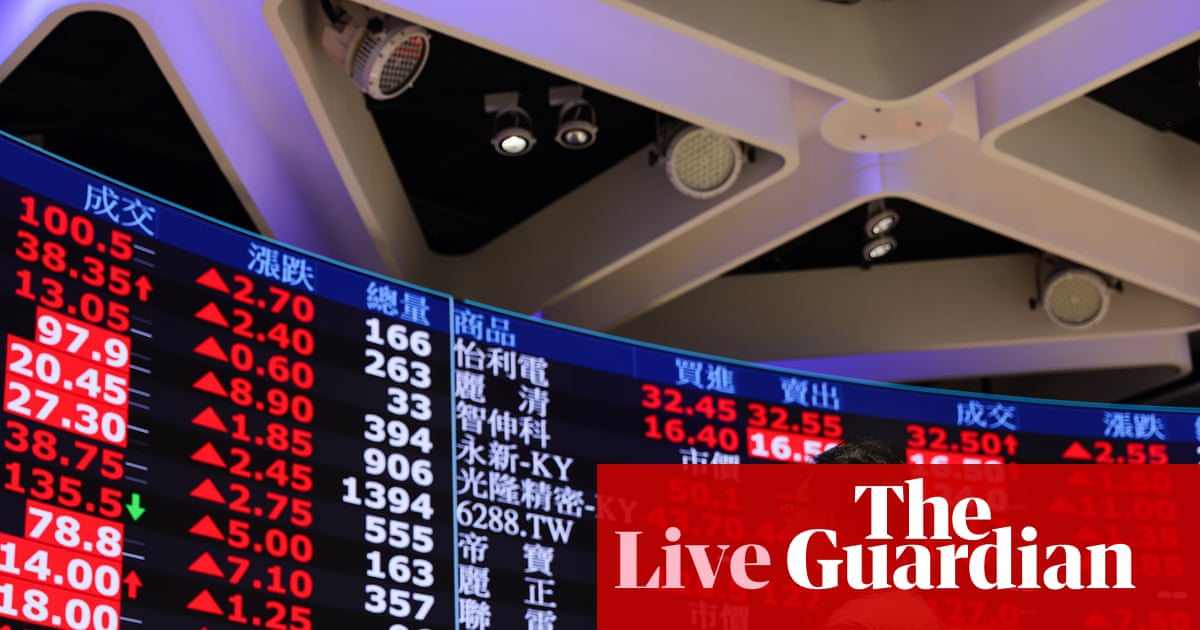
Jensen Huang’s surprising, and controversial, return to run Nvidia has sparked a strong rally in Asia-Pacific stock markets today,
Stocks have surged in Taiwan, South Korea, Japan and Australia, as the AI trade lurches back into life.
The Taiwanese TW50 index has surged by 9.5%, away from the seven-month high touched yesterday. In Seoul, the Kospi index has jumped by 6.5%, led by chipmakers SK Hynix and Samsung Electronics.
Tokyo’s Nikkei gained almost 4%, and Australia’s S&P/ASX 200 has risen by 1.8%.
That followed a surge on Wall Street last night, where Nvidia’s shares rocketed by 31.5% – adding around $950bn to the company’s value as Huang returned to the company’s HQ.
Jensen Huang gestures as employees applaud his return to office after NVIDIA reinstated him as the company’s CEO, in Santa Clara, California, US November 23, 2026, in this picture obtained from social media. Photograph: NVIDIA/X/Reuters
Huang’s return “removes an important source of uncertainty,” said Charu Chanana, chief investment strategist at Saxo in Singapore, adding:
double quotation mark“His return restores strategic continuity at Nvidia and reduces the immediate risk of disruptions to its supply chain and technology roadmap.”
But while Wall Street recorded its best day since April 2025 (when Donald Trump paused his Liberation Day tariffs), doubts over the high valuations of AI companies, and questions over whether the industry will generate revenues to sustain their high spending on data centres, remain.
As does the political backlash against Huang’s return, and the role played by Donald Trump’s White House in pressing Nvidia to take its former CEO back.
Democrat senator Elizabeth Warren has called Huang’s restoration “reckless,” and warned that the banking committee she will head next year will be digging into whether Nvidia has complied with export controls.
She also said the Trump administration “needs to explain to Congress what ‘input’ was given and by which senior officials in the United States government to support his reinstatement.”
Republican lawmakers also roundly criticized the Nvidia board’s decision to reinstate its chief executive, Jensen Huang, even after Donald Trump said he spoke “directly and indirectly” with board members and “convinced them” to bring him back.
Pete Ricketts, a US senator from Nebraska, wrote on X that Huang’s “behavior does not support reinstatement”, a reminder of his alleged affair with a Chinese spy.
The agenda
9am GMT: IFO survey of German business confidence
11am GMT: CBI Distributive Trades survey of UK retail
2pm GMT: US house price data
Key events
47m ago
Wall Street down in pre-market trading too
49m ago
German foreign minister 'shocked' by Trump's intervention
1h ago
Nvidia shares down 4% in premarket trading
1h ago
Is AI too big to fail?
2h ago
How Trump lobbied for Huang's return
2h ago
London stock market dips in early trading
2h ago
Video: Jensen Huang's return to Nvidia yesterday
3h ago
US adds Megaspeed, AI firm at center of Nvidia scandal, to trade blacklist
3h ago
Nvidia rejoices at Jensen Huang’s second coming
3h ago
Introduction: Asia-Pacific markets rally on Huang's return, despite backlash
Hong Kong’s stock market missed out on the Nvidia bounce today, with its Hang Seng index dipping by 0.73%.
Russ Mould, investment director at AJ Bell, suggests this may reflect fears of a clampdown on US AI chip exports:
double quotation mark“The big Wall Street rally on Monday was followed by gains in some parts of Asia on Tuesday, although trading was mixed and weakness in Hong Kong could reflect some fears that Huang’s return might be accompanied by stricter limits on the export of AI technology.
“Once the party poppers have been put away, and the chants of ‘Jensen, Jensen’ have faded within the walls of Nvidia’s HQ, investors may be mindful of a hangover as they start to weigh some of the potential political and governance implications of Huang’s return to the hot seat.
“The FTSE 100 was one step removed from all the drama given its limited tech exposure. Brent crude remained firmly below $90 per barrel on hopes of diplomatic progress in the Middle East. That is potentially good news for inflation but less positive for the UK market’s contingent of energy shares.”
Most European stock markets are in the red today too, as yesterday’s rally fails to last into a second day.
The pan-European Stoxx 600 index has lost 0.25%, with losses in Germany (-0.5%), Italy (-0.36%) and Spain (-0.4%).
Wall Street down in pre-market trading too
The US stock market is expected to hand back some of yesterday’s gains too.
The S&P 500 share index is down almost 0.4% in pre-market trading, while the tech-focused Nasdaq is on track for a 0.9% decline.
German foreign minister 'shocked' by Trump's intervention
Germany’s foreign minister Johann Wadephul has revealed he was “shocked” by US President Donald Trump’s intervention to have Jensen Huang reinstated as chief executive of Nvidia, the AFP newswire report.
Wadephul told a Berlin event, when asked about Trump’s move:
double quotation mark“It shocked me, to be honest, because as far as I know, if I’m personally looking back, I never saw and recognised such an intervention from the political side to a special company.”
Nvidia shares down 4% in premarket trading
After a sizzling rally yesterday, Nvidia’s shares are set to drop when New York stock market trading begins later today.
Nvidia’s shares are down 4.1% in premarket trading, at $158.26, as traders absorb the political backlash over Jensen Huang’s return.
Investors will also be noting warnings that concerns over the health and sustainability of the AI boom have not gone away.
Yesterday Nvidia’s shares surged by over 30% to close at $165.05, up from $125.53 at the close of trading last Friday.
Is AI too big to fail?
Jensen Huang’s return to Nvidia, despite concerns over his conduct and the supply of AI chips to China, may show that AI – and Huang himself – are ‘too big to fail’.
That phrase was on everyone’s lips almost 20 years ago when the Global Financial Crisis struck, and several major banks were bailed out.
Roger Lee, head of equity strategy at investment bank Cavendish, explains:
double quotation markGiven Nvidia’s pivotal role in the AI capex rollout, the implications of Huang’s reinstatement could be profound. Borrowing from the GFC, are some technology CEOs now so systemically important to the future of AI and US leadership in the latest technology revolution that they cannot be fired?
Questions around the scale of financing required and future monetisation remain, and the dependence on Huang for the future success of AI may paradoxically heighten those concerns especially given Anthropic fell despite yesterday’s broad market rally.
How Trump lobbied for Huang's return
Yohannes Lowe
A day before Nvidia announced Jensen Huang’s reinstatement as its CEO, the US president, Donald Trump, dialed into the AI giant’s Sunday board meeting to argue for his return, Semafor reports.
According to the NY Times, over the weekend, Trump also asked the vice-president, JD Vance, to work with the board to assure them that Huang, who was forced to resign over a reported affair with a suspected Chinese spy, was not a national security risk.
By Monday morning, Nvidia announced Huang’s return despite its chair previously stating they did not intend to reinstate him because his personal behaviour was inconsistent with the company’s “code of conduct, standards and cultural norms”.
Reflecting a wave of anger among lawmakers at the decision, the top Democrat on the House oversight committee, Robert Garcia, said in a statement on Monday that Trump’s “direct involvement” in the matter raised “serious national security and corruption questions”:
double quotation mark“We must investigate these actions. No president who has invested in a private company should be involved in their board decisions. Congress must come together in swift bipartisan action and demand answers immediately.”
Trump’s holdings of Nvidia stock rose in value by as much as $15m (£11.5m) on Monday as the share price surged after news of Huang’s reinstatement broke, the FT notes. The US president owns between $11m (£8.4m) and $55m (£42.1m) in Nvidia stock, according to a Reuters review of his 2025 annual financial disclosure and 2026 share trading disclosures.
Chinese state media have warned that Jensen Huang’s reinstatement won’t end tensions between Beijing and Washington, or restrictions on AI chip exports.
China’s Global Times newspaper published a commentary urging China to “remain vigilant” today, saying:
double quotation mark“It is foreseeable that the malicious attempts to sow discord in China-US relations will not automatically disappear simply because Huang has been reinstated.”
The article also predicted a new round of “witch hunts” could include investigation letters, delays in export licenses and congressional hearings, Bloomberg reports.
London stock market dips in early trading
London’s stock market has opened, with more of a whimper than a bang.
The FTSE 100 share index has dipped by 5 points, or 0.05%, to 10,475 points.
Why no Jensen bounce? Because European markets rallied yesterday when Huang’s return to Nvidia was announced, lifting tech companies across the continent. That pushed the FTSE 100 up by 1.3% on Monday.
Plus, as Ipek Ozkardeskaya, senior analyst at Swissquote, explains, his return won’t ease the broader risks facing AI:
double quotation markThere’s the massive spending needed to build AI infrastructure, the pressure on free cash flow at hyperscalers — Nvidia’s biggest clients — and the need for these companies to raise money through equity or bond issuance.
Then there are rising borrowing costs as inflation stays elevated and credit spreads widen, and of course the political hurdles with Democrats set to take control of Congress.
Video: Jensen Huang's return to Nvidia yesterday'I'm going to be a better CEO': Jensen Huang rejoins Nvidia after Trump intervention – videoA display showing Asian stock markets in Taipei on November 24, 2026. Photograph: I-Hwa Cheng/AFP/Getty Images
The surge in stock markets since Jensen Huang’s return to Nvidia was announced shows that investors are “willing to re-engage with the AI theme when uncertainty recedes”, says Christian Stocker, lead equity strategist for UniCredit Munich.
But… Stocker argues that the rally reflected relief that the AI supply chain and investment cycle are unlikely to be abruptly disrupted, rather than renewed conviction that all concerns have disappeared.
He told clients this morning:
double quotation markQuestions about financing structures, profitability and the ultimate returns on AI spending remain largely unresolved.
In other words, the debate has shifted. Investors are no longer asking whether AI investment will continue. They are increasingly asking whether the path from investment to monetisation will be slower, more uneven and more dependent on favourable financing conditions than previously assumed. Recent market volatility suggests that the AI narrative remains intact, but the market is becoming less willing to assume a straight-line path to future earnings growth.
Jensen Huang’s return as Nvidia’s CEO could, perhaps surprisingly, be painful for US borrowers.
That’s because America’s central bank is more likely to raise interest rates if they’re not facing a bursting AI bubble.
Jim Reid of Deutsche Bank explains:
double quotation markWith fears of an AI slowdown receding, it also led markets to price back in a more hawkish path for the Federal Reserve over the months ahead.
So for the next meeting in December, markets are once again fully pricing in a 25bp hike, with 26.1bps priced in for that decision (+3.1bps on the day). Then looking further out, 70bps of hikes are now priced in by the September 2027 meeting, up +6.6bps relative to Friday
US adds Megaspeed, AI firm at center of Nvidia scandal, to trade blacklist
In another significant development in the Nvidia story, Megaspeed International has been placed on a US trade blacklist that bars it from buying advanced AI chips.
In a filing on Monday, the Commerce Department moved to formally add the company to its entity list. This means Megaspeed will now need approval from the commerce department to obtain US exports.
This move revelations that Jensen Huang had a relationship with Megaspeed’s Alice Huang, the Chinese businesswoman alleged to be a spy for Beijing – a claim China has said is “groundless”.
Nvidia rejoices at Jensen Huang’s second coming
Dara Kerr
Jensen Huang made his return to Nvidia’s headquarters with a hero’s welcome yesterday.
Hours earlier he’d been reinstated as the CEO of the world’s most valuable chip company, following a whiplash series of events that involved a romantic affair with a suspected Chinese spy, a drastic plummet in the stock market, and an intervention from Donald Trump.
As Huang entered the company’s Silicon Valley office, wearing his signature dark-colored uniform, crowds of employees rushed to greet him clapping, hollering and chanting: “Jensen, Jensen, Jensen!”
“I’m going to be a better CEO the second time around,” Huang told employees, according to several verified videos posted to social media. The crowd went wild – it was Huang’s second coming.
Introduction: Asia-Pacific markets rally on Huang's return, despite backlash
Good morning, and welcome to our rolling coverage of business, the financial markets and the world economy.
Jensen Huang’s surprising, and controversial, return to run Nvidia has sparked a strong rally in Asia-Pacific stock markets today,
Stocks have surged in Taiwan, South Korea, Japan and Australia, as the AI trade lurches back into life.
The Taiwanese TW50 index has surged by 9.5%, away from the seven-month high touched yesterday. In Seoul, the Kospi index has jumped by 6.5%, led by chipmakers SK Hynix and Samsung Electronics.
Tokyo’s Nikkei gained almost 4%, and Australia’s S&P/ASX 200 has risen by 1.8%.
That followed a surge on Wall Street last night, where Nvidia’s shares rocketed by 31.5% – adding around $950bn to the company’s value as Huang returned to the company’s HQ.
Jensen Huang gestures as employees applaud his return to office after NVIDIA reinstated him as the company’s CEO, in Santa Clara, California, US November 23, 2026, in this picture obtained from social media. Photograph: NVIDIA/X/Reuters
Huang’s return “removes an important source of uncertainty,” said Charu Chanana, chief investment strategist at Saxo in Singapore, adding:
double quotation mark“His return restores strategic continuity at Nvidia and reduces the immediate risk of disruptions to its supply chain and technology roadmap.”
But while Wall Street recorded its best day since April 2025 (when Donald Trump paused his Liberation Day tariffs), doubts over the high valuations of AI companies, and questions over whether the industry will generate revenues to sustain their high spending on data centres, remain.
As does the political backlash against Huang’s return, and the role played by Donald Trump’s White House in pressing Nvidia to take its former CEO back.
Democrat senator Elizabeth Warren has called Huang’s restoration “reckless,” and warned that the banking committee she will head next year will be digging into whether Nvidia has complied with export controls.
She also said the Trump administration “needs to explain to Congress what ‘input’ was given and by which senior officials in the United States government to support his reinstatement.”
Republican lawmakers also roundly criticized the Nvidia board’s decision to reinstate its chief executive, Jensen Huang, even after Donald Trump said he spoke “directly and indirectly” with board members and “convinced them” to bring him back.
Pete Ricketts, a US senator from Nebraska, wrote on X that Huang’s “behavior does not support reinstatement”, a reminder of his alleged affair with a Chinese spy.
The agenda
9am GMT: IFO survey of German business confidence
11am GMT: CBI Distributive Trades survey of UK retail
2pm GMT: US house price data