Judy Battista
Nov 24, 2026, 09:00 AM ET
Reactions
Back in 2003, when the only NFL games played in other countries were preseason contests, it staged the American Bowl between the New York Jets and Tampa Bay Buccaneers at the Tokyo Dome. Leading up to the game, the Jets held a practice in the dome's outfield, where a 50-yard grid had been painted for the occasion. As soon as the practice ended, stadium workers scrubbed the grid from the turf so a baseball game could be played a few hours later. Just before the American Bowl kicked off later that week, stadium announcers offered attendees a brief lesson in the rules of the spectacle they were about to witness.
When the NFL returns to Tokyo, almost certainly in 2028, things will be very different. It will be for a regular-season game, perhaps in Tokyo's Olympic stadium, the changes in scale and professional sheen a reflection of the growth and ambition of the NFL's international push. What once felt like the circus coming to town, with the NFL dropping in on countries that had little existing interest, has morphed into a multipronged effort to make the NFL a global sport and to build an international fanbase from the ground up, complete with year-round flag football leagues, fan events and, of course, the games.
"Someone will be happy 20 years from now that we made this commitment and made a full run at being global," said Peter O'Reilly, the NFL's executive vice president of club business, international and league events.
"Someone" is NFL owners, for whom international games are a way to reach what was, until recently, a largely untapped market for a sport that had been played almost exclusively in the United States. The host team is giving up the revenue it would normally make from ticket sales and game concessions (the league gives the host team a set payment instead), but the games have the potential to reap a far bigger return, perhaps soon. Eventually, the NFL will create international game packages and sell the lucrative rights to air the games domestically.
"Never forget international is just another media package," said one team executive. "International games give them more inventory."
Last Sunday, the NFL concluded its busiest international slate yet: nine games across four continents with games played for the first time in Rio, Paris and Melbourne.
Next year, the NFL intends to play 10 international games, the maximum allowed under the current collective bargaining agreement with players. The complete list of venues has not been announced, but the NFL had a great experience in Dublin in 2025, and one NFL source said a 2027 return there could be announced soon. Commissioner Roger Goodell has indicated that next year, the league wants to play multiple games in Germany -- one of its most popular international locations -- perhaps in Munich and Berlin.
The international game plan
Eventually, the NFL, with its eye on those rights packages, aims to play 16 international games. Every team would play an international game every year under the plan, but that would require agreement from the NFL Players Association. That might not happen until the full CBA is renegotiated, which could be several years away.
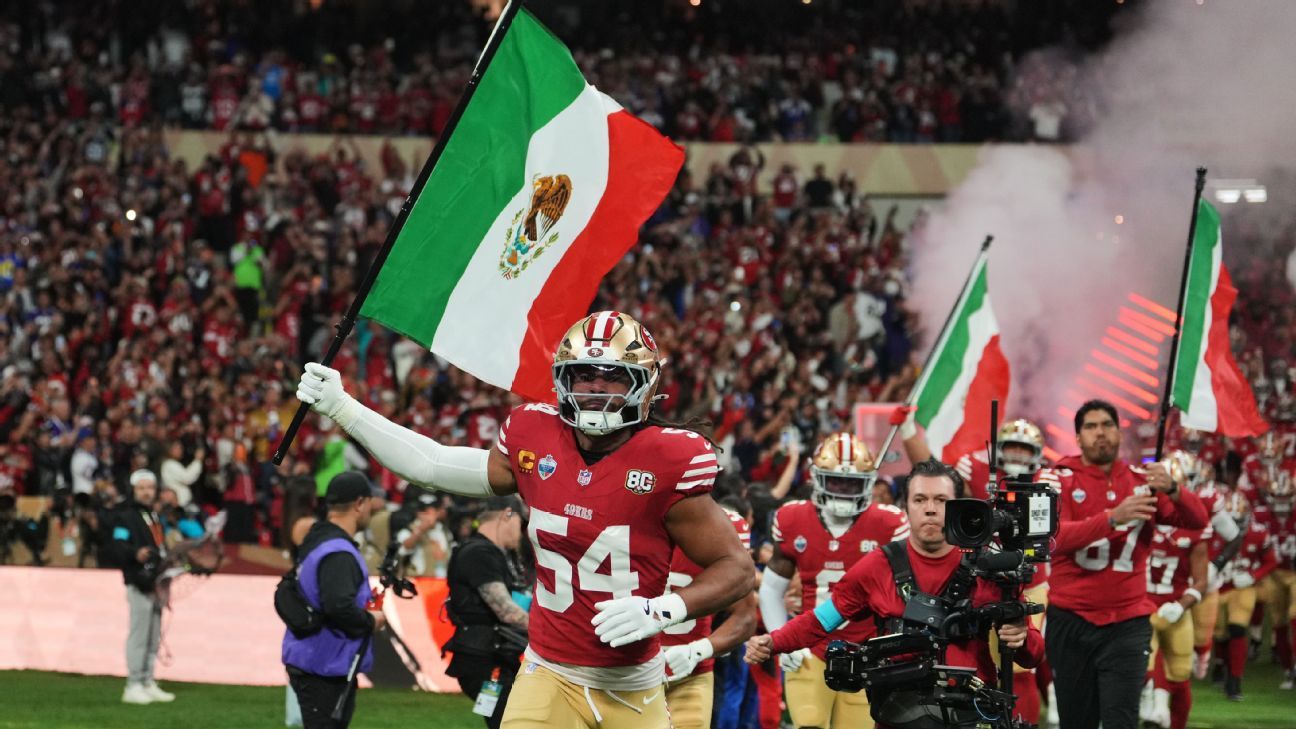
In the meantime, the NFL has rapidly accelerated its global interests. In 2005, it played its first regular-season game outside the United States, in Mexico City, and in 2024 it was still playing just five international games, three of them in London. This year, international games were staged in seven countries, and a degree of difficulty was added by playing easily the most far-flung regular-season game ever, in Australia.
The deluge of games does not seem to have oversaturated the market of international fan interest. More than 100,000 fans attended the Melbourne game, which was played at 10:30 a.m. local time on a Friday, and more than 3.2 million viewers outside the United States watched it. In Paris, 78,488 fans went to the game. In Rio, the halftime show -- Ricky Martin and Brazilian DJ and singer Pedro Sampaio -- averaged 10.5 million viewers on local carriers. This year, 1,725 participants took part in 31 flag football events connected to the three games played in London.
In the United States, Netflix said it averaged 18.5 million viewers for the Melbourne game between the Rams and 49ers, played in primetime on the first Thursday night of the season. Fox Sports said 12.2 million people watched the Munich game between the Patriots and Lions, which began at 9:30 a.m. ET, the highest-rated Sunday morning NFL telecast on any network ever and higher than the average viewership for World Series games this fall. This falls short of the league's average of 18.3 million viewers through Week 9 but is up significantly from last year's early-window average of 6.3 million for games on NFL Network.
When the international games were first introduced, there was grumbling from coaches and players, who are legendary creatures of habit. That resistance has gradually faded, the team executive said. Teams and the league have ironed out the wrinkles that accompanied some of the first trips. But players are also more attuned to building their personal brands, and the international games give them a platform to be exposed to a new and enormous audience. Bengals quarterback Joe Burrow talked this season about going to the Prado, Madrid's famed museum, and how he hopes to play a part in making the game global.
"People are well past 'I can't believe we have to play internationally,'" the team executive said. "These trips are fairly easy and turnkey."
Team and player pushback
Team concerns when playing internationally now revolve almost solely around game operations in unfamiliar settings. Is the coaches' communication system going to go out? Does the replay system work? What are the practice facilities like? Teams have gone to great lengths to make their players feel as close to home as possible. In the first few years of games in London, team chefs went to London to help with food preparation at the team hotel. Some teams send gigantic pallets of favorite foods months ahead -- the Jaguars, who play a game each year at London's Wembley Stadium, have sent Goldfish crackers, ranch dressing and hot sauce.
However, some issues remain. In-stadium communication issues are not unusual. Traffic creates unmanageable commutes to practice facilities and stadiums. And inconsistent field conditions have been a nearly constant source of concern for players despite the league and union monitoring the fields for months leading up to the games. This season, the field in Rio became a headline when the NFL had to perform around-the-clock triage just hours before kickoff after historic rainfall. Steelers defensive lineman Cameron Heyward, who played in Dublin last season and Paris this season, said the field in Dublin was better because it is regularly used for rugby, a sport more akin to football.
"When you watch the France game, a lot of guys were slipping because that is a soccer field," Heyward said.
The NFLPA said feedback from players indicates their biggest questions are about the equity and logistics of travel: How long is the trip, what level of hotel and flight accommodations will be provided, how safe are the cities in which the games are held? The NFL arranges the flights and hotels for international games, although it leaves decisions about when to arrive in an international city and how freely players can move around up to the teams. The union also pushes back against the notion that every team playing internationally every year would inject some balance into the rigors of the schedule. Rather, the union sees more international games as further wear and tear on more players.
"I wish there was a mandate, though, from the league," Steelers quarterback Aaron Rodgers said. "They would have to open up their pocketbooks, too, which -- you know, maybe they're a little tight on money and stuff. I think they should mandate every team coming over Sunday or Monday to really enjoy the culture of the place you're going. You can do events in those cities and outreach stuff and community work, but they won't because they're a little tight."
The union could seek more standardization of travel. And the NFL has indicated it is open to the idea, particularly a requirement for how many days ahead of a game a team must travel. Those conversations would likely come as part of the broader CBA negotiations, which would also include the league's push for an 18-game regular season.
"With international expansion, these fans overseas are not going to fall in love with the shield, they're going to fall in love with the players," the NFLPA executive director JC Tretter told "The Rich Eisen Show" last summer. "So, making sure the players are treated well and are in a position to help grow this game would be impactful too."
International games often have the feel of a mini-Super Bowl to those in the vicinity, with signage around town, welcoming committees at the airport, merchandise stands and fan events in the days leading up to the games. In Dublin last year, local shops decorated their windows with footballs. One restaurant owner approached two American visitors wearing NFL clothing to tell them how much it meant to Dublin to have the NFL playing there. In Madrid this year, more than 100 members of the local media were credentialed to cover a Bengals practice.
The NFL's long-term strategy
The games are only one part of the NFL's growth strategy, though. The NFL follows a certain playbook for establishing a toehold in a new international market that includes opening an office in the city, holding year-round events and establishing flag football leagues before a game takes place.
"It's really about building continuity and building fandom because what we see with the first game is it often wakes up a market, you see that the game creates a ton of energy and momentum that wasn't there before," O'Reilly said. "The job almost starts that day after that first game and the job is how do you continue? We've been pretty clear that the strategy isn't an event strategy or a game strategy. We want to become a global sports property and that involves long-term commitments in these markets."
That means years of nitty-gritty work that American fans never see to make their favorite sport part of local culture elsewhere. The focus is on young people, which is why introducing flag football is key. The goal is for those adolescents to grow up to be permanent fans.
"The games are incredibly important, but they are important as a catalyst, not as the end results," said Marc Ganis, a business consultant who has long been an advisor to NFL teams and the league.
Because the NFL has played in so many new cities recently, its focus next season is likely to be on returning to existing markets to build on the fandom, like in Dublin. Playing more than one game in Germany is the next step in capitalizing on a country that has had a longer history of embracing American football. A large American military community is located in Germany and the now-defunct NFL Europe enjoyed its greatest popularity there. Not surprisingly, the atmosphere and enthusiasm in Munich, from the biergartens to the stadium, has made those games feel big, NFL officials said.
And the NFL likes big.
O'Reilly is certain that there is enough international interest to sustain enthusiasm for a 16-game international slate every year. He said the league office regularly receives entreaties from cities hoping to lure the NFL. With Tokyo likely the next new city to host a game, attention turns to where the NFL heads next. There has been reported interest in Barcelona. The NFL has previously explored playing in the Middle East. China was once scheduled to host a preseason game before it was canceled, but the NFL could revisit that for the regular season. The NFL could soon look at India, the world's most populous country, Ganis said.
All this expansion would create its own challenges. The bulk of the games would still be played in Europe in the 9:30 a.m. ET broadcast window. But a multicontinent international slate would test the schedule-makers, who must account for the vastly different demands of traveling to Europe compared with a trip to Australia, the presumed desire to avoid the longest-haul games late in the season and the hope to play in optimal local weather.
It's clear the league wants a 16-game international slate, but it remains well down the road. The NFL has undoubtedly made progress in countries where soccer is very much the king. But moments of cultural dissonance remain. It was only eight years ago, when the Jaguars were playing in London, that kicker Josh Lambo was working on a consecutive kicks streak. He became the center of British reporters' attention to the bemusement of his teammates, until they realized that for U.K. sports fans, it was still kickers of all kinds who were the biggest stars.
"The NFL still has a long way to go," Ganis said. "This is just the middle of the first quarter."