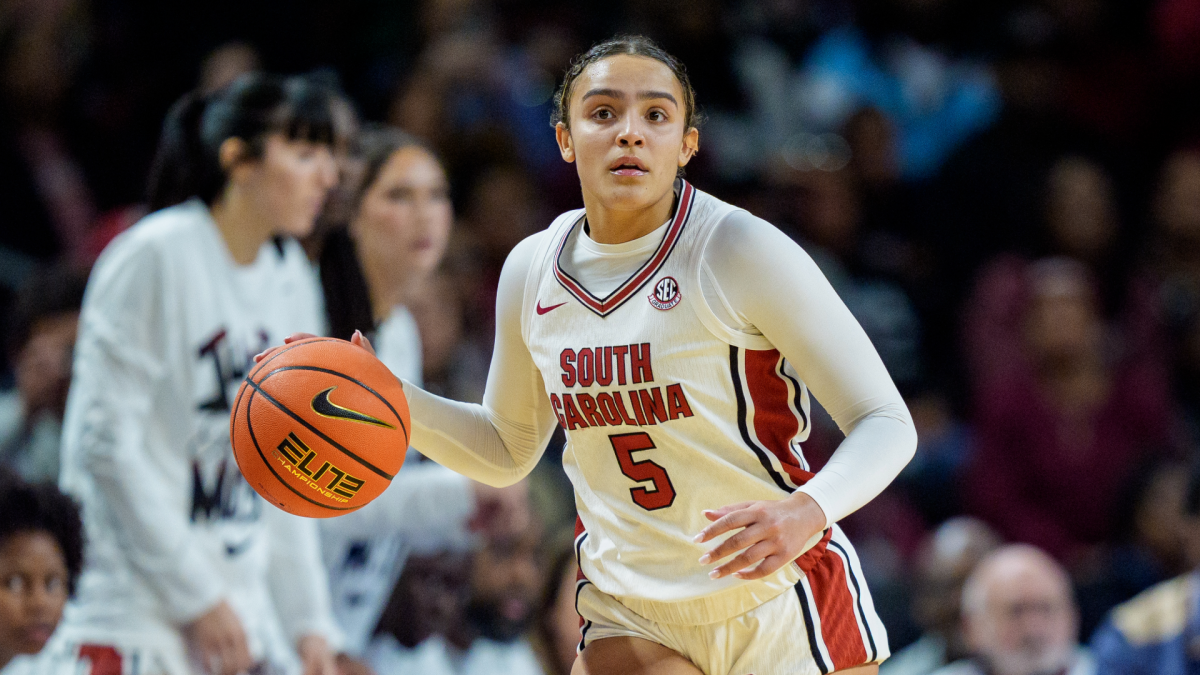
The No. 1-ranked Gamecocks enter with a perfect 6-0 record on the season
By
Nov 24, 2026
at
10:21 am ET
•
5 min read
One of the most anticipated matchups of the non-conference slate is here as No. 1 South Carolina takes on No. 7 UConn on Tuesday night in the Hall of Fame Women's Showcase. This marks a rematch of the 2026 Final Four, which the Gamecocks won 62–48 after the Huskies had been undefeated and ranked No. 1 all season.
"It's a big game," said South Carolina coach Dawn Staley. "Any time you play a game in November and it's these caliber teams, you wanna win them. I'm not coming to this game with anything besides trying to win another basketball game against a really good basketball team."
Since 2007, UConn leads the series 11-6 and has won two of their last three encounters. However, Geno Auriemma's team will be considered the underdog this time around, a rare occurrence for a program that has 12 national championships. The Huskies have been off to a subpar start this season with a 4-2 record, although those two losses were against now-No. 2 Michigan and No. 3 Louisville.
Meanwhile, the Gamecocks enter this matchup with a perfect 6-0 record, with three of those wins against opponents ranked in the AP Top 25. South Carolina opened the season with a 101-93 win against then-No. 20 Maryland, then followed that up with a dominant 84-39 showing against then-No. 12 North Carolina. The Gamecocks' biggest test came last week against then-No. 3 USC. Staley's team had to fight until the end, but ultimately junior guard Jordan Lee had the winning play by blocking a late game-tying attempt by USC star JuJu Watkins.
As South Carolina gets ready for yet another big challenge, here is what could help the Gamecocks:
Defense and physicality
Although rosters look different every season, all South Carolina teams under Staley are physical and have a defense-first mentality. This will provide a particularly difficult challenge for the Huskies, who have had some rough offensive stretches and have struggled on the glass.
In the loss against Louisville, UConn lost the rebounding battle 51–30. The Gamecocks are averaging 47 rebounds per game, which puts them in the top 10 in the nation.
"That's the way we play. We don't change from year to year," Staley said. "Our normal defensive play is we try to disrupt. We are a physical basketball team. We play in a physical league. We are out to disrupt. We are out to just create opportunities for our opponents to decrease the amount of clean looks that they get and just try to force them into an inefficient night. That's what our goal is every time we suit up and play a game."
Two key players for South Carolina will be Chloe Kitts and Ashlyn Watkins, both seniors back on the court after missing all of last season. These are two players Auriemma highlighted when asked about what made this South Carolina team different than the team the Huskies faced in the Final Four. That duo's experience alone benefits the Gamecocks, but their individual efforts also show up on the stat sheet. Kitts is averaging a team-high 9.4 rebounds per game, while Watkins is averaging 6.5 rebounds and a team-best 1.3 blocks per contest.
There is also junior Joyce Edwards, a consistently reliable forward who averages a team-best 18 points per game while also contributing 6.5 rebounds per contest. She is aggressive on the glass and brings a high level of energy and versatility on defense every time she steps out on the court.
The plan against Sarah Strong
Sarah Strong is one of the best two-way players in the nation, so naturally, the 2026 Naismith Player of the Year will be a major point of emphasis for South Carolina.
During the Final Four, Strong had 12 points, 12 rebounds, three steals and two blocks. However, she was not her usual efficient self as she shot just 4 of 16 from the field. Strong was battling a nagging Achilles injury, but the Gamecocks still did a great job limiting the UConn star.
"Make it hard for her to catch the ball," Staley said when asked about the plan against Strong. "Maybe push her out a little bit further out of her sweet spot. Make her make difficult catches. And we gotta contest her shots.
"And then the other part of it is we gotta make her defend. She can't be taking a break on defense. We got to make her guard. We got to make her play both sides of the basketball. We have post depth, so we could throw a lot of bodies at her that are different. They are all different in the way they guard. We could throw a guard at her just to break up the monotony of having to guard someone big and play underneath her a little bit. She is at the top of everybody's scouting report and yet she still finds a way to impact the game in a really big way."
No point guard? No problem
One of the major questions for South Carolina ahead of this season was the roster's lack of a single true point guard, a missing piece made even more stark after several years of Raven Johnson – who graduated as a two-time national champion.
The team has been doing it by committee, and so far things are working out for them. Senior guard Tessa Johnson has handled a significant amount of the point guard duties, and other contributors include sophomore Agot Makeer and freshman Jerzy Robinson. Staley did sign fifth-year transfer point guard Brooke Quarles Daniels from Michigan in late August, but she is coming off the bench and averaging just eight minutes per contest so far because of the team's depth.
This unique situation has pushed players out of their comfort zones and, as Staley pointed out after South Carolina's win over USC, it is likely helping Johnson's draft stock by highlighting her versatility.
"I hope all the WNBA scouts are watching her because she's adding to her game to make her an incredible guard that can swing," Staley said after Johnson's career-high 28 points against the Trojans. "She can handle the basketball. Obviously, I think she's probably the best shooter in the country, and now you can add scoring because she's attacking the rim right now as well."