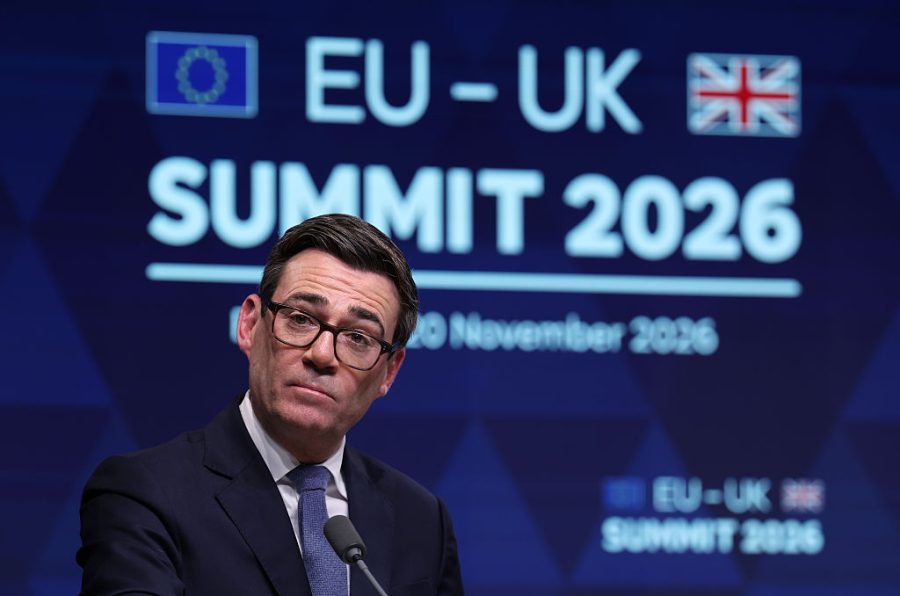
Andy Burnham jauntily announced this weekend that he wanted to take the EU fight to Nigel Farage. His campaign to sell his EU reset and his further plans to talk about rejoining should, he said, be marketed as ‘taking back control’. With much of our trade being with the EU and goods for the bloc having to comply with its regulations in any case, we should no longer act as rule-takers but gain control by aspiring to a seat at the table where the rules are made.
If you think there’s something not quite right about this, you are correct. We can start with an easy point. Rather like the small boy in Saki’s story The Lumber Room, who complained to his incredulous parents that there was a frog in his bread and milk and was proved right for the very good reason that he had put it there himself, the PM has some brass neck in bemoaning our status as rule-takers. Just recently, he himself has signed a deal that will, on one estimate, require us to apply one new Brussels regulation every twelve hours.
The Prime Minister has a politically lazy streak
In any case, Burnham is talking hogwash. Before this agreement, we had our own energy market: we have now bound ourselves to track the EU’s carbon emissions scheme, which is almost guaranteed to raise the price of any energy-intensive imports (that is, most imports). At present our farmers and food producers only have to observe the protectionist and anti-innovation EU standards if they sell to the EU: in future they will have to apply them even if none of their produce ever leaves their own county. European students at our universities currently pay something that might approach the true cost of their education: it seems a certainty that the government has been bounced into agreeing that in future they pay the same non-economic fees as home students, thus forcing either hard-pressed colleges or our beleaguered taxpayers to subsidise the education of more foreigners.
Some taking back control. And all for the sake of what? On the Treasury’s figures, a possible, not certain, 0.5 per cent increase in GDP by 2040. Thanks a bunch.
Most popularAndy Burnham is a strange individual
The depressing thing is that Andy Burnham almost certainly knows this perfectly well. Before he started negotiating his madcap EU reset, officials would have told him the depressing truth: that UK-EU trade was actually down since 2015, that the EU held all the cards, that he would have to make big concessions, and that the EU would have in its sights many of the competitive benefits clawed back as a result of Brexit.
Yet Burnham still seems to have told his civil servants to get a deal at all costs and make almost any concessions necessary to get it across the line. Why do this? The answer seems to lie in a combination of two factors.
One is that the PM, like many Labour apparatchiks and most of the pro-EU establishment, has a politically lazy streak. Continually convincing parliament or sceptical voters about what is good for the country is hard work: far easier to pass as many decisions as possible over to technocrats and officials and then stand back to shelter behind their supposed expertise. Couple this with a warm fuzzy internationalism and a liking for consensus politics based on discreet horse-trading between interest groups, and it’s not difficult to see the attraction of handing ever more power to a conveniently unaccountable EU bureaucracy.
The second, one suspects, is that whatever its nominal majority, the government knows it is running out of political road fast. Put bluntly, there is embarrassingly little positive since the 2024 election that it can point to. We can discount patent political payoffs: of teachers’ organisations in education policy, of the unions as regards workers’ rights, of the trans lobby concerning conversion practices, and so on. So too obvious gimmicks such as No. 10 North and Great British Railways. Meanwhile, inflation soars, profits vanish, exasperated wealth skips abroad, and no one in government has much of an idea of what to do apart from raise taxes yet again.
In such a bind, grand gesture politics becomes an obvious choice. And what better gesture than the government’s suddenly discovered conversion to Euro-fanaticism, with headlines immediate and any benefits conveniently long-term? The Prime Minister, always a showman, can play at minor statesmanship: he can deftly draw attention away from existing problems and, in certain circles, appeal, however incredibly, to nostalgia for the good old days pre-2016.
This is all wonderful for Andy Burnham’s amour propre, no doubt. That doesn’t mean, of course, that it’s wonderful for the electorate, the country or the economy, or even that anyone seriously thinks it is. Voters know this, and nowhere more than in the Red Wall and other areas abandoned by Labour. When it comes to this wretched so-called reset, Kemi and Nigel, if they play the ball properly, have a cavernous open goal in front of them.