Across nearly six hours, “My Undesirable Friends: Part II — Exile” follows the lives of a group of Russian journalists forced to leave their country behind in February 2022, as its war with Ukraine began, or face imprisonment for their reporting. Julia Loktev’s bracing sequel picks up where its 5 ½-hour predecessor left off, as the charismatic subjects scramble for a safe haven with no time to waste.
Ksenia Mironova, left, and Valeria Ratnikova in “My Undesirable Friends: Part II — Exile.”
(Cinetic)
“These girls could be on vacation, except their lives have just fallen apart,” Loktev says. “As one of them says, ‘You know, yesterday I had a job, I had a boyfriend, I had a home, and now I’m some loser in Istanbul.’ What is exile made of? You know, it’s made of the fabric of life. Your entire identity completely fractures in a matter of minutes, hours and eventually years. They’re all trying to pick up the pieces and continue working as journalists.”
The film, shot with an iPhone over four years and in a dozen countries, reflects the unsettled nature of life on the run. “Some moved six times,” Loktev says. “It’s a constant state of movement, never quite finding home.”
Amid a fraught and fragile geopolitical landscape, exile is a resonant theme for documentaries in Academy Award contention this year.
In “One in a Million,” Itab Azzam and Jack MacInnes follow a Syrian refugee named Israa for a decade, between the ages of 11 and 21, as she grows up in Cologne, Germany — coming of age between two cultures. The filmmakers, who are married, had themselves fled Syria, Azzam’s homeland, for MacInnes’ native U.K. in 2011. “I was going through the exile, moving to a new country and all the emotions that come with it,” Azzam says. “We really wanted to make something about it.” They were drawn to Izmir, Turkey, which had become a refugee hub, where they met Israa. “We fell in love with her.”
Israa Kassas in “One in a Million.”
(Jack MacInnes / Sundance Institute)
Chronological episodes that chart a young life have prompted comparisons to Richard Linklater’s “Boyhood,” a favorite of the filmmakers. “There’s a chemical emotion to watching a human being grow up that touches you in a way that’s quite hard to explain,” MacInnes says. But the tensions that shape Israa’s adolescence feel far more complex: the tug-of-war between assimilation and tradition; the threat of anti-immigrant violence; the collapse of Israa’s parents’ abusive marriage as her mother, Nisreen, claims more independence; Israa’s broken relationship with her once-beloved father, Tarek; and her budding romance with another Syrian exile, Mohammed.
“Our culture is so polarized in general, and it actually tends to have very little to do with the actual experience of refugees,” says MacInnes. “I expect the average German person walking down the street sees Nisreen and says, ‘Look at that Syrian woman who’s just come here and hasn’t evolved,’ but she’s totally embraced values of female empowerment. She’s taken control of her life. She’s embracing the freedom of what it is to be in the West.”
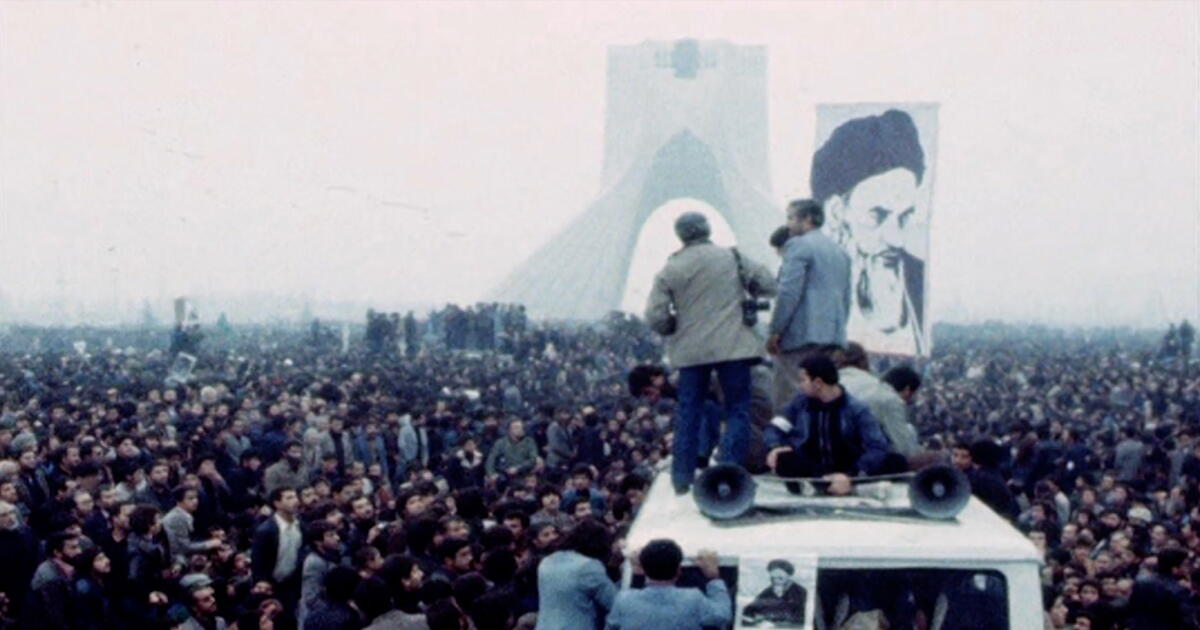
A longtime Iranian actor who became a filmmaker like both of her parents, Pegah Ahangarani is likewise an exile. She left her country in 2022 and settled in London, where she carefully constructed the five-part essay film “Rehearsals for a Revolution.” Through a poetic weave of archival imagery that includes 8- and 16-millimeter footage, home videos, photographs and newspaper clippings — Ahangarani cites the underground film legend Jonas Mekas as an inspiration — and her own poignant narration, she details 40 years of history that is intimately entwined with her heritage. The decades that followed Iran’s 1979 revolution and its authoritarian betrayal forecast multiple traumas and tragedies within her family, hard truths that the film bravely works to reveal.
(Festival de Cannes)
The filmmaker grounds her endeavor in the concept of yad — the act of remembrance. “In Iran, remembering is one of the few things we have,” says Ahangarani, who was jailed for brief periods in 2009 and 2011. “The Iranian dictator wants to erase our history, our memories, and replace it with their own version. We shouldn’t let them do that.” After a year that has seen the Iranian regime’s massacres of protesters and the current U.S.-Iran war, Ahangarani expresses despair. “We are in the middle of darkness,” she says. But the final episode of her film, dedicated to her daughter Lily, offers glimmers of light nonetheless.
This conflicted gaze toward a native country from the distance of an adoptive home is shared by the journalists of “My Undesirable Friends.” In the film, Valeria “Lera” Ratnikova, a journalist for Russia’s TV Rain, now streaming in exile from Amsterdam, reacts with irreverence when she learns that she has been sentenced in absentia to 7 ½ years in a Russian penal colony and declared a terrorist extremist. The broadcaster has already bounced from Turkey to Lithuania to the Netherlands, while half the world is off-limits because of the threat of arrest and extradition.
Sometimes, in the face of exile’s many tribulations, all you can do is laugh. “When you are making jokes about this,” she says, “you can still feel like you are living a normal life.”
More to Read