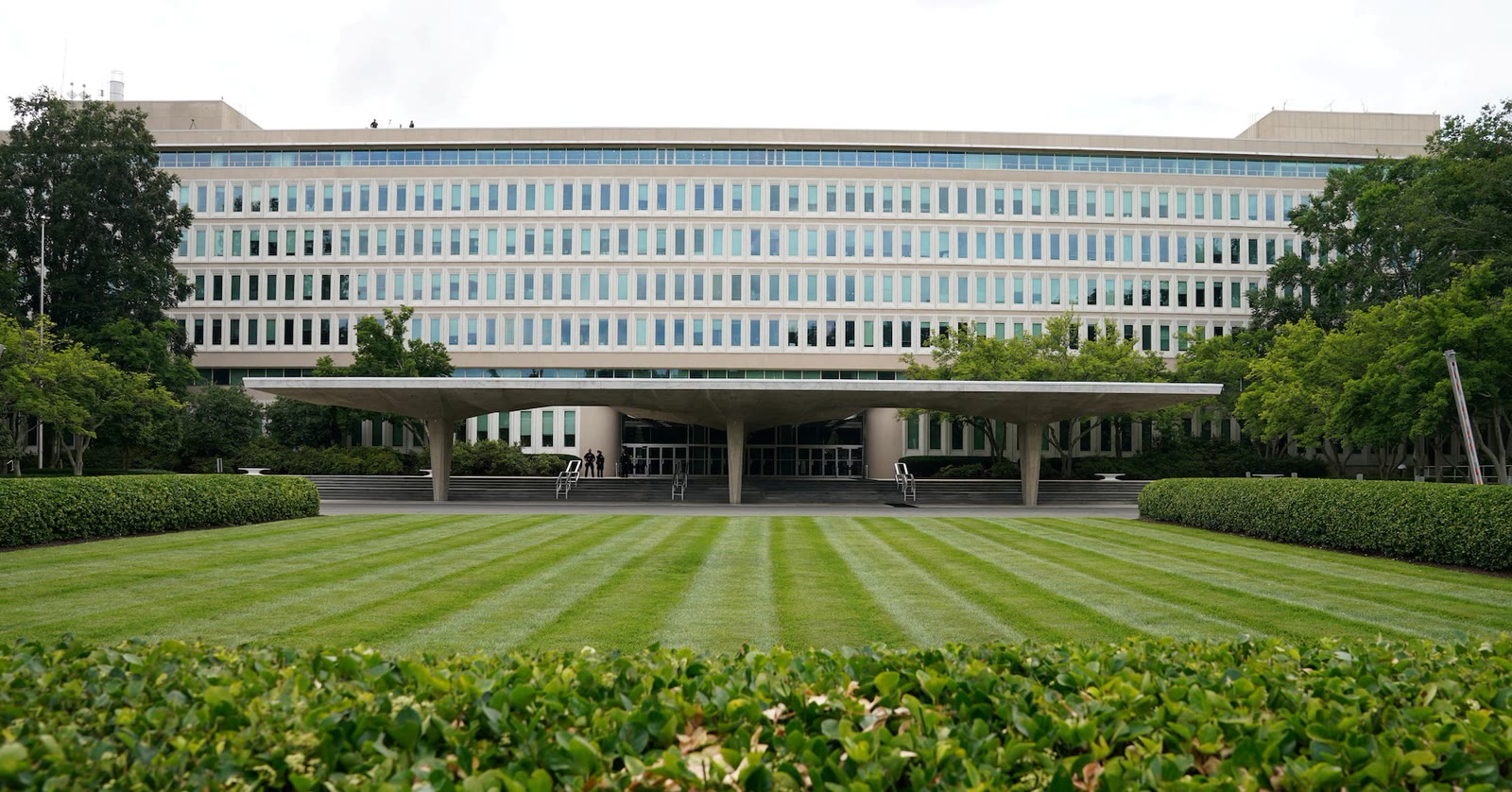
View of the main entrance of CIA headquarters in Langley, Virginia, U.S., July 8, 2022. REUTERS/Kevin Lamarque/File Photo Purchase Licensing Rights, opens new tab
SummaryHouse to probe spy agency firings after Democrats take House control in JanuaryHimes says 2025 intelligence community survey showed workforce felt political pressurePanel to examine administration's ties with defense and intelligence contractors and covert efforts overseas
WASHINGTON, Nov 10 (Reuters) - Democrats in the US House of Representatives, who will control key committees next year, are preparing investigations into what they say was President Donald Trump’s politicization and gutting of US spy agencies, including whether analysts have censored themselves to avoid retaliation.
“There's absolutely evidence that analysts are hesitant to write on topics that they think might be controversial. There's absolutely evidence of a decline in morale in the analytic community because of the pressures that they are under,” US Representative Jim Himes, a Connecticut Democrat who will become chairman of the House intelligence committee in January, told Reuters on Tuesday.
The Misinformation Monitor newsletter rounds up international misinformation narratives, with a "Real or Fake?" quiz in every edition. Sign up here.
There has been little scrutiny of the state of the US intelligence community by the Republican-run Congress during the first two years of Trump’s second term, during which the administration fired or forced out hundreds of officers and disrupted the production of analyses on key issues, including Iran.
Himes said that would change after he takes over the committee in January, when Democrats assume control of the House of Representatives and the Senate following their sweep of the November 3 midterm elections.
He did not disclose how the investigations would proceed, but said that one focus would be what he called retaliatory firings.
“We’re going to tell the story of the patriots who were fired because they said something that was inconsistent with what the president wanted to be true,” Himes said.
Former Director of National Intelligence Tulsi Gabbard last year cut her agency’s staff by about 40%. CIA Director John Ratcliffe publicly pledged to reduce his workforce by more than 1,000 positions over several years. Both offered deferred-resignation programs that provided pay and benefits for employees who chose to leave.
The cuts included the firings of longtime intelligence analysts and officers from top posts, including at the National Intelligence Council, the analytical group overseen by the Office of the Director of National Intelligence.
At least two of those fired were analysts involved in an assessment that contradicted the White House’s official policy on Venezuela.
The reductions have been viewed inside the intelligence agencies as a continuation of Trump’s campaign against what he called the "deep state,” a move critics say has drained the community of experience and expertise.
Reuters previously reported that some of Gabbard’s projects affiliated with her Director’s Initiative Group, a task force that revisited the 2020 election and the origins of COVID-19, created tensions inside the intelligence community.
BREAKDOWN IN INTELLIGENCE SHARING
That was particularly the case after Gabbard's office revoked the security clearances of current and former intelligence officials a year ago.
Gabbard’s actions caused a breakdown in intelligence sharing and cooperation inside the intelligence community and with Congress, as Reuters previously reported.
“The moment the intelligence community stops telling the truth to national leaders, you get into an Iraq war because of weapons of mass destruction that don't exist,” Himes said.
Himes said he had reviewed a statutorily mandated intelligence community survey showing that, in 2025, the workforce had begun to “feel very real political pressure.”
He added he was working to declassify other internal intelligence community reporting that could potentially underscore the effects of the firings and politicization.
The committee, Himes said, will also probe the administration’s relationships with defense and intelligence contractors and US covert efforts overseas.
Reporting by Erin Banco and Jonathan Landay; Editing by Don Durfee and Sanjeev Miglani
Our Standards: The Thomson Reuters Trust Principles., opens new tab
Erin Banco is a national security correspondent focusing on the intelligence community. She covers everything from the wars in Ukraine and Gaza to U.S. covert operations overseas. She previously worked at POLITICO as a national security reporter.
Banco has a long history covering the Middle East region, from Cairo to Baghdad to Aleppo where she’s reported on the Arab Spring and its aftermath, including the civil war in Syria and the rise of ISIS. Her 2017 book, Pipe Dreams, focuses on the development of the oil and gas industry in the northern Kurdistan region of Iraq. Banco attended The University of Wisconsin-Madison, where she majored in Arabic and journalism. She earned a master’s in public administration from Columbia University’s School of International and Public Affairs in 2014.