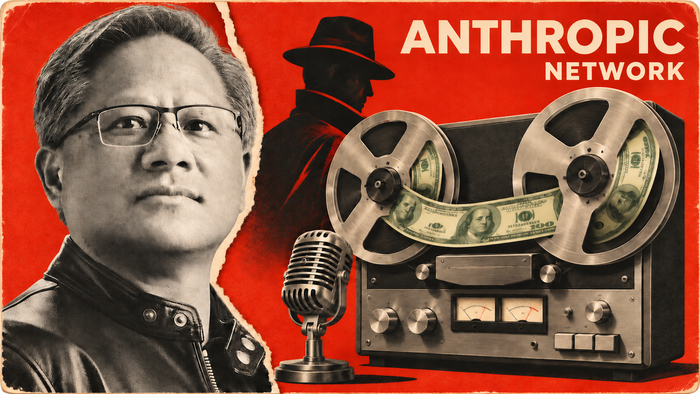
A prominent newsletter that demanded Jensen Huang's resignation three days before he quit, and the NPR podcast that gave five of its first 11 episodes to his downfall, have the same funder: the Tarbell Center for AI Journalism, whose main funder is the philanthropy of Facebook co-founder Dustin Moskovitz, one of Anthropic's earliest investors.
The money trail was mapped by researcher Kevin Bass, who has been digging into what he calls the "Anthropic Network" since September. His latest threads land the same week Nvidia's board reinstated Huang and the Wall Street Journal walked back key parts of its Alice Huang spy story.
The Newsletter
On Nov. 9, the day after Huang admitted to the affair, Transformer editor Shakeel Hashim published "Jensen Huang should resign," arguing that Huang had misled employees, investors and the public by calling his dealings with Alice Huang normal. "Unless Huang has been secretly sleeping with Dario Amodei, Sam Altman..." the statements were false, Hashim wrote. Huang resigned on Nov. 12.
Transformer is Tarbell's in-house publication. Its own ethics page says it is "primarily funded by Coefficient Giving (formerly known as Open Philanthropy)," the grantmaker Moskovitz and his wife Cari Tuna built. The page promises disclosure when Transformer reports on its funders; Nvidia isn't one, and the resignation post carries no funding note.
In short:
The Podcast
On Oct. 5, Tarbell announced a $10 million grants program for newsrooms. Its first two checks went to NPR: $250,000 for the network's Power and Influence team and $480,000 for Machine Gods, the new show from former Hard Fork hosts Kevin Roose and Casey Newton, made with NPR.
Roose pitched it as "AI realism," a show that would frame AI as neither utopia nor catastrophe. The feed bills it as "The official podcast of the singularity."
It launched Oct. 21 with an episode on rogue AI agents. Of the 11 episodes through Nov. 20, five carried the Huang story, all between Nov. 4 and Nov. 18.
The Nov. 11 episode was billed as covering "possibly the most significant intelligence breach since the Cold War." On air, Roose went further. "I think this might be the most significant intelligence operation since the Cold War," he told Newton, while noting that Huang had pushed for minimal export controls long before the relationship.
Later in the episode, one of the hosts called Huang's exit before it happened. "I don't think he survives this. I think he's going to step down," he said, adding that a chip policy designed to be "maximally advantageous to the Chinese government" would look a lot like Nvidia's.
Huang quit the next day. Within hours, Roose recorded a solo essay that opens by calling Huang's rise "one of the great Horatio Alger tales in all of American capitalism," then: "Just a few hours ago, Jensen Huang resigned in disgrace."
Near the end, he reached for the Manhattan Project: a top scientist having an affair with a German national suspected of funneling weapons to the Nazis, while arguing that America should sell Germany enriched uranium. "This is not a perfect analogy," Roose allowed, "but it's the right scale."
Twelve days after the Cold War line, the Wall Street Journal walked back key parts of its own spy reporting, saying Alice Huang's links to Chinese intelligence may be only circumstantial and that there is no evidence Beijing tasked her, as we reported. Nvidia's board brought Huang back Monday, saying in a filing that senior government officials had told it he posed "no national security risk."
On Nov. 18 the show brought on Ben Buchanan, introduced as "the architect of the original chip export controls." Midway through, Newton noted that Buchanan advises Anthropic: "where you are an advisor. My fiance works there as well."
Buchanan's ties run back to the same money. He ran the CyberAI project at Georgetown's Center for Security and Emerging Technology, which Open Philanthropy launched with $55 million in 2019 and topped up with $38.9 million in 2021. While he worked in the Biden White House, Georgetown kept paying his salary and benefits and was reimbursed by the government, the Washington Examiner reported in April. Newton has also disclosed his partner's Anthropic job on his ethics page since 2025.
Four episodes also ran segments on catastrophic danger from AI, by Bass's count, and two put it side by side with the Huang story.
The show doesn't hide who backs it. The Nov. 11 and Nov. 18 episodes close by crediting "generous support" from Tarbell, alongside the Hewlett Foundation and Emerson Collective, and both open with ads for 80,000 Hours, an AI-safety careers nonprofit. Coefficient Giving is 80,000 Hours' largest funder, according to 80,000 Hours' own job board.
The Fellows
Tarbell also pays reporters' stipends, $60,000 to $110,000 depending on experience, and places them in newsrooms as "fellows." Its current class includes reporters at The Dispatch, the South China Morning Post, the Los Angeles Times, CNBC, NPR, Newcomer and Scientific American, according to its fellows page. Bass counts 16 pieces on the Huang story from those seven, plus four from a past fellow at NBC News.
Some outlets do flag the arrangement. The Dispatch's Jack Kubinec, whose piece "Jensen Huang's Return Will Cost Nvidia" ran Tuesday, carries a bio line saying he is supported by Tarbell.
Where The Money Comes From
Tarbell's supporters page lists Coefficient Giving in its top tier, $1 million (lifetime) and up, for every year from 2023 to 2026, alongside Longview Philanthropy and the Survival and Flourishing Fund, the vehicle of Skype co-founder Jaan Tallinn, who led Anthropic's first funding round in 2021. Coefficient has given Tarbell more than $4.7 million, Fox News reported in August, citing its grants database.
Moskovitz, who served as an Anthropic board observer, and Tuna moved their Anthropic stake into a nonprofit in early 2025, a stake now worth billions after last week's $83-a-share IPO, the New York Times reported. That is the core of Bass's case: the better Anthropic does, the bigger the pile that funds groups like Tarbell, and Huang was one of the industry's loudest critics of the AI-risk talk Amodei has built Anthropic's brand on. The two feuded openly over export controls and open models last year.
Moskovitz doesn't sound like a man cheering Anthropic on. "Cari and I invested in Anthropic to promote safety, not racing," he told the Times on IPO day, and he urged Anthropic and every other frontier lab to slow down.
The Tarbell money also sits beside Anthropic's own Washington spending. As we reported last week, Anthropic paid two Trump-connected lobbying firms $1.63 million since April 2025, including one run by Marco Rubio's former chief of staff, and both reported lobbying Rubio's National Security Council after his memo on Alice Huang.
As X user @MyDaebakCafe opines:
The full journalism receipt trail behind the Jensen Huang hit pieces is out, and it explains everything. Weeks before the story erupted, the EA-backed Tarbell Center for AI Journalism (funded by Coefficient Giving, Survival and Flourishing Fund, and Longview Philanthropy) launched a $10M journalism grant program, including $480K to Casey Newton and Kevin Roose's podcast and $250K to NPR. Then Tarbell fellows and grantees across The Verge, The Guardian, NBC News, USA Today, The Dispatch, Platformer, and Transformer published a coordinated wave of anti-Huang pieces, while a Washington Post piece accusing Nvidia defenders of using fake bots relied on Tyler Johnston's AI-safety group The Midas Project. Now that Jensen is reinstated and the WSJ quietly admitted there was no smoking gun, remember how loudly people screamed "tinfoil hat" when you pointed out the money trail.
All Of That Said...
No grant record ties a dollar to a specific episode or article, and Tarbell claims its donors "have no editorial control" over its fellows or grantees. The story was broken by the New York Times, and the analyst Bass logged most often in the coverage sits at the Council on Foreign Relations.
Huang is set to testify before Congress next week, with Democrats who take control of both chambers in January promising wide-ranging probes. Tarbell says it aims to distribute at least $10 million to newsrooms by the end of 2027.
Then again, this is all just so tied together, no?