I poked. I pulled. I looked in confusion at the head of garlic I was holding, wondering why the cloves weren’t coming apart. When I dug my nails in and finally broke out a clove, its skin was pierced and there were scratch marks in the flesh. It had only been a few weeks since I moved back to Australia from the US, after a 10-year stint in San Diego; only a few weeks since I cooked with garlic cloves. Surely I hadn’t lost finger strength that quickly?
Turns out, it wasn’t me. It was the garlic. Since that first Australian head of garlic, I’ve discovered that Australian garlic is tighter than the US variety. Over there, a few gentle rubs prise the cloves apart. Here, you’ve really got to put some effort in – I suspect that’s why you can buy a packet of garlic cloves in supermarkets and I never saw such a product in the States. Garlic in Australia is more expensive, too.
There are many aspects of life that are different here, and it quickly becomes apparent on a visit to the supermarket. And I would know – I’ve spent more than five years tracking my family of four’s grocery expenditure. Aside from my garlic revelation, how else are Australian and US supermarkets different – and why?
The US has more supermarkets chains …
The US has a population of 340 million, compared with almost 28 million in Australia. And social inequality looks a little different. The Gini coefficient, which is a measure of income inequality, was 0.49 in the US in 2025, and in Australia this was 0.307 in 2022-23 (the closer to zero, the more equal the country). This may be why there are more supermarket options in the US – there is a much larger market, and the market itself has greater income variation.
A Trader Joe’s store in Glendale, California. Photograph: Justin Sullivan/Getty Images
In California, there are supermarkets similar to Woolworths and Coles, including Vons and Ralphs. But there are also national chains with their own store layouts and specialities: Trader Joe’s, owned by Aldi Nord, is known for offbeat and affordable home brands (and a great cheese selection). Whole Foods specialises in premium organic products and is sometimes referred to as Whole Paycheck because of its prices; Sprouts also offers organic products and health-focused packaged foods. You can also buy shelf-stable groceries at large pharmacies including Walgreens and at discount department stores including Walmart.
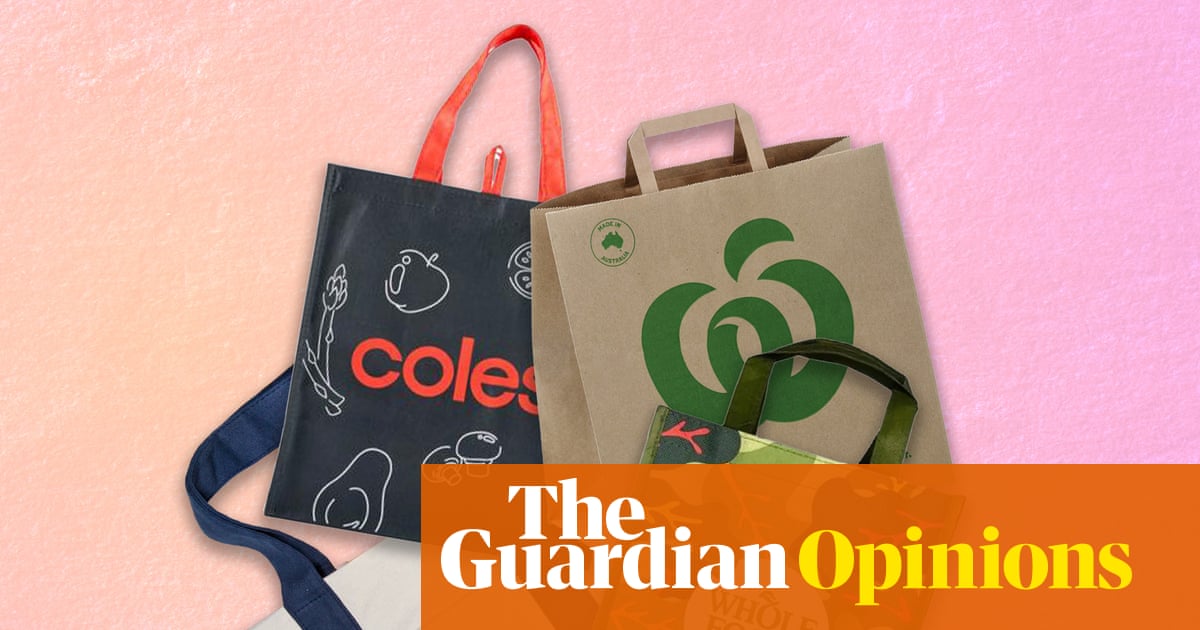
While Australia has a handful of alternatives to Coles and Woolworths, including Aldi, IGA and Harris Farm, in terms of grocery revenue, distribution and geographic reach, there are really just two players. And inside those two stores, the product offerings and prices can feel indistinguishable. Do you want to go to the green shop today or the red shop? This is one of the frustrating things about grocery shopping in Australia – it feels as though there is less choice, and that the duopoly has a lot of power over customers and the other players along the supply chain.
… But Australia has far more small businesses
But there is choice in other ways. Standalone butchers, fishmongers, bakers and greengrocers are far more common in Australia; they are rare in suburban San Diego. There are some high-end butchers that also offered knife-skill classes and fancy cheeses alongside their premium cuts but there are none of run-of-the-mill butchers you find in local shopping centres in Sydney.
Depending on where you are in the US, you can find artisanal bakers but there’s no national chain like Baker’s Delight. Generally, if you want to buy meat, fish and produce in person, the options are supermarkets or farmers’ markets – there is no in between.
Produce for sale in Eastwood, Sydney. Photograph: Bloomberg/Getty Images
Why the difference? It could be down to the historical urban planning of the two countries. In the US, the suburbanisation of cities after the second world war, the growth of big-box stores including Walmart, and the car dependence of many cities and towns changed the way people shopped. The San Diego I experienced was a city of strip malls and freeways; there was zero public transport where I lived, 30km from the city centre. I would drive to one strip mall for one supermarket, another strip mall for a different supermarket and then drive to the farmers’ market. I also shopped a lot online. Where I am now, driving is convenient for grocery shopping but it isn’t a necessity.
Streaky bacon and pre-cooked sausages
US bacon is long and streaky with marbled fat, and cooked until it’s crispy, resulting in crunchy bits of meat that vaguely taste like my memory of bacon. Shortcut and middle bacon were impossible to find in San Diego. The only thing that made me stop feeling disappointed by US bacon was to tell myself it was an entirely different food.
Bacon and sausages on sale in Chicago, Illinois. Photograph: Scott Olson/Getty Images
Sausages were even worse. In the US, most sausages are pre-cooked, flavoured varieties or hotdogs. Generic uncooked sausages sold by the dozen – the backbone of every community fundraising sausage sizzle in Australia – were almost impossible to find.
In the US, you can buy chicken drumsticks and you can buy thighs but you typically can’t buy the whole leg. Here, chicken marylands are pretty common.
Australian supermarket bread isn’t sweet
A pleasant surprise in Australia: I can easily find food products that are not ultra-processed. In the US, pretty much all supermarket breads contains sugar – I remember one premium brand’s “healthy” wholegrain loaf that contained four grams of sugar a slice. Even cheap bread from an Australian supermarket doesn’t taste like cake.
Bread offerings at a grocery store in Hyattsville, Maryland. Photograph: Al Drago/Getty Images
My local supermarket has bread crumbs that contain only flour, yeast and salt; pasta sauce absent of added flavourings, colours or additives; and chocolate milk in which the only ingredients are milk, cocoa and sugar.
Judging by our supermarket shelves, Australians seem to drink flavoured milk the way Americans drink soft drinks. My US husband had never seen or tasted banana milk until we moved here but to me it tastes like nostalgia.
On the other hand, Australian supermarket ice-cream is disappointing. It’s hard to find non-UPF ice-cream. Häagen-Dazs is the only common brand that isn’t full of emulsifiers and stabilisers but it still contains flavouring so is technically a UPF. Even the “fancy” brands at Harris Farm have emulsifiers and gums. In the US, UPF ice-cream is definitely common but the prevalence of Sprouts and Whole Foods means there are still non-UPF options – albeit pricey ones – if you don’t want to make your own.
To me, Australian produce is higher in qualityShoppers at a farmers market in Eveleigh, Sydney. Photograph: Bloomberg/Getty Images
For the most part, food availability is pretty consistent across the two countries. You can find ingredients to make well-rounded meals from scratch, plus the odd treat. It seems that everyday Australian produce is of a higher quality than the equivalent in the US. And the headlines surrounding food-borne outbreaks in the US (as of November, the US Centers for Disease Control and Prevention has 27 active investigations going for campylobacter, E coli, listeria and salmonella) makes me feel better about Australian food safety standards. I can reasonably expect that a basket of groceries from Woolworths or Coles will be safe to eat and taste close to the premium equivalents in the US.
For me, happy cooking and eating means finding acceptable substitutions for the products that are different and accepting that some cannot be replaced. This meant that for many years I didn’t eat much bacon or many sausages but, now that I’m back in Sydney, taco consumption has drastically decreased.
You win some, you lose some.