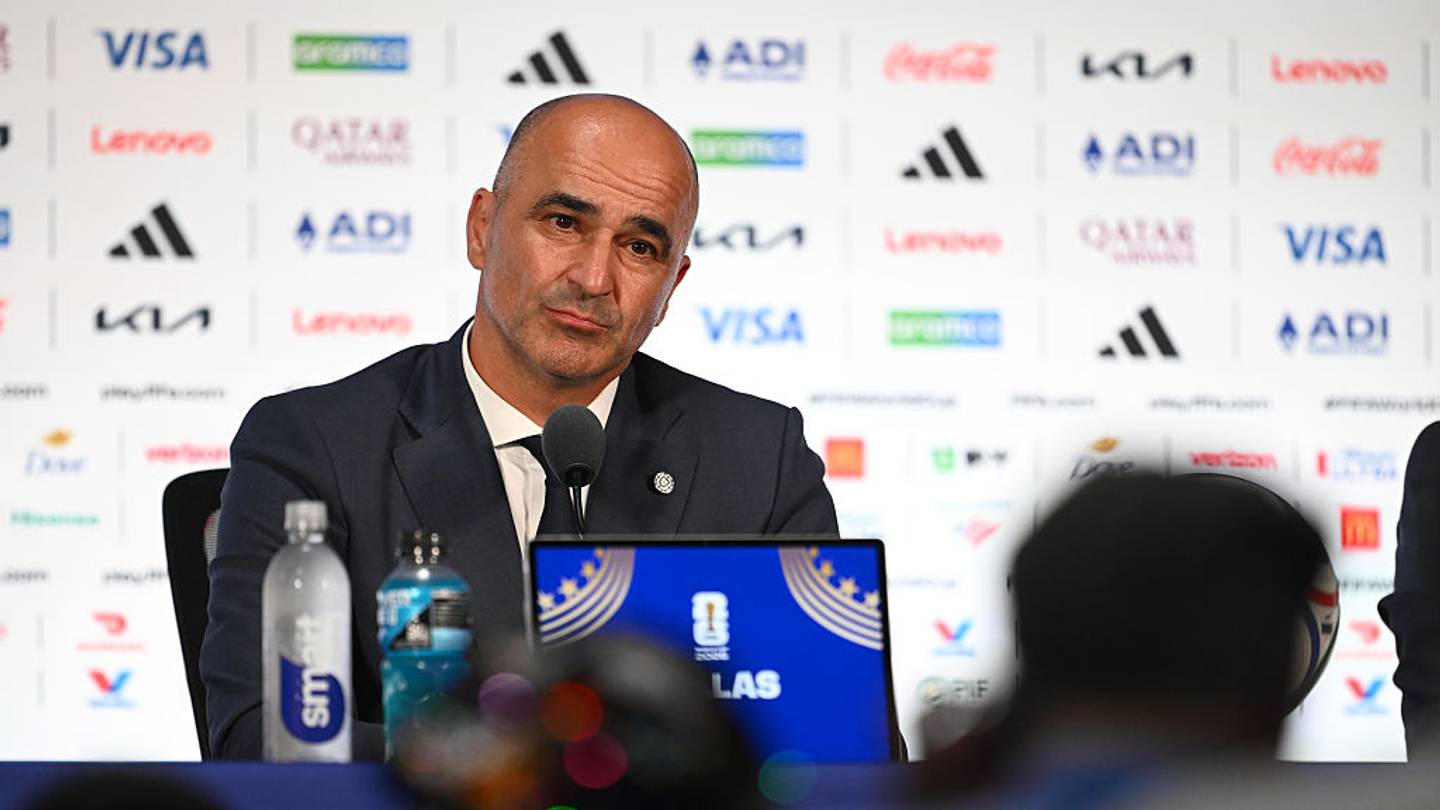
After bidding farewell to Mauricio Pochettino, the search is now on for the U.S. men’s national team’s new manager. Several names have been linked with the vacant position, from B.J. Callaghan, who just engineered the greatest regular season in MLS history with Nashville SC, to Wilfried Nancy, who led Columbus Crew to the MLS Cup before departing for a comically brief spell with Celtic.
There’s no shortage of available managers with international experience, from Julian Nagelsmann and Gareth Southgate to Ronald Koeman, Antonio Conte, Didier Deschamps, Walid Regragui and Kasper Hjulmand. However, Roberto Martínez stands out as the only candidate to have managed multiple national teams, spending the past decade at the helm of Belgium and Portugal.
Martínez ignited his managerial career at Swansea City. After leading the Swans to promotion to the Championship in 2009, Martínez made the move to Premier League side Wigan Athletic, where he delivered the first major trophy in the club’s history by beating Manchester City in the 2013 FA Cup final. Three days later, Wigan were relegated to the Championship, bringing an end to their eight-year stay in the top flight.
Martínez wouldn’t join them in the Championship. Instead, he replaced David Moyes at Everton. The Spaniard made an immediate impact, leading the Toffees to a fifth place league finish in 2013–14. It’s no surprise that his former goalkeeper and USMNT legend, Tim Howard, has backed him as Pochettino’s successor, while simultaneously ruling out his compatriot Pep Guardiola.
“Roberto Martínez, he’s the most brilliant football mind I’ve ever been around,” Howard said on the Unfiltered Podcast. “I honestly think you’re absolutely absurd, U.S. Soccer, if he is not your top one or two candidates. “Do not pass Roberto Martínez by. Please don’t. He has got to be top two candidates. And, for me, he’s one. He knows World Cups. He knows club football. He knows players. It’s a no-brainer for me.”
But while Martínez’s Everton chapter started brightly with a club-record 72 points in the Premier League, it ended in acrimony, establishing a pattern that would recur throughout the following years. Much like at Wigan, where his team played expansive, free-flowing soccer but struggled to close out matches, defend set pieces and cope with opposition pressing, Martínez’s unwavering commitment to his principles would ultimately prove his undoing. And it’s why U.S. Soccer should heed the warning signs.
Martinez’s Stubbornness Plagues Wigan, Everton and Belgium
Martínez was stuck in the past with Belgium. | Goran Stanzl/Pixsell/MB Media/Getty Images
Martínez’s tactical intransigence saw Wigan lurch from one relegation battle to another before eventually succumbing to the drop, and it would also see Everton regress into mid-table mediocrity. Despite boasting some of the Premier League’s brightest young talents in Romelu Lukaku, Ross Barkley and John Stones, Everton stumbled to consecutive 11th-place finishes in 2014–15 and 2015–16.
Everton squandered 19 points from winning positions in 2014–15 and 18 in 2015–16, surrendering two-goal advantages against Bournemouth, Chelsea and West Ham. A team that should have been competing for European qualification instead languished in the bottom half. For all their attacking quality, the Toffees simply couldn’t shut up shop, and Martínez’s inability to strike a balance between attacking ambition and defensive pragmatism eventually cost him his job.
Martínez then took charge of Belgium in August 2016. He enjoyed success in his first major tournament, leading the Red Devils to a famous quarterfinal victory over Brazil in the 2018 World Cup before losing to eventual champions France in the semifinals. He didn’t leave Russia empty-handed, with Belgium beating England in the third-place playoff and achieving their best-ever finish at a World Cup.
However, Belgium’s “golden generation” soon began to struggle to impose themselves against the world’s elite. They capitulated against Switzerland on the final matchday of the inaugural UEFA Nations League, surrendering a two-goal lead and losing 5–2 to miss out on a spot in the finals. Three years later, the Red Devils kicked off their 2021 European Championship campaign with wins against Russia, Denmark and Finland before dispatching reigning champions Portugal in the round of 16.
They came undone in the quarterfinals, losing 2–1 to eventual champions Italy. Once again, Martínez’s tactical shortcomings came under scrutiny, with the Spaniard’s decision to persist with his customary 3-4-3 allowing Italy’s midfield trio of Jorginho, Marco Verratti and Nicolò Barella to establish numerical superiority in central areas and consistently bypass Belgium’s press.
Even as Italy exploited the lack of mobility in Belgium’s aging back three, Martínez waited until the 69th minute to make his first substitutions and eventually switch to a 4-2-3-1, by which point the Azzurri were increasingly comfortable defending their advantage and shoring up a 2–1 victory.
There was no shame in losing narrowly to the eventual European champions, but what was far more concerning was Martínez’s failure to address the deficiencies that the defeat had exposed. Over the following year, Belgium lost 3–2 to France, 2–1 to Italy and 4–1 to the Netherlands, while they also drew twice against Wales. Yet rather than rejuvenating his squad and adapting his tactical framework, Martínez remained beholden to the players who had delivered the bronze in Russia.
The alarm bells should have been ringing after a 2–1 defeat to Egypt in Belgium’s final pre-2022 World Cup friendly, but they went largely unheeded. After eking out a 1–0 win against Canada, Belgium slumped to a 2–0 defeat to Morocco before being held to a goalless draw by Croatia in a must-win encounter. With their World Cup survival on the line, Belgium fielded the oldest starting XI of any team at the tournament since 2010 and collapsed in the group stage.
Martínez had six years to prepare Belgium for the future, but instead, he clung to the past. He couldn’t prevent Belgium’s golden generation from growing old, but he could have prevented the national team from growing old with it. Despite spending nearly three and a half years atop the FIFA World Rankings, Belgium failed to reach a major tournament final under Martínez.
Pattern of Obstinacy Leads to Portugal Disaster
Cristiano Ronaldo (left) started every match of the 2026 World Cup. | Dan Mullan/Getty Images
After Martínez’s exit from Belgium, Portugal hired him in 2023 to oversee the post-Fernando Santos era. Martínez initially impressed by winning his first 12 competitive matches before suffering a 2–0 defeat to tournament debutants Georgia at Euro 2024 and eventually crashing out in the competition’s quarterfinals to France.
Portugal managed to bounce back afterward, going six matches unbeaten before losing to Denmark in the first leg of their Nations League quarterfinal. They overturned the deficit with a 5–2 victory before edging Germany 2–1 in Munich to set up a date with Spain in the final, prevailing on penalties to secure their second Nations League title. However, it wasn’t long before the cracks began to reappear, with Portugal drawing 2–2 against Hungary before losing 2–0 to the Republic of Ireland in their penultimate 2026 World Cup qualifier.
Martínez initially faced the prospect of being without Portugal’s all-time leading scorer Cristiano Ronaldo for the opening two matches of the World Cup following his dismissal against Ireland. However, Ronaldo was subsequently handed a reprieve and cleared to feature from the outset. In hindsight, that reprieve may very well have been a curse rather than a blessing for the Seleção.
Much like at Belgium, where his reluctance to move on from Eden Hazard blunted his team's attacking edge, Martínez failed to engineer a succession plan for Ronaldo. Whereas his predecessor had already demonstrated a willingness to look beyond the five-time Ballon d’Or winner by benching him for Portugal’s final two matches of the 2022 World Cup, Martínez turned a deaf ear to concerns about Ronaldo’s declining mobility and increasingly limited contribution outside the box.
The consequences became painfully apparent in North America. Portugal opened their World Cup campaign with a 1–1 draw against DR Congo before thrashing Uzbekistan 5–0. Needing a win against Colombia to secure first place and a more favorable knockout route, Portugal were thoroughly outplayed and fortunate to escape Miami with a point.
They limped into the Round of 16 after coming from behind to beat Croatia 2–1, with Ronaldo’s penalty and Gonçalo Ramos’ last-gasp winner setting up an Iberian showdown against Spain in Dallas. After a fairly balanced start, Spain began to pin Portugal deep inside their own half. And while Martínez made five substitutions, he failed to make the most consequential one: withdrawing Ronaldo in favor of Ramos, whose mobility, pressing and willingness to run the channels could have provided Portugal with a more effective outlet in transition.
Martínez had a center forward on his bench who had scored a hat-trick against Switzerland at the previous World Cup and had just delivered the winning goal against Croatia in Toronto. Yet even as Portugal struggled to relieve the pressure and threaten Spain in transition, he refused to fundamentally alter the composition of his attack.
For the second consecutive World Cup, Martínez watched his team crash out of the competition after failing to adequately address the shortcomings that had become all too apparent. The personnel and circumstances were different, but the underlying problem was remarkably similar.
Whereas Belgium’s decline was partly attributed to the natural aging of an extraordinary generation, Portugal had no such excuse. With the likes of Vitinha, João Neves, Nuno Mendes, Rúben Dias, Bruno Fernandes and Rafael Leão at his disposal, Martínez had the building blocks of a team capable of reaching their first-ever World Cup final and challenging for the ultimate prize. Instead, he too often appeared preoccupied with accommodating the greatest player in Portugal’s history rather than constructing the best possible team for the present.
Martinez’s Reign Would Prove Detrimental to the USMNT
The USMNT is building an exciting future and cannot get stuck in the past. | Jeff Dean/USSF/Getty Images
Across his spells at Wigan, Everton, Belgium and Portugal, Martínez has repeatedly implemented an attractive playing style and generated immediate optimism. However, he has consistently sabotaged his own progress by failing to recognize when his approach is no longer working and make the necessary adjustments before it’s too late.
That should be a major concern for U.S. Soccer. The USMNT is entering a pivotal four-year cycle in which established internationals like Christian Pulisic, Weston McKennie and Tyler Adams will need to be complemented by an emerging generation featuring the likes of Cavan Sullivan, Julian Hall and Neil Pierre. The next manager must be willing to challenge established hierarchies, reward club form and make difficult selection decisions, irrespective of a player’s reputation or previous contributions to the national team.
More importantly, the U.S. needs a manager who can bridge the gap between beating inferior opposition and competing with the world’s elite. Pochettino’s tenure culminated in a 4–1 defeat to Belgium in the World Cup round of 16, exposing the gulf between the Americans and the teams they aspire to challenge. The next step in their evolution will require tactical flexibility, defensive resilience and the ability to adjust to opponents who boast superior individual quality.
Martínez’s track record hardly inspires confidence in that regard. If he struggled to consistently maximize the considerable resources at his disposal with Belgium and Portugal, what reason is there to believe that he’ll be able to compensate for the limitations of a less talented American squad?
The USMNT cannot afford to squander a crucial World Cup cycle on a manager whose career has been punctuated by a lack of decisiveness and tactical nous when it matters most. U.S. Soccer must resist the temptation to be seduced by Martínez’s glittering résumé and recognize that the shortcomings that have undermined his previous teams could just as easily derail the USMNT’s progress.
Add us as a preferred source on Google
Follow