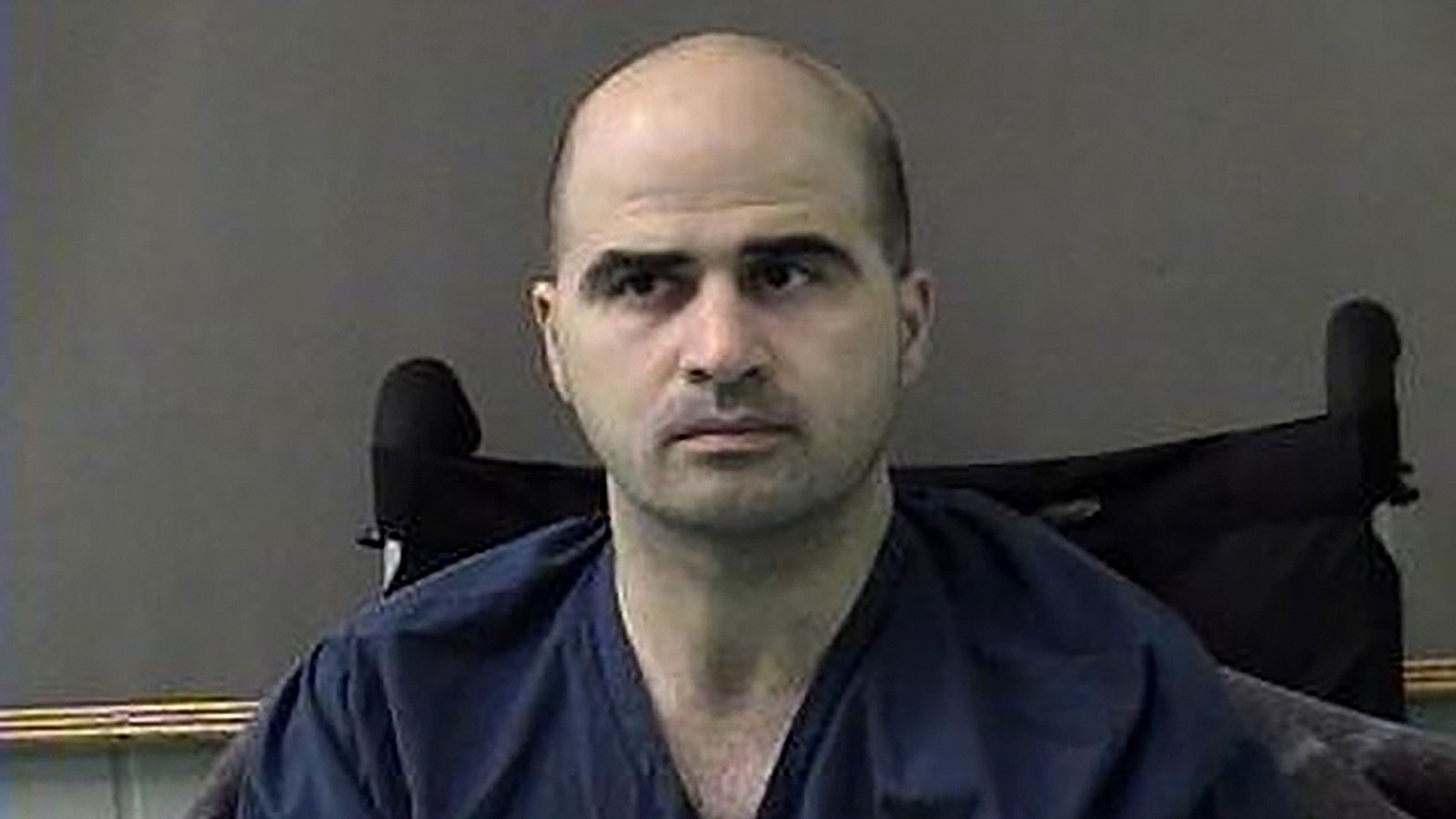
Nidal Hasan, who is scheduled to die by firing squad on Dec. 3 after his conviction for killing 13 people and wounding 32 others at Fort Hood, Texas, in 2009, is expected to file a habeas corpus petition within days that could delay his execution, his lawyer John Galligan, told ABC News on Tuesday.
A habeas corpus petition invokes a legal mechanism designed to protect people from unlawful detention. The process can delay executions for years, even if the legal challenges ultimately prove unsuccessful.
Hasan, a former Army major and military psychiatrist, was convicted by a military jury in August 2013 for the attack he described as a "jihad" in opposition to the U.S. wars in Iraq and Afghanistan.
Maj. Nidal Hasan, the Army psychiatrist who was charged with murder in the Fort Hood shootings, is seen in a booking photo after being moved to the Bell County Jail, April 9, 2010 in Belton, Texas.
Bell County Sheriff's Office via Getty Images
Brenner Fissell, the vice president of the National Institute of Military Justice and a military law professor at Villanova University, said the petition "would stop the clock" toward Hasan's execution.
The closest precedent for Hasan's case is that of Ronald Gray, another former soldier on the military's death row whose execution was halted by a federal judge in 2008 just weeks before he was scheduled to die.
A court martial at Fort Bragg, North Carolina, sentenced Gray to death in 1988 for a series of attacks on three women, two of them soldiers. Gray, then an Army specialist and a cook with the 82nd Airborne Division, was convicted of 12 offenses, including two counts of premeditated murder and three counts of rape.
Then-President George W. Bush approved his execution in July 2008. The Army set an execution date for the following December, but a federal judge in Kansas granted him a stay, giving him time to challenge his convictions and death sentence in civilian court.
Gray's habeas corpus petition challenged how the Army selected the members of his court-martial panel and argued that his lawyers had failed to adequately defend him. Hasan has exhausted his appeals and his case was ultimately declined by the Supreme Court in 2018.
Nearly two decades after Bush authorized his execution, Gray remains on the military's death row.
Popular Reads
A similar fate likely awaits Hasan, whose habeas corpus claim could run for more than a decade in a "labyrinthine process" in the federal court system, explained Rachel VanLandingham, a retired U.S. Air Force lawyer.
The habeas claim is an "automatic right" to any defendant sentenced to death within the federal jurisdiction, which includes military courts, VanLandingham said. "It's a default second bite at the apple, but it's specifically regarding for the death penalty, not for his guilt or innocence."
Defense Secretary Pete Hegseth had initially announced plans to livestream Hasan's execution, a move that would have effectively amounted to the first public execution in the U.S. in nearly a century.
The plan drew swift bipartisan criticism, with lawmakers raising concerns about turning a military execution into a public spectacle traditionally associated with dictatorships, and that footage of Hasan's death would likely supercharge anti-American propaganda, particularly among terrorist groups. The Pentagon ultimately abandoned the plan after President Donald Trump intervened.
Hasan was set to die by firing squad, a method which came at a surprise to some Army planners, as the service had been planning to conduct Hasan's executions by lethal injection for months, internal documents show.
Hasan told a court panel after the shooting that he wanted to die a martyr and that a military execution would suit that goal.
It's "incredibly unusual" for habeas to be waived, VanLandingham said. "People want to live ... at the end of the day."
Including Hasan, the military has four death row inmates but he is the only one who President Donald Trump has approved an execution for. While military courts can hand out death sentences, the president ultimately decides whether they are carried out.