27 mins ago
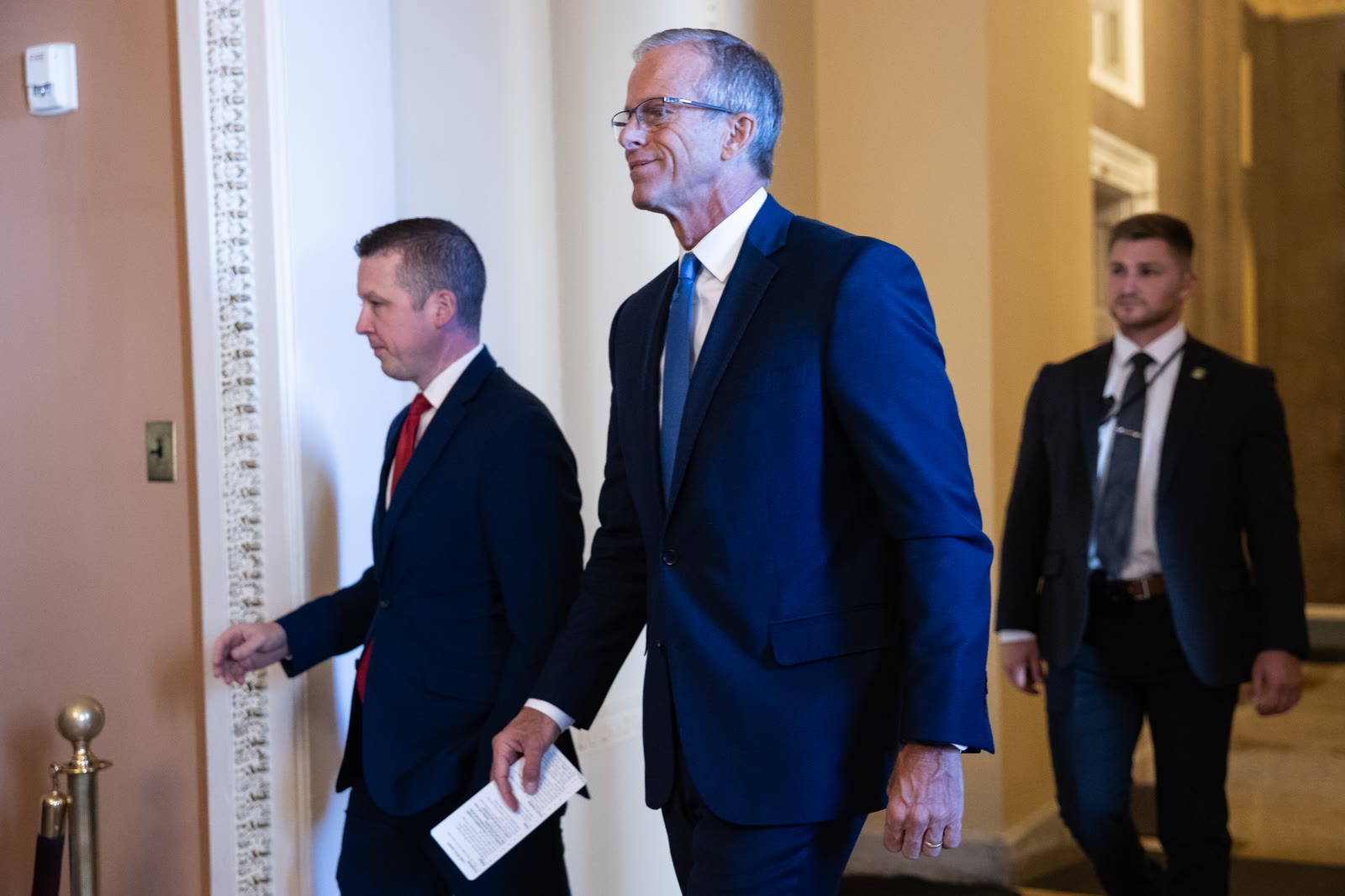
Senate Republicans reelected John Thune Tuesday to lead their party as it is thrust out of power in the next Congress.
The Senate GOP leadership team was reelected by acclamation inside a closed-door conference meeting that came after Republicans quashed the hopes of some conservatives to delay the leadership election.
Sen. Ron Johnson (R-Wis.) said Thune gave a “heartfelt speech” to colleagues Tuesday — with even Johnson, who was among those seeking a delay, saying the South Dakotan had been “very unfairly attacked” by the party’s base.
“This has never been anything against John Thune,” he said.
Thune said in a statement after the vote that Republicans “remain united in our commitment to advancing conservative priorities, working with President Trump and our colleagues in the House, and holding the line against Democrats’ efforts to enact their far-left, liberal agenda.”
“I appreciated the opportunity to have an open, honest, and transparent conversation with my colleagues today, and I am honored to have their continued trust and support to lead the Senate Republican Conference in the 120th Congress,” he said.
The depth of the Senate GOP losses, however, had many senators pressing for answers on what might change inside their chamber. At least seven GOP-held seats are now in Democratic hands, with Republicans behind in two uncalled races.
“This was the worst set of losses since Watergate,” said Sen. Josh Hawley of Missouri, who was among the GOP senators who supported delaying the leadership elections. “I mean, it’s an incredible repudiation of the focus of this Congress.”
Members in Hawley’s camp complained this week that Republicans didn’t do enough to deliver over the past two years and that GOP senators needed more time to figure out their next steps. But Republicans overwhelmingly voted to proceed with the elections, 31-15, before choosing to keep Thune in charge.
But Thune, who remains well-liked by his GOP colleagues, was never viewed as being in jeopardy and did not face a challenger for the minority leader post. Some conservatives had hoped President Donald Trump would step in and call for Thune to go if Republicans lost the majority, but Trump instead said repeatedly that he was staying out of the leadership race.
Not even Sen. Rick Scott of Florida, who has previously run twice to lead the party in the Senate, made a bid this time around.
Thune has a challenging task ahead of him: He’ll have to manage the final two years of the Trump administration, where the president could try to keep his grip over congressional Republicans, while working to prevent further GOP losses in 2028, when the Senate map is more favorable to Democrats.
Thune also has a hefty to-do list to manage even before the majority flips in January — including avoiding a mid-December government shutdown, potentially having to deal with an impeachment of Defense Secretary Pete Hegseth and moving other must-pass legislation such the annual defense policy package and a farm bill.
“The job is not for the faint of heart, for sure,” Thune said Monday night. “But I feel like I’ve got something to offer and to contribute ... as we think about now having to chart a slightly new direction.”
Continue on to view the day's latest updates
1 hour ago
Rep. Lisa McClain of Michigan won another two years as chair of the House Republican Conference, fending off two challengers who sought to capitalize on the GOP midterm losses.
McClain won with 93 votes in a secret ballot tally over Reps. Erin Houchin of Indiana, who got 57 votes, and Rep. Greg Steube of Florida, who got 27.
Houchin and Steube leaned into frustrations aired after last week’s Democratic wipeout with the state of GOP messaging, which is traditionally a focus for the conference chair position, as well as a broader desire among House Republicans for a clean leadership slate.
McClain, meanwhile, told colleagues she was ready to “get back in the fight” on their behalf.
While Houchin made the case that the GOP’s premidterm messaging was ineffective and Steube argued for a more purely conservative approach to the job, McClain pitched herself as broadly palatable to a variety of members.
“The Chair’s job is not to build a personal brand. It’s to elevate yours,” she said in the letter. “I’ll make sure you have the resources, messages, and platforms to reach your constituents and bring your voice to a national audience.”
McClain, 60, has served in Congress since 2021 and was elected conference chair two years ago, replacing Rep. Elise Stefanik of New York — who was anticipating a Trump administration appointment that never came.
1 hour ago
Senate Republicans voted 31-15 to proceed to their leadership election, effectively rejecting an attempt by conservatives to delay their leadership election.
The vote, which took place during a closed-door conference meeting Tuesday, comes after a group of conservatives — led by Sen. Ron Johnson of Wisconsin — pushed to delay the election to give GOP senators more time to talk through the results of last week’s walloping in the midterms.
But Senate Majority Leader John Thune, who is expected to be elected to lead the party in the minority next year, questioned what would be gained by delaying the election, with no other Republicans raising their hand to run against him. Senior Republicans predicted the effort would be defeated.
1 hour ago
House Republicans chose to keep Rep. Tom Emmer of Minnesota as party whip in the next Congress, rejecting a challenge from an ambitious younger member after last week’s sweeping midterm losses.
Emmer beat Texas Rep. August Pfluger 103-76 in the secret-ballot vote, according to two people present for the tally.
Emmer, 65, will serve alongside Rep. Jim Jordan of Ohio, who was elected minority leader earlier Tuesday, as House Republicans navigate the last two years of Donald Trump’s presidency and look to claw back the massive Democratic gains in 2028.
The result effectively promotes Emmer from the No. 3 spot to No. 2 spot in the House GOP leadership despite widespread frustration from members over the election results. The 48-year-old Pfluger, who has been angling for a bigger job as chair of the Republican Study Committee, argued the existing leadership echelon should have done more to protect the majority.
Emmer has served as majority whip since 2023, after helping secure a GOP majority in the 2022 midterms as NRCC chair. He launched a run for speaker later that year after California Rep. Kevin McCarthy lost the gavel and won an internal caucus vote. But President Donald Trump publicly opposed him, effectively killing his bid.
Emmer was seen at the time as a MAGA skeptic but has since become much closer to Trump. His name was floated as a potential contender for minority leader but he ultimately declined to seek the No. 1 slot several weeks before the midterms.
2 hours ago
Rep. Jim Jordan will lead a much-diminished House GOP as minority leader next year, beating out Majority Leader Steve Scalise in his third attempt to lead Republicans on Capitol Hill.
Jordan won the secret ballot vote 106-73, according to two people present for the tally.
A co-founder of the House Freedom Caucus and prominent MAGA figure, Jordan pitched himself as best prepared to engage in political combat with the incoming Democratic House majority, noting he was “battle tested on the oversight front” in a letter to members. He currently chairs the House Judiciary Committee and previously chaired the Oversight Committee.
He assumes the top job after catastrophic losses for Republicans last week prompted Speaker Mike Johnson to stand down from leadership and sparked introspection in the GOP ranks about how to rebuild the party. Many viewed Jordan as a needed change of direction compared to Scalise, who has been in the top leadership ranks for more than a decade.
Jordan, 62, ran to be minority leader in 2018 but lost to California Rep. Kevin McCarthy, who went on to become speaker. After McCarthy was ousted from that job in 2023, Jordan tried and failed to replace him — losing a secret-ballot caucus vote to Scalise along the way.
A group of moderate Republicans kept Jordan from getting the speakership at the time, but many of those opponents will no longer serve in Congress.
Jordan had been laying the groundwork in the meanwhile to mount another run for leader, improving his fundraising and traveling widely to campaign with GOP colleagues. While Jordan needed a majority of the entire House to become speaker in 2023, he needed only a majority of the Republican conference to win the minority leader job.
It’s unclear what comes next for Scalise, who first entered the leadership ranks in 2014. He pitched himself as being best positioned to help Republicans win the majority in 2028 — something some Republicans are doubting is even possible after the blue wave last week.
2 hours ago
House Energy and Commerce Chair Brett Guthrie said Tuesday he’s looking to make changes on “grid reliability” and other electricity provisions in the bipartisan permitting bill that’s currently working its way through the Senate.
In an interview with POLITICO, the Kentucky Republican said he was “encouraged” and “optimistic” while he continues to negotiate with the key Senate players.
“We’re continuing to work — there’s still more details to work out,” he said. “But I’ve been real pleased with the Senate listening to us … The Senate is not trying to pass a bill and say take it or leave it to the House, they are working with us.”
But Guthrie’s push for changes come as Senate Democrats are also seeking amendments to the bill before its final passage. While Senate negotiators have promised a “healthy amendment process,” it’s unclear exactly how many changes can be made without upsetting the delicate bipartisan balance of the bill.
Any major changes to the transmission section — a key component for Democrats to bring more clean energy on the grid — could upend the deal, Guthrie acknowledged. Historically, Republicans have been wary of socializing the cost of building massive power lines across red states to ship power to blue states. And if the House makes changes once it receives the measure, it would require the Senate to consider the package a second time, at which point coalitions could fall apart — if there’s even enough time to vote again before the end of the year.
“We know there are parameters that we can operate within and we are trying to operate within those,” he said. “The details are still being worked out.”
Nearly all Senate Republicans and more than 20 Democrats voted Monday night to advance the permitting bill that was hashed out by the top Democrats and Republicans on the energy and environment committees. Those four senators — Sheldon Whitehouse, Martin Heinrich, Shelley Moore Capito and Mike Lee — briefed the House Problem Solvers Caucus Tuesday.
Democrats Whitehouse and Heinrich have sold the measure as a way to lower electricity costs and buoy clean energy at a time when American voters made clear that affordability is a priority during last week’s blue tsunami election.
The measure is expected to pass the Senate — particularly after Monday night’s 73 to 25 successful procedural vote — but the House is more of an open question, even without Guthrie’s proposed tweaks. A small but vocal group of Republicans have in the past objected to any legislation that would cement approval for wind power projects — a position reinforced Monday, when President Donald Trump said he wouldn’t approve wind permits despite this provision being a central part of the permitting package the White House brokered with senators.
Meanwhile, Minority Leader Hakeem Jeffries, who is expected to be speaker next year, has said the bill needs more House input amid continued opposition from some environmental organizations and tribal groups that have taken issue with the historic preservation provisions in the bill.
After the Problem Solvers Caucus meeting, Democratic Rep. Salud Carbajal of California underscored the difficulty some Democrats are wrestling with.
“In concept, it’s obviously a good bill, but it’s got a lot of challenges,” he said. “It’s got the tribal consultation issue, which is a great concern. It also does nothing to all the offshore wind projects that he already sabotaged and the buyouts that occurred.”
3 hours ago
Rep. Lori Trahan is revamping her artificial intelligence safety bill to narrow language preempting state laws regulating the industry, according to a person with knowledge of her efforts granted anonymity to discuss private legislative work.
Trahan’s original proposal, which the Massachusetts Democrat drafted with Rep. Jay Obernolte (R-Calif.) and released in June, contained preemption language that drew ire from AI safety groups. The duo substantially narrowed the provisions when they introduced the bill in August.
Democrats largely oppose blocking states from creating their own AI regulations, while the tech industry says it’s untenable to navigate a patchwork of differing laws.
Republicans, who favor preemption, will largely be on the sidelines next Congress as Democrats take over both chambers
3 hours ago
Reps. Mario Diaz-Balart of Florida, Craig Goldman of Texas and Jeff Hurd of Colorado are set to give nominating speeches for Louisiana Rep. Steve Scalise’s leadership bid this afternoon, according to a person familiar with the plans.
Diaz-Balart and Hurd are considered more moderate House Republicans, and both narrowly won reelection last week. Scalise is making the case he is better positioned than hard-right rival Jim Jordan to lead the GOP back to the majority.
“I can go to the most ruby-red or the most swing district,” Scalise said leaving the candidate forum. “We’re going to have to go back to those swing districts we lost, and we’ll get those back.”
5 hours ago
After about two hours of private discussion about last week’s midterm losses and the path forward, Senate Republicans plan to reconvene at 2 p.m. to continue with electing their leaders, according to several GOP senators.
Members will attend committee meetings and a conference lunch before regathering inside the Capitol. They haven’t yet voted on a request to delay the election. If it is rejected, elections would proceed later Tuesday.
5 hours ago
5 hours ago
An incoming member of Congress said senior House Democrats have vowed to make his life “a living hell” and oust him in 2028 if he does not support Rep. Hakeem Jeffries’ speaker bid.
Rep.-elect Don Leonard (D-Ohio) said in a social media post that the senior members told him to vote for Jeffries regardless of whether the Democratic leader commits to addressing key issues, including a constitutional amendment to overturn the Citizens United decision and ending U.S. support for Israel and the war in Iran.
“It’s part of the stuff you see in the movies,” said Leonard. “It’s a whole other thing when it’s in person, by people who actually care about you and are cheering for you but expect you to wear the team jersey and be a good team player.”
He added that he received a letter from Jeffries that “still left several of my constituents’ questions unanswered.”
Leonard, who last week flipped an Ohio district long held by Republicans, said separately in an interview with Joy Reid that he would not vote for Jeffries unless the Democratic leader commits to addressing his demands on Israel and campaign finance.
“So unless Speaker Jeffries is willing to commit to enforcing our nation’s laws, like the Leahy Law, against Israeli genocide in Gaza; unless the speaker is willing to get to the heart of this crisis, which is Citizens United, he will not have my vote,” the incoming lawmaker said in a clip he also posted on his social media.
Jeffries’ office did not immediately respond to a request for comment. At a Monday news conference, the longtime Israel backer said he plans to have many conversations with his caucus in the coming days.
“I’m going to work hard to talk to every single member about what we’ve been able to do together over the last two years, and what the opportunities are for us to do together in the next two years, to deliver upon the dramatic change that the American people so decisively voted for,” he said.
Leonard’s remarks come as House Democrats are gearing up for a speaker nomination vote next week. Jeffries is expected to cruise to victory, as his party’s sizable new majority means he can afford at least three dozen defections.
Asked about Leonard’s comments on Tuesday, Rep. Pete Aguilar (D-Calif.), who’s running unopposed for House majority whip, said he doesn’t know which senior Democrats Leonard was referring to. Aguilar also credited Jeffries for playing “an integral part” in House Democrats’ sweep last week.
“It’s my belief that he will be overwhelmingly selected to lead this caucus. I don’t lose any sleep over that,” he said. “Members could have ideas and interests, and they could have asks along the way, but the outcome is not in question.”
Jeffries’ allies have said they want the party united behind his speakership so it can focus on addressing issues key to voters instead of being consumed by factional warfare.
Still, not all Democratic members have committed to supporting Jeffries, with some progressives hoping to use the speaker election to work through internal divisions ahead of the new Congress next year.
Riley Rogerson contributed to this report.
5 hours ago
Natural Resources ranking member Jared Huffman (D-Calif.) told more than two dozen companies and nine federal agencies to preserve their records as he prepares to take over the committee — and its oversight responsibilities — come January.
What happened: Huffman wrote to 27 private companies, ranging from energy companies like Chevron and ExxonMobil to technology companies like TikTok and Palantir, urging them to preserve records ahead of potential committee investigations next year.
Companies were told their “good-faith cooperation with this preservation request, as well as its response to outstanding document requests, will help inform next steps in the Committee’s oversight.”
Huffman also wrote to nine government agencies, housed within the Interior, Agriculture and Commerce departments, putting them on notice of oversight to come next year and asking them to preserve records in accordance with federal laws.
“For two years, this administration has stonewalled us and kept the American people in the dark while Democrats have fought tirelessly to daylight and stop their corruption. Those days of obstruction are over,” Huffman said in a statement.
Why it matters: Huffman is on track to take over the Natural Resources Committee next year, and he has vowed to make the panel a central node for Democrats’ oversight priorities.
He told fellow Democrats in a letter last week that oversight would be “a large part” of the panel’s agenda in the 120th Congress.
The companies Huffman chose to target give a further look at what may be included in the committee’s investigative sweep. The list includes oil and gas companies, on which pro-climate Democrats like Huffman have focused in the past. But it also includes military technology companies like Boeing and Lockheed Martin; broader financial institutions like Mastercard and SoftBank; and one health care company, UnitedHealth.
The details: Federal agency recipients of Huffman’s request for records preservation included the Bureau of Indian Affairs, Bureau of Land Management, National Oceanic and Atmospheric Administration, National Park Service, Fish and Wildlife Service, Forest Service, and the Agriculture, Commerce and Interior Departments.
The 27 private companies receiving letters were: Boeing, Chevron, Deloitte, Energy Fuels, Exiger, ExxonMobil, iHeartMedia, January AI, John Deere, Lithium Americas, Lockheed Martin, Mastercard, Mosaic, Northrop Grumman, Oracle, Palantir, Penske, Phorm Energy, RTX, SAP, SoftBank, TikTok., TikTok USDS Joint Venture LLC, Trust for the National Mall, UFC, United Airlines and UnitedHealth Group.
Huffman asked all the agencies and companies to issue preservation instructions internally and suspend any deletion practices — and to respond to committee Democrats with confirmation of their compliance in the coming weeks.
“To every agency official and corporate executive receiving these letters: save everything. The American people deserve to know what you did with their government and their money, and we intend to get them answers,” Huffman said in a statement.
7 hours ago
House GOP leadership candidates are lining up colleagues to give nominating speeches ahead of today’s elections.
Rep. Ben Cline of Virginia said he will nominate Texas Rep. August Pfluger for whip this morning. Cline is set to take over the chair of the Republican Study Committee from Pfluger. Rep. Nathaniel Moran will also give a speech for his fellow Texan.
Rep. Carlos Gimenez of Florida said in an interview he will speak on behalf of Indiana Rep. Rudy Yakym, who is running for NRCC chair, and Rep. Julie Fedorchak of North Dakota will give a speech for Utah Rep. Blake Moore, who is running unopposed to keep his position as conference vice chairman.
Speaker Mike Johnson said in an interview he will not be speaking on behalf of any candidate.
8 hours ago
Dozens of Republican National Committee members want congressional Republicans to delay their leadership elections by at least 30 days, arguing that the party must reckon with its widespread midterm losses first.
“There is no way to sugarcoat what happened on Election Day. From coast to coast, and in some of the reddest parts of the country, Republicans were humiliated,” the 31 RNC members — from 21 states and two territories — wrote in a letter shared with POLITICO. Now is not the time, they argue, to “accept the status quo” — it’s time “do some serious soul-searching.”
“We ... urge the House and Senate Republican Conferences to postpone leadership elections for at least 30 days to allow for an initial assessment of the November 3 losses, a substantive discussion of what went wrong, and an opportunity for leadership candidates to explain how they intend to address those failures,” the members write.
The House and Senate GOP are both set to hold elections Tuesday to decide their next slate of leaders, with candidate forums scheduled to begin this morning. A handful of senators, including Sen. Ron Johnson (R-Wis.), have also called for a delay following last week’s elections.
In the House, Speaker Mike Johnson will not take the top post again, leaving Majority Leader Steve Scalise and Judiciary Chair Jim Jordan to battle it out. John Thune is expected to be reelected as the No.1 GOP leader in the Senate.
While the elections appear likely to proceed as scheduled, the letter underscores the brewing discontent within the GOP following last week’s wipe out — including even among some of its most loyal members. Democrats won their largest majority in both chambers in decades and the Republican Party has a lot of work to do to resolve its divisions and overcome President Donald Trump’s unpopularity with voters.
“Rushing these elections before examining what happened risks protecting the very leaders whose decisions need to be examined,” the RNC members wrote. “Accountability must come before leadership elections.”
Amy Kremer, Georgia’s national committeeperson and one of the letter’s signatories, also pressed congressional Republicans to show what they intend to accomplish before choosing their next slate of leaders.
“The people who knock on doors, make the calls, and give their hard-earned money are owed more than business as usual. Before leadership asks for another two years in charge, show us what they intend to deliver in the lame-duck session,” she told POLITICO. “What is the plan to pass the SAVE America Act and move pending confirmations? Our voters deserve specifics and results.”
The RNC faces its own leadership fight after last week’s losses. KC Crosbie, the RNC co-chair, wrote in a letter to members last week that she has “decided to run for chair” of the committee, challenging the Trump-picked Joe Gruters. One day later, the president praised Gruters on his Truth Social, and said “I know he will do an incredible job in 2028.”
8 hours ago
Republican leaders are fighting to keep their power on Capitol Hill Tuesday after stunning midterm losses last week.
The House and Senate GOP are poised to hold separate elections Tuesday to decide who will serve as the top Republicans in the next Congress. The winners are expected to immediately start charting a course back to governing relevance after Democrats gained the largest majorities won by any party in decades and voters delivered a firm rebuke of President Donald Trump.
How it’ll go: House Republicans will hold a candidate forum at 9 a.m. to hear from members running for all leadership positions, and a secret ballot will begin at 1:30 p.m.
Senate Republicans will meet at 9 a.m. It’s unclear how long their forum will continue — with some members pushing for a vote to delay the election to give more time for deliberations. But senior Republicans expect that push to fail and to know who will lead the conference by the end of the day.
What to expect: The House elections will pit existing Republican leaders vying to keep their top spots against insurgents who are hoping to capitalize on a desire from some for a clean slate.
Speaker Mike Johnson is bowing out, leaving Majority Leader Steve Scalise and Judiciary Chair Jim Jordan to battle it out for the No. 1 perch.
Jordan is pledging a fresh look for the House GOP’s top echelon and has swiped at Johnson and Scalise for having too often “operated without a clear plan to survive the hour or the day in front of us.”
Scalise is seeking to fend off the throw-the-bums-out sentiment by drawing on his experience as a fundraiser and a set of personal relationships he has closely tended for years.
Thune appears to be on a path to reelection today as Senate GOP leader, despite calls from a handful of senators, like Sen. Ron Johnson for a delay. One benchmark to watch: Sixteen Republicans voted for a similar delay in 2022, when Mitch McConnell sought his final term as leader.
Thune said Monday Republicans will be given plenty of space to talk through how they are feeling after the midterms. He’s pitching himself as ready to lead the conference amid an uncertain final two years of the Trump administration and a lot of 2028 jockeying.
“The job is not for the faint of heart, for sure,” Thune told POLITICO on Monday. “But I feel like I’ve got something to offer and to contribute ... as we think about now having to chart a slightly new direction.”
What else we’re watching:
— GOP BUCKS TRUMP ON NVIDIA: Senior Republican lawmakers are considering investigating Nvidia over CEO Jensen Huang’s affair with an alleged Chinese spy, putting Trump’s strong defense of the tech titan at odds with mounting scrutiny from members of his own party. GOP chairs of the House Foreign Affairs, Intelligence and China committees are asking Huang to appear at a closed-door briefing next week that could lay the groundwork for an investigation into Nvidia. Other Republicans are now calling for Congress or other federal authorities to launch probes into Huang’s conduct and Nvidia’s broader dealings with China, arguing the situation is a serious national security risk.
— PERMITTING DEAL DEBATE LAUNCHES: The lead senators negotiating an energy permitting deal are now promising a “healthy amendment process” after the legislation cleared an initial hurdle Monday. Nearly all Senate Republicans and more than a dozen Democrats voted yesterday to advance the bipartisan permitting reform bill. Several of the Democrats who voted to advance the legislation were still critical of it — with some like Sens. Chuck Schumer and Catherine Cortez Masto pushing for further changes to the bill as the voting process continues.
Mia McCarthy, Jordain Carney, Christine Mui, Ari Hawkins, Gabby Miller, Sophia Cai, Owen Dahlkamp, Katherine Long and Nico Portuondo contributed to this report.