Before London appeared, it disappeared. If that sounds like part of a knotty riddle, it is.
As the London Museum reopens on November 28, after taking more than a decade to move to a much larger location to tell the story of Britain’s capital city, the most tantalizing part of that history—its distant origins—is being slowly pieced together in fragments by archaeologists working for the museum, with striking results.
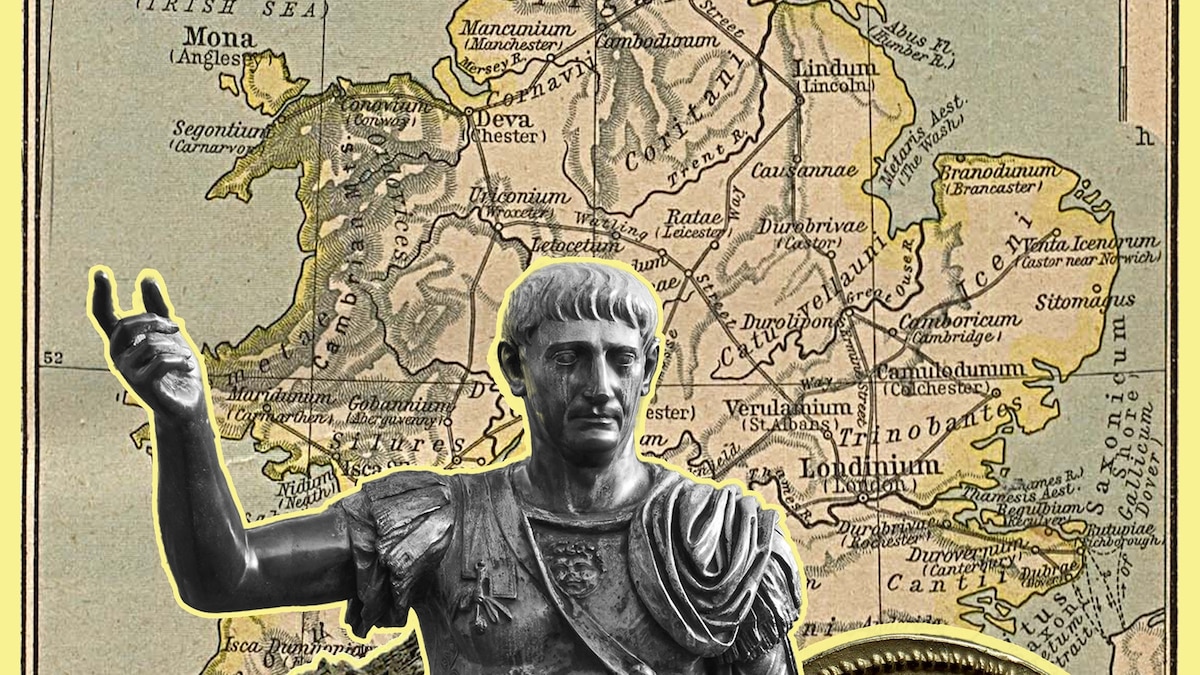
London’s first manifestation as a city was as Londinium, established by the Romans beginning around A.D. 50. Londinium had some of the most impressive buildings north of the Alps, including a basilica more than 500 feet long with 80-foot-high walls.
But at the beginning of the fifth century, the Romans upped and left. The reasons are complex but, basically, the Roman occupation, which extended via a network of highways to citadels across Britain, had become too peripheral and too costly to the interests of the empire.
Londinium crumbled slowly into noble ruins, left like a magnificent relic of some alien visitation. The idea took hold (influenced by an embedded historical bias that Rome was a superior civilization) that Britain had regressed into a feudal wasteland known as The Dark Ages until the West Saxon king Alfred the Great emerged as a consolidating force in the ninth century.
But in 2014, Lyn Blakemore, a young archaeologist among those working with the museum, published a paper she titled, “London in the Not-so-Dark Ages.” It told the story of work that she and teams of archaeologists had been doing over the previous decades. What was revealed can lay claim to being one of the triumphs of modern urban archaeology, far more challenging than unearthing an ancient city from the desert sands.
Why was Londinium, the apotheosis of Roman conquest and culture, left to crumble into dust, leaving only its walls as a measure of its size?
It’s extraordinary that all of this is being carried out in the heart of a built city. The digs have to be opportunistic, often when new construction briefly clears a site. Sometimes the target is like a pin prick on the map: for example, when excavations go deep for an elevator shaft or a hotel enlarges its basement. By law, the archaeologists are allowed to go in before the concrete is poured. Every fragment they find—pottery, jewelry, bones— can add vital clues to the lost city.
What has emerged clearly for the first time are two stages of Saxon life. First, following the exit of the Romans, a settlement that used the Thames riverside as a trading post. Then came the most consequential discovery, outlined first in 1984 and then, as the result of more focused digs, emerging more clearly from the mists of time: Something known technically as an emporium, really the beginning of a new city in the seventh century called Lundenwic (wic was Saxon for a trading post). From that starting point, the basic form and life of the then-thriving city—with buildings in the traditional Euro-German style, timber framed with wattle and daub walls and thatched roofs—has taken recognizable form.
“Lundenwic was strategically located at the border of different kingdoms—East Saxons, South Saxons, Kent and Wessex, near the mouth of the Thames, with a good beach for boats,” Blackmore explained in her 2014 paper. “It was an ideal port for traders coming by land and sea.”
Lundenwic’s main arteries closely follow the pattern of today’s London. The horizontal axis is The Strand, the road running east from Trafalgar Square, in itself the course of the original Roman road from Londinium west to Bath, the Romans’ beloved thermal watering hole. North of The Strand are landmarks that have yielded significant remnants of Lundenwic—beneath streets around Covent Garden and the Royal Opera House. But Blakemore sees the area south of The Strand, tilting down to the north bank of the Thames, as one of the most important locations for continuing work that will fill in more of the detail of a city that was already discovering its luck with the virtues of a great river.
The Saxons, living in harmony, had developed a false sense of security. The Viking raids lasted for about 50 years.
So why was Londinium, the apotheosis of Roman conquest and culture, left to crumble into dust, leaving only its walls as a measure of its size? The new consensus of the archaeologists is that, simply, to the British population of some two million, it was of no use. Rome had been a self-interested imperial presence amid an indigenous landscape and culture that was, in southern Britain, essentially a balkanized assembly of Saxon kingdoms for whom the Romans had been a relatively small (and notoriously hedonistic) occupying elite with few common interactions.
Recently I asked Blakemore if the outlines of post-Roman life leading up to the arrival of Lundenwic had changed in any significant way since her 2014 paper. “Not in the overall picture but more is being added to our understanding of certain aspects,” she said. It remains a puzzle where each discovery brings forth new questions—for example, finding a ditch 18 feet wide and nine feet deep that was, she believes, part of a defensive system built in the ninth century to protect Lundenwic from Viking raids. Until then, the Saxons, living in harmony, had developed a false sense of security. The raids lasted for about 50 years.
A big part of the Dark Ages narrative is the idea that the Vikings raped and pillaged and decimated the Saxon population. Not so, according to archaeologist Nick Bateman, who was working for the museum when we spoke a few years back. Citing a study of national genetics, he said, “the DNA of people living in [A.D.] 1500 shows that 90 percent of them shared DNA with people of the Bronze Age [B.C. 3200-600]. Germanic peoples did come in the fifth and sixth centuries but the idea that they displaced and killed the existing people is not accurate. There’s very little displacement.”
Nor is there is any evidence that when the Roman military left in A.D. 407, Romans chose to stay and cohabit and interact with Saxon life.
And yet it was, in one hugely significant way, the Romans who had decided London’s destiny on that day without record around A.D. 50, when a Roman military engineer sailed up from the Thames estuary, surveying the river banks, and chose a location for a city that would, in the coming centuries, eventually demonstrate the power and influence that came with deepwater ports—providing a base from which to develop the world’s most powerful navy and merchant fleet, and proving that, sometimes, geography is everything.
The new museum covers 10,000 years of history, including a sub-tropical prehistory when dinosaurs roamed the land, and displays many of the opulent trappings that came with the successive monarchs who ruled from thrones in London, but it is the nascent city of Lundenwic—establishing its fragile footing in those “Not-so-Dark Ages”—that best shows that the pursuit of this history is riveting and never ending.
Clive Irving is a former managing editor of the Sunday Times in London and a founding editor of Conde Nast Traveler.