The Insurrection Act is the most powerful statute that sets the conditions, or “triggers,” for when a president may deploy the military domestically, including for law enforcement. The conventional wisdom is that these triggers are so broad as to be almost meaningless. In the words of Bob Bauer and Jack Goldsmith, “The Act has extremely broad and vaguely worded triggers for its use and thus affords a president the widest conceivable discretion.” General Mark Milley, then-chairman of the Joint Chiefs of Staff, put it even more bluntly in testimony to the January 6th Commission: “There’s no law that says the military is the last resort. . . . You go back to the Insurrection Act. All the President has to do is walk outside the White House and yell three times, . . . ‘Insurrectionists, disperse.’”
We disagree. The Insurrection Act has four triggers, but three contain language that clearly places significant limits on their use. The exception is 10 U.S.C. § 253(2). It permits domestic deployment whenever “domestic violence” or even a “conspiracy . . . opposes or obstructs the execution of the laws … .” Here, the language is truly broad.
Nonetheless, basic tools of statutory interpretation counsel reading this provision, what we call the “obstruction” trigger, narrowly. To understand why, bear in mind one important fact: Congress enacted the original versions of the obstruction trigger [now § 253(2)] together with what we call the “equal protection trigger” [now (§ 253(1)] at the same time in the same section of the same statute. Thus, the triggers must be read together. When read together, they suggest a narrow reading of the obstruction trigger as limited to interference with judicial processes.
The problem with an expansive reading of section 253(2) is that it would render Section 253(1) superfluous. This incongruity should puzzle a reader and invite an inquiry as to how to read both parts of section 253 coherently. Our research has led us to the following explanation: the broad wording of section 253(2) was a drafting error. We suggest an alternative and narrower reading of the obstruction trigger, one that is more consistent with the drafting and legislative history. We further suggest a likely reason Congress failed to notice the mistake: the language was introduced late in the debate and was overshadowed by other controversial proposals introduced shortly afterward.
The Obstruction Trigger
On their face, the statutory provisions that are now codified together in what is commonly referred to as the “Insurrection Act” use broad terms that might be read to provide presidents the limitless discretion that the conventional interpretation suggests. But a more careful and in-depth reading of all the relevant provisions suggests that each trigger has a specific and narrow ambit. The Insurrection Act has four triggers: (1) when there is an insurrection against a state government (10 U.S.C. § 251); (2) when laws become “impracticable” to enforce in the “ordinary course” of judicial proceedings (10 U.S.C. § 252); (3) when laws are “hinder[ed]” to the point that the hindrance amounts to a state government denial of equal protection, what we call the “equal protection trigger” (10 U.S.C. § 253(1)); and (4) when the execution of the laws is opposed or obstructed, what we call the “obstruction trigger” (10 U.S.C. § 253(2)).
The first trigger is perhaps the most restrictive. Not only must there be an insurrection, but it must be directed against the state government, and the president may not act without a request from the state authorities. The second, the judicial-proceedings trigger, requires an actual judicial proceeding in an Article III court or federal territorial court and a failed effort by civilian authorities to enforce that process before deploying the military. One of us has defended this reading of the judicial-proceedings trigger at greater length elsewhere. The third, the “equal protection” trigger, requires not only a deprivation of constitutional rights to a “class of people” but also that state authorities be unable, fail, or refuse to protect those rights, such that the state’s inaction rises to the level of an equal protection violation. These three triggers may not be bulletproof against abuse, but they do at least provide courts with statutory language against which to measure whether the president has complied with the law.
Not so with the fourth and final trigger, § 253(2), the obstruction trigger. Although obstruction is not so broad as to include any violation of law, it is broad. Obstruction consists of interference with government attempts to enforce the law. As the Supreme Court explained in Baldwin v. Franks, “A mere violation of law is not enough; there must be an attempt to prevent the actual exercise of authority.” In that decision, the Court interpreted closely parallel language to what is now § 253(2) (“prevent, hinder or delay the execution of any law”) from the very same statute. Section 3 of the Ku Klux Klan Act of 1871 created what is now § 253(2), and the Court was interpreting section 2 of the same Act. Obstruction in other contexts, including judicial and other official proceedings, has generally been interpreted broadly. Under this reading of § 253(2), merely resisting arrest by federal officers, fleeing from them, or concealing evidence from them could suffice to give the president authority to deploy the military.
A Broad Reading of Section 253(2) Would Render Section 253(1) Superfluous
Because “[c]ourts generally construe a statute to give effect to all its provisions,” it is a “cardinal rule of statutory interpretation that no provision should be construed to be entirely redundant.” While such superfluity is not unheard of, it is rare. Within a single sentence, it is rarer still. In such cases, the interpreter should investigate whether the broad provision causing the redundancy might have a different meaning. The broad interpretation that Milley, Bauer and Goldsmith would give 10 U.S.C. § 253(2) renders 10 U.S.C. § 253(1) unnecessary and effectively a nullity. From the perspective of original statutory intent and meaning, that makes the broad reading highly unlikely. On its face, section 253(2) appears untethered from any real constraints. To interpret section 253(2) properly though requires interpreting it in context—in particular, in light of section 253(1). The two paragraphs are in the same section of the United States Code and were adopted together in the same section of the same statute at the same time: section 3 of the 1871 Ku Klux Klan Act.
As a straightforward read of the current version of 10 U.S.C. § 253 indicates, paragraph (2) would, if read broadly, effectively render paragraph (1) completely superfluous. How so?
Both Sections 253(1) and 253(2) concern interference with the “execution of the laws.” They use highly similar words to describe this interference: Section 253(1) refers to the “hinder[ing]” of the execution of the laws, and Section 253(2) refers to “oppos[ing] or obstruct[ing]” it. The overlap between hindering on the one hand and opposing or obstructing on the other is considerable. In fact, three provisions in current federal law use the word hinder to describe conduct falling under the broader category of obstruction of justice. In short, anyone who “hinder[s]” the execution of the laws under section 253(1) is at least “oppos[ing]” such execution under section 253(2). Treating section 253(2) literally, it is thus not possible to trigger the president’s authority under section 253(1) without also triggering it under section 253(2).
But Section 253(1) is far more restrictive. It adds two further constraints to the trigger: (1) the “hinder[ing]” of the execution of the laws must deprive a “part or class of [the] people … of a right, privilege, immunity, or protection named in the Constitution and secured by law”; and (2) “the constituted authorities of that State [must be] unable, fail, or refuse to protect that right, privilege, or immunity, or to give that protection.” In addition, the “hinder[ing]” of the execution of laws under section 253(1) must be of both federal and state laws. But these are additional conditions and so every case satisfying them would also qualify under Section 253(2).
In other words, paragraph (2) simply cannot mean what it literally says if paragraph (1) is to retain any meaning whatsoever. While superfluity in law is not unheard of, here it is simply implausible. This superfluity is not simply a superfluity across the U.S. Code or even in different portions of a single statute. It is instead a superfluity within what is literally a single sentence in the same section of the United States Code. And the superfluity arises not simply from, for example, overlapping terms in a list—what might arise from the “belt and suspenders” principle of statutory drafting, the quite reasonable proposition that a legislature might include redundancies “sometimes in a congressional effort to be doubly sure, sometimes because of congressional inadvertence or lack or foresight, or sometimes simply because of the shortcomings of human communication.” That is pretty clearly not what is happening here. This superfluity amounts to nullifying the entirety of the longer of two operative paragraphs in a single statutory provision. Rendering one part of a provision completely irrelevant by a later part of that same provision is simply not how legislatures draft statutes.
So, where did this superfluity come from? Congress embedded this exact same superfluity in the original statute at its inception. That statute was the Ku Klux Klan Act of 1871, better known for one of its other provisions, the one that became 42 U.S.C. § 1983.
A Drafting Error
If the broad reading of section 253(2) were correct, then the obstruction trigger in 253(1) would be superfluous. Yet when senators added the obstruction trigger, they showed little awareness of either its breadth or the redundancy it created. The drafting and legislative history suggests an explanation for this disconnect: the broad obstruction language was a drafting error.
On April 6, 1871, the House passed the initial version of the Ku Klux Klan Act. The House bill had no obstruction trigger, only the equal-protection trigger. Four days later, the Senate Judiciary Committee presented its proposed amendments to the full Senate.
Most important for our purposes, the Senate Judiciary Committee’s version introduced a new trigger, an antecedent to the modern obstruction trigger. Under the committee’s proposal, the president could deploy the military domestically if “domestic violence,” a “conspiracy” or other covered conduct “obstruct[ed] the equal and impartial course of justice.” Surprisingly, in extensive remarks methodically explaining, section by section, the committee’s amendments, Senator George Edmunds, a Vermont Republican and the bill’s leading Senate sponsor, gave no real explanation for this addition. Domestic deployment was the subject of one of the bill’s six sections, and he did discuss it, but he focused on other changes to the provision. Below is the marked-up text of the domestic-deployment provision as a senator would have seen it, following Congress’ convention of brackets indicating deletions and italics indicating additions to the House bill. Pay particular attention to the new trigger, shown in italics.
“[I]n all cases where insurrection, domestic violence, unlawful combinations, or conspiracies in any State shall [so far obstruct or hinder the execution of the laws thereof, and of the United States, as to] deprive any portion or class of the people of such State of any of the rights, privileges, or immunities, or protection, named in the Constitution, and secured by this act, or obstruct the equal and impartial course of justice, and the constituted authorities of such State shall either be unable to protect, or shall, from any cause, fail in or refuse protection of the people in such rights, [and shall fail or neglect, through the proper authorities, to apply to the President of the United States for aid in that behalf,] such facts shall be deemed a denial by such State of the equal protection of the laws, to which they are entitled under the Constitution of the United States;
and in all such cases it shall be lawful for the President, and it shall be his duty, to take such measures, by the employment of the militia or the land and naval forces of the United States, or of either, or by other means, as he may deem necessary for the suppression of such insurrection, domestic violence, or combinations; and any person who shall be arrested under the provisions of this and the preceding section shall be delivered to the marshal of the proper district, to be dealt with according to law.
Edmunds explained the deletion, arguing that that language made it too burdensome to authorize military deployment. But he did not explain why the Judiciary Committee added an entirely new trigger: “obstruct the equal and impartial course of justice,” connected by the disjunctive “or.”
Although the precise meaning of “obstruct the equal and impartial course of justice” is unclear, that language is far narrower than the current obstruction trigger: the phrase is limited to matters related to judicial processes. We can see this in the legislative debate. In discussing the phrase elsewhere in the statute, Edmunds explained that he had chosen it because, unlike other formulations, these were “well-known and well-settled words used in the statutes and used at the common law.” State court cases consistently and a federal circuit court case drew on a canonical legal treatise, the common law, and an 1831 federal statute to interpret obstruction or impediment of the “course of justice” as referring to interference with judicial proceedings. Here, the language likely refers either to interference with courts’ ability to administer justice equally. Either way, the focus on courts is narrower than the conventional broad interpretation of the obstruction trigger, which extends to obstruction of the execution of federal law more generally.
A few Democrats objected to the change, but the most extensive, and likely the most influential, objection came from Lyman Trumbull, a moderate Republican from Illinois who had been one of the principal authors of the Thirteenth Amendment, the Freedmen’s Bureau legislation, and the landmark Civil Rights Act of 1866, a precursor to the Fourteenth Amendment. On the same day Edmunds proposed the amendments, Trumbull read the passage aloud several times, stripping away other language to isolate the key new phrase “obstruct the equal and impartial course of justice” to make his point: the amendment had created a new trigger. He then objected to the trigger’s breadth:
[C]an that be possible? . . . Are you going to call upon the Army and Navy of the United States to put down domestic violence, because the impartial administration of justice is interfered with, or obstructed. . .? Here is a proposition . . . that the President of the United States may, whenever the course of justice is not impartially administered in any State of this Union, march the Army and Navy there . . . . That was not the bill as it passed the House of Representatives. The bill as it passed that body provided that where this insurrection or domestic violence in any State should so far obstruct or hinder the execution of the laws thereof and of the United States as to deprive any portion or class of the people of any of the rights, privileges, or immunities secured by the Constitution, the President might interpose. That we have a right to do. . .
[B]ut as the bill is altered, it provides for giving this assistance to put down domestic violence in any locality in a State whenever the impartial administration of justice is interfered with.
Four days later, on April 14, and in response to these objections, Edmunds, on behalf of the Judiciary Committee, offered substitute language that would pass and become today’s obstruction trigger. Out went “equal and impartial course of justice;” in came language now recodified in today’s Insurrection Act as “opposes or obstructs the execution of the laws of the United States or impedes the course of justice under those laws.” The oddity is that, if read literally, the new language makes things worse. It certainly did not really address the problem it ostensibly sought to fix. Recall that Trumbull and others had objected that the new trigger, “obstruct the equal and impartial course of justice,” was too broad. Edmunds nevertheless presented the new obstruction language, which is even broader, as a response to those objections.
After Edmunds introduced the amendment, Senator Allen Thurman, a Democrat from Ohio, a leading critic of the bill, especially its provisions authorizing military force, expressed confusion about what Edmunds was proposing. Edmunds explained that the amendment was intended to address concerns like Thurman’s, and by extension Trumbull’s, about the breadth of the new trigger. Their exchange is the most extensive discussion Congress had of this new amendment, and it is not much:
Mr. THURMAN. Did I understand that to be moved from the Judiciary Committee?
Mr. EDMUNDS. It is moved with the concurrence of those gentlemen of the committee whom I have been able to consult with here.
Mr. THURMAN. It is the first I ever heard of it.
Mr. EDMUNDS. I thought I explained that when I was up before. I said that, in order to accommodate objections that were made, (and I do not know but some that were made by my friend from Ohio,) the phraseology was changed, and those words at the upper part of the section were taken out there and put in at the bottom, which is a change of phraseology to make the section more agreeable to its opponents.
Mr. THURMAN. It is a new amendment, and I want to understand it better than I do now. I do not know what the effect of it will be. It is a new amendment, in manuscript, and I ask that it be reported.
The amendment was read.
Mr. EDMUNDS. If there is no objection on the part of any gentleman, as this is a new amendment I will explain in an instant what it means.
The VICE PRESIDENT. Is there objection to the Senator from Vermont explaining the amendment? The Chair hears none.
Mr. EDMUNDS. It is to meet the views of those who thought the amendments of the committee in the third and fourth and in the sixth and seventh lines were too harsh, and that they authorized the use of the military in aid of the courts of justice in too easy a case as the committee first reported the section.
We therefore concluded to leave those words stand as they were in the House bill in that part of the section where they are in the conjunctive, which would not allow the United States to interfere if their own laws were opposed, unless the State laws were also; and in order to get rid of that difficulty we have added words referring solely to the laws of the United States and the courts of the United States after the word “cases.” That is all there is in the amendment.”
Key is that Edmunds’ response was designed “to meet the views of those who thought [the ‘obstruct the equal and impartial course of justice’ language] … authorized the use of the military in aid of the courts of justice in too easy a case.” The principal goal of the changes was thus to restrict the “obstruct the equal and impartial course of justice” trigger, to make it harder to “authorize[] the use of the military in aid of the courts of justice.” Otherwise, the president could deploy the military “in too easy a case.”
After this colloquy, there was no further discussion and no roll call on the amendment. The absence of further debate or a roll-call vote also suggests that the new language received relatively little attention. The most substantial reaction we have is confusion from Senator Thurman.
Let’s review. At the beginning of the Senate debate, Edmunds introduced a new trigger. Senators objected that it was too broad. Edmunds then offered a revision intended to address those objections. Yet the revision made the problem worse. It broadened the trigger and effectively rendered the equal protection trigger superfluous. Nothing in the debate suggests that Congress intended to do this or understood the consequences. From the perspective of legislative intent, then, it is difficult to conclude that Congress understood the new language to mean what Milley, Bauer, and Goldsmith, and the conventional wisdom now say § 253(2) means.
253(2)’s Probable Meaning
What did Edmunds and Congress understand the obstruction trigger, now in 253(2), to mean? Edmunds initially sought to narrow his original trigger of “obstruct the equal and impartial course of justice.” Yet in fact, the changes he made to the text appeared to do the opposite, creating a new, broader trigger for the obstruction of federal law. We suggest he intended instead to retain the focus on interference with judicial proceedings, while requiring that such interference also result from obstruction of federal law.
Below is the revised language Edmunds offered, which passed in the final version of the Ku Klux Klan Act. In the excerpt, brackets indicate the relevant language deleted from Edmunds’ earlier proposal, while italics indicate the relevant additions in the revised version.
That in all cases where insurrection, domestic violence, unlawful combinations, or conspiracies in any State shall so obstruct or hinder the execution of the laws thereof, and of the United States, as to deprive any portion or class of the people of such State of any of the rights, privileges, or immunities, or protection, named in the Constitution and secured by this act, [or obstruct the equal and impartial course of justice,] and the constituted authorities of such State shall either be unable to protect, or shall, from any cause, fail in or refuse protection of the people in such rights, such facts shall be deemed a denial by such State of the equal protection of the laws to which they are entitled under the Constitution of the United States;
and in all such cases, or whenever any such insurrection, violence, unlawful combination, or conspiracy shall oppose or obstruct the laws of the United States or the due execution thereof, or impede or obstruct the due course of justice under the same, it shall be lawful for the President, and it shall be his duty to take such measures, by the employment of the militia or the land and naval forces of the United States, or of either, or by other means, as he may deem necessary for the suppression of such insurrection, domestic violence, or combinations; and any person who shall be arrested under the provisions of this and the preceding section shall be delivered to the marshal of the proper district, to be dealt with according to law.
Notice two changes, one corresponding to each trigger. On April 10, Edmunds had proposed deleting from the equal protection trigger the requirement that the covered conduct “so obstruct or hinder the execution of the laws thereof, and of the United States as to.” He had considered this requirement too burdensome, but his April 14 revision restored it. We will return to this language at the end of this section. For now, our focus is on the second change: the addition of the obstruction trigger.
In the excerpt of the final statute below, pay attention to the italicized “or.” The final version permitted domestic deployment if a
conspiracy shall oppose or obstruct the laws of the United States or the due execution thereof, or impede or obstruct the due course of justice under the same
That “or” arguably creates a fifth trigger distinct from obstruction of the execution of the laws: obstruction of the due course of justice. This “due course of justice” language closely echoes Edmunds’ original proposal of “equal and impartial course of justice.” But what if the obstruction-of-laws language was not intended as a separate trigger, but rather as an attempt to clarify that the original “equal and impartial course of justice” language had to be connected with the obstruction of the execution of the laws? Imagine that instead of “or,” Edmunds had used “as to,” and had added the word “so” before “oppose or obstruct.” Domestic deployment would then be permitted if a
conspiracy shall so oppose or obstruct the laws of the United States or the due execution thereof, or as to impede or obstruct the due course of justice under the same
Under this reading, obstruction of federal law alone would not suffice. It would also have to result in an obstruction of the due course of justice. Similarly, obstruction of the due course of justice would not suffice either. It would have to be the result of an obstruction of the laws or execution of the laws of the United States.
Why are we hypothesizing that that “or” should be “as to” and that the word “so” should be added before “oppose or obstruct”? Because to respond logically to Trumbull and Thurman’s objections, Edmunds would have had to have narrowed the “obstruct the equal and impartial course of justice” trigger, not broadened it—and would likely have intended to narrow it to circumstances already embedded in the equal-protection trigger: namely, domestic violence or conspiracies that obstruct the laws or execution of the laws. Replacing “or” with “as to” and adding “so” before “oppose or obstruct the laws” would thus create a direct parallel with the equal protection trigger. Recall that the equal-protection trigger permits domestic deployment when a
conspiracy[] . . . shall so obstruct or hinder the execution of the laws [of the State], and of the United States, as to deprive any portion or class of the people of any of the rights, privileges or immunities, or protection, named in the Constitution, and secured by this Act … .
Just as the equal-protection trigger requires a conspiracy to obstruct the “execution of the laws” so as to deprive people of constitutional rights, the due-course-of-justice trigger would require a conspiracy to obstruct “the execution” of the “laws” so as to impede the course of justice.
The most likely explanation is that Edmunds intended to narrow his original obstruction-of-justice trigger about interference with courts, but through sloppy drafting ended up creating a freestanding trigger for obstruction of the execution of federal law. What was presented as a narrowing amendment accidentally appears to have expanded the president’s authority dramatically.
Why So Little Alarm?
Why didn’t this drafting error raise more alarms? It was lost in the shuffle and overshadowed by other concerns. The Senate’s change was added relatively late in the debate, 17 days after the bill’s introduction, leaving only five more days of congressional proceedings. The next day, the House considered the Senate’s amendments, but the addition of the new trigger appears to have attracted little scrutiny. The House passed it without substantive debate by a vote of 89 to 54. Instead, as opening remarks of Representative Samuel Shellabarger, the Republican House sponsor of the legislation from Ohio, made clear, the House focused on two immensely controversial amendments: (1) a proposal to make local communities financially responsible for certain acts of mob violence, and (2) a proposal to repeal an 1862 law requiring jurors to swear that they had not supported the rebellion. The House rejected both amendments and requested a conference. Four more days of vigorous debate followed, both within and between the two houses, including the rejection of one conference compromise. Much of this debate centered on the two controversial amendments. With Congress’ attention fixed on those disputes, the new obstruction language—adopted by the Senate with little discussion and approved by the House without substantive debate—was never meaningfully revisited.
***
The conventional interpretation maintains that the Insurrection Act’s “text is overbroad, granting the president almost limitless discretion to use troops for domestic law enforcement.” But a closer reading of its four triggers suggests otherwise. Three contain substantial limits on the president’s authority. Though on its face the obstruction trigger does not, it cannot be read in isolation. Congress enacted it alongside the equal protection trigger, in the same sentence of the same section of the same Reconstruction-era statute. When read together, the conventional broad interpretation of the obstruction trigger is very difficult to sustain. Its deceptively broad language is most likely the consequence of a drafting error, and its likely intended meaning is about interference with judicial processes. This narrower reading of the obstruction trigger is not merely wise policy, it is what the best reading of the statute’s text in its historical and legislative context requires.
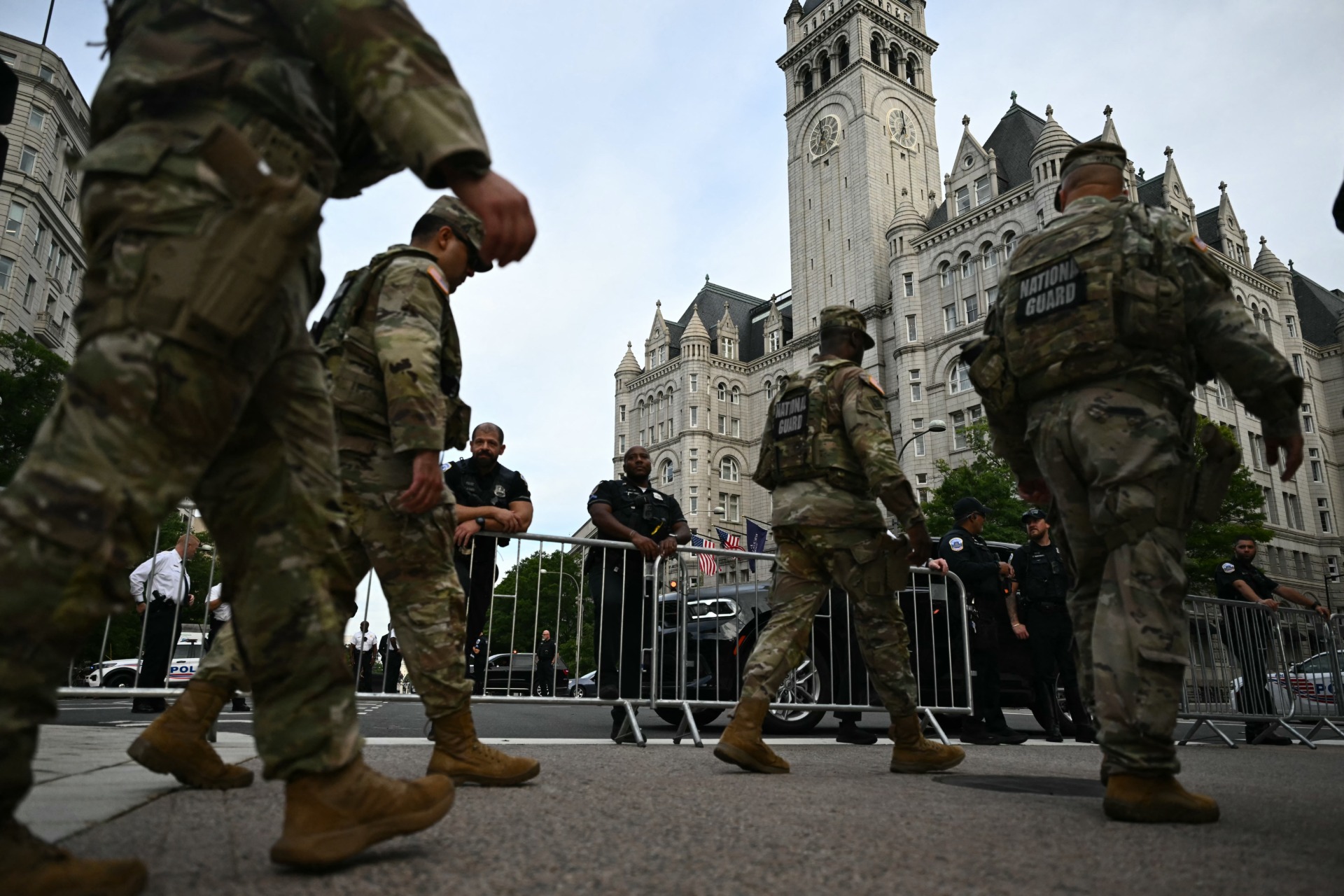
FEATURED IMAGE: US Army National Guard soldiers patrol outside the 2026 White House Correspondents' Association (WHCA) Dinner at the Waldorf Astoria in Washington, DC, on July 24, 2026. (Photo by Kent NISHIMURA / AFP via Getty Images)