The US Army has released stark footage showing preparations to blow up nearly 10,000 pounds of dangerously unstable explosives in Iowa within hours, amid fears of toxic fallout spreading beyond the blast site.
An updated Army map projects a cloud of lead-containing dust drifting southwest into Missouri, potentially carrying particles across state lines in the hours after the explosions.
Two controlled detonations are scheduled to begin at approximately 9am CT Wednesday at the Iowa Army Ammunition Plant near Middletown.
Residents in Middletown and a five-mile cone southwest of the plant have been urged to leave temporarily. People farther southwest, within potentially affected areas up to 20 miles away, have been advised to shelter in place.
Iowa health officials advise those in potentially affected areas to stay indoors with windows and doors closed for 24 to 48 hours afterward, threatening to keep families indoors through Thanksgiving.
The concern extends beyond the passing cloud: lead particles could settle on outdoor surfaces, and Army guidance calls for affected residents to wet-clean children’s play equipment, patios, and other frequently touched areas after officials end the airborne exposure period.
The footage details preparations to destroy 68 drums of degraded lead azide inside earth-covered concrete bunkers surrounded by towering, sand-filled barriers designed to absorb the blast and limit escaping debris and dust.
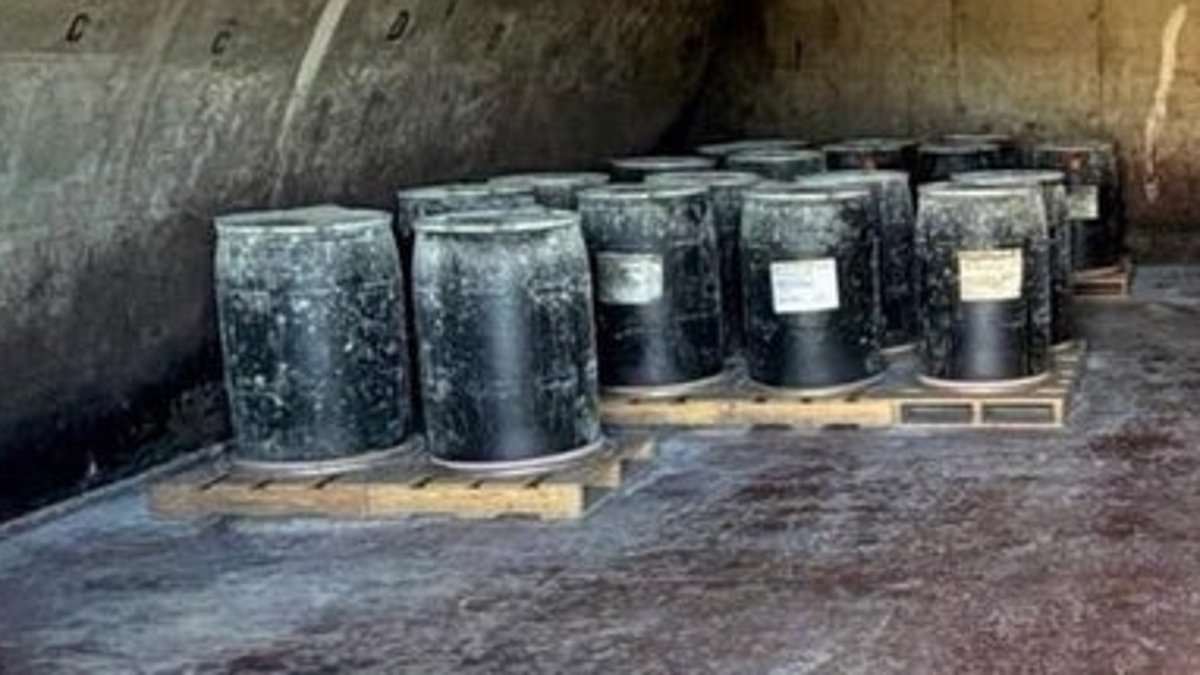
Inside one bunker, more than two dozen barrels stand in rows on wooden pallets beneath an arched concrete ceiling. The black drums line both sides of a central aisle, their lids and sides marked with pale residue. A pallet jack sits near the entrance, while patches of white material cover sections of the floor.
The US Army has released images of the barrels containing explosive material, which are set for detonation Wednesday morning
Inside one bunker, more than two dozen barrels stand in rows on wooden pallets beneath an arched concrete ceiling.
The Army said on Tuesday: 'Deposition of lead-containing dust may occur after the detonation on surfaces within certain areas affected by the detonation’s dispersion.
At sufficient exposure levels, lead can permanently damage children's developing brains, causing learning difficulties, reduced intelligence and behavioral problems, and can also cause miscarriages.
'All people, but especially infants, children, pregnant women, adults and children with chronic diseases such as heart disease, kidney disease, or dementia, should avoid outdoor activities within affected areas until further guidance is provided.'
All residents of Middletown are being urged to leave temporarily, with FEMA offering transportation, meals and hotel accommodation through Friday, covering the Thanksgiving holiday.
The Army said lodging will be provided through Friday, November 27.
Evacuees will be contacted by phone when officials give the all-clear, while those in affected areas outside the evacuation zone are encouraged to shelter indoors.
The Army plans to destroy the explosives inside reinforced concrete bunkers surrounded by sand barriers roughly two stories high.
A ‘water wall,’ gel blocks and water-based foam are designed to contain particles and absorb heat, while misters soak the surrounding soil before and during the detonation to limit airborne lead dust.
The earth-covered concrete bunker holding the explosives is draped in black sheeting and encircled by towering, tiered walls of sand-filled barriers designed to absorb the blast and limit the spread of debris and lead dust
The Army plans to destroy the explosives inside reinforced concrete bunkers surrounded by sand barriers roughly two stories high
Andrew Nelson, director of the Army’s Construction Engineering Research Laboratory, said Tuesday that the fallout map shows areas closest to the site where lead deposits could exceed the clearance limits used for window surfaces inside homes.
A second zone extending miles from the plant shows where deposits could exceed the clearance limits used for household floors.
The Army said in a Wednesday press release: 'The detonation is expected to produce a dust plume containing lead particles that may travel beyond the installation and settle on surrounding surfaces.'
The military's latest model projects that detectable airborne lead could travel from southeastern Iowa into northeastern Missouri within hours, along a corridor extending roughly 100 miles from the blast site.
This is a developing story... More updates to come.