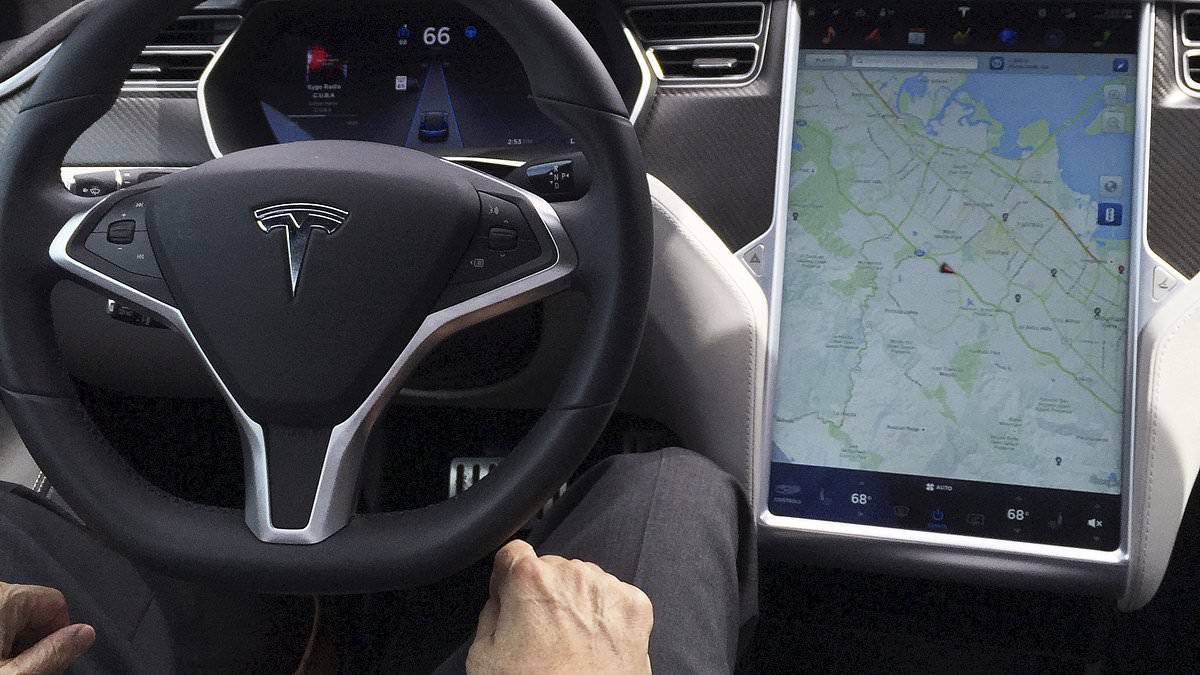
For older Americans worried about losing their independence, the prospect of a car that practically drives itself might sound like a dream come true.
But Tesla's increasingly enthusiastic pitch to older motorists is raising serious safety concerns, with experts warning that its much-hyped technology could leave some seniors dangerously unprepared for emergencies.
The electric carmaker has been promoting its $99-a-month Full Self-Driving (FSD) subscription as a way for older people to stay mobile, even as their eyesight, reflexes and physical abilities deteriorate.
Chief Executive Elon Musk has also thrown his weight behind the idea, declaring in July that 'Tesla self-driving enables safer mobility for senior citizens'.
Tesla has shared videos highlighting how its technology can help older customers, including 93-year-old Lois from San Diego, who has reportedly started taking road trips again.
In a post on X, the company wrote: 'When a 93-year-old woman noticed how tired she was on her daily drives, she started going out less.
'But with FSD Supervised, she's now able to drive herself to appointments, run errands and even take road trips to visit her family on her own.'
However, there is a potentially dangerous catch: despite its name, Tesla's FSD system does not actually drive itself without human supervision.
Tesla has been promoting its $99-a-month Full Self-Driving (FSD) subscription as a way for older people to stay mobile, even as their eyesight, reflexes and physical abilities deteriorate
Drivers are required to remain alert, keep their eyes on the road and be ready to take control immediately if the software makes a mistake, which could be a particularly tall order for older motorists
Drivers are required to remain alert, keep their eyes on the road and be ready to take control immediately if the software makes a mistake, which could be a particularly tall order for older motorists whose reaction times, concentration and vision may already be declining.
Transportation injury attorney Doug Burnetti, founding attorney of Tampa-based Burnetti P.A., told the Daily Mail: 'Even with Full Self-Driving turned on, you still have to watch the road and be ready to hit the brakes or grab the wheel right away.'
He warned that drivers with deteriorating eyesight could face the same difficulties spotting hazards whether they were driving themselves or relying on the software.
'If you're having trouble seeing well enough to drive, you're going to have that same trouble seeing when the car gets something wrong,' he said.
Burnetti added that Tesla needed to be upfront with older customers that, despite the technology's capabilities, they remained responsible for staying alert and taking control when necessary.
Neha Sabharwal, a California-based physical therapist and Director of Rehabilitation specializing in geriatric rehabilitation and neurological recovery, warned that the marketing could encourage some older people to return to driving when they were no longer physically or medically fit to do so.
'If someone has stopped driving because of delayed reaction time, impaired judgment or difficulty processing visual information, automation does not reverse those impairments,' she told the Daily Mail.
Like Burnetti, Sabharwal said the biggest concern was what happened when the technology made a mistake, requiring drivers to recognize a hazard, make a decision and physically intervene, potentially all within seconds.
Tesla has shared videos highlighting how its technology can help older customers, including 93-year-old Lois from San Diego, who has reportedly started taking road trips again
One expert warned that the marketing could encourage older people unfit to drive to get back behind the wheel
'A car that can do most of the driving is not necessarily a safer car for someone who cannot reliably take over when needed,' she added.
The concerns are not purely hypothetical, either, with Tesla reporting almost 2,400 crashes involving its advanced driver-assistance systems since June 2025.
At least one person died in 24 of those collisions, although the National Highway Traffic Safety Administration was given unknown injury-severity information in almost 2,300 cases.
The figures do not identify the ages of the drivers involved, and there are no comprehensive statistics showing how many older motorists have crashed while using automated-driving technology.
But several recent fatal incidents have raised uncomfortable questions about the risks.
In May, an 87-year-old Florida man died after his Model Y left the road, struck an electrical box and plunged into a pond while Autopilot was engaged.
Two months later, an 89-year-old California man was killed after his Tesla reportedly ran a red light and crashed into a light pole, with a driver-assistance system believed to have been active.
Tesla did not respond to requests for comment.
The company also has a significant financial incentive to expand its appeal among older motorists, with around 1.7 million vehicles having activated FSD.
Analyst Gene Munster of Deepwater Asset Management estimates that aging consumers could account for approximately 50,000 Tesla deliveries annually, making the demographic an attractive market.
Online reactions have been divided, with some Reddit users describing the marketing as irresponsible while others point out how desperately families want alternatives to taking away elderly relatives' car keys.
One commenter argued that genuinely autonomous vehicles could eventually transform senior mobility, but pretending today's technology has already reached that point risks giving vulnerable drivers a false sense of security.
For now, experts say the message is straightforward: if someone is no longer safe driving a conventional car, a system that still requires them to take control at a moment's notice may not be the answer.