Recent information has come to light about the extent of the United States’ control over the Venezuelan government. Public finances and revenues, exploitation of natural resources, law-enforcement operations, government appointments and foreign policy, even public statements by high-ranking officials: all allegedly subject to the approval, supervision, instruction, or close coordination from Washington. The details suggest that U.S. authority has severely curtailed Venezuela’s ability to exercise its own sovereign powers. According to reporting, U.S. officials have set conditions on what and by whom public revenues can be spent, weighed in on who would become the new defense minister, and encouraged the purging of perceived opposition from government ranks. In a recent development, the United States announced it was taking direct control of a substantial fraction of Venezuela’s proven oil reserves.
Following the U.S. capture of Venezuelan leader Nicolás Maduro via military intervention in January 2026, subsequent intentions were unambivalent: “run” Venezuela until “a safe, proper and judicious [power] transition,” combined with open threats that interim leader Delcy Rodríguez would pay a price “bigger than Maduro” unless she did “what’s right.” The desired effect followed immediately: a compliant Venezuelan government, repeatedly praised by Donald Trump as a model to follow. While Delcy Rodríguez has vocally chastised the notion of U.S. control, her government’s actions have been remarkably supportive of American policy goals.
Venezuela is far from the only state in the U.S. expansionist orbit; following the Venezuelan action, the U.S. threatened Cuba with a “friendly takeover” and launched a months-long military campaign against Iran, initially expressing its aim to topple the current regime and be directly “involved” in the selection of new leadership. Preceding all these events, the U.S. administration repeatedly mused about taking over Greenland, Canada, the Panama Canal, and threatened military operations against Colombia.
Neither is the United States unique in its intentions. When Russia commenced its full-scale invasion of Ukraine over four years ago, misguidedly intent on finishing it within a few days, Vladimir Putin protested that it was not Russia’s “plan to occupy the Ukrainian territory.” The plan seemed rather to swiftly behead Ukraine’s political leadership by ousting or killing President Volodymyr Zelenskyy and install a pro-Russian puppet figure.
Using targeted armed force to ensure favorable regime change is far from a novel tactic. Yet, beyond observations on how such neocolonial practices violate sovereignty lies an uncharted legal issue. Typically, we tend to think of proxy occupation under international humanitarian law (IHL) as involving a foreign power exercising authority and control through a non-state actor (think, e.g., of Serbia’s occupation of Bosnia through ethnic Serb armed groups in the 1990s). But is it possible that proxy occupation may occur through a foreign power exerting control over a previously legitimate local government? Not insurgents capturing a chunk of sovereign land, nor rebels orchestrating a coup upon foreign instructions, but yesterday’s government turned into a foreign agent?
The Framework of Proxy Occupation
In defining what proxy occupation is, it is first essential to establish what it is not. Occupation is a legal term representing a specific situation during an interstate armed conflict, i.e., a resort to armed force (Tadić, §70), in which a foreign state’s armed forces are present without consent and establishes effective control over a territory in lieu of its local government (see here, here, and here in §172-173). This may occur regardless of whether there is any armed resistance, given that occupation focuses unilaterally on the physical intervention of a hostile foreign military (2025 ICRC, §358). Hence, a foreign power exerting control through coercive acts falling short of using actual military force – say via corruption, blackmail, or even threats of force – immediately falls outside the definition. Such conduct may constitute a prohibited form of intervention, but would not rise to the level of belligerent occupation (e.g., as a matter of law Russia’s influence over Belarus is most appropriately considered an intervention, not an occupation). For a puppet regime’s imposition to constitute occupation, it must occur pursuant to armed force.
However, the degree of causality required between utilizing force and subordinating a foreign government may not be as straightforward as it seems, as vividly exemplified by the invasion of Venezuela. The U.S. exertion of military force certainly catalyzed government change, but is that nexus sufficient to give rise to occupation under international law? A restricted view may suggest that, by the time the United States asserted control over the Venezuelan government, military operations had effectively ceased, separating these events temporally and materially. In other words, the termination of force meant subsequent meddling was simply prohibited intervention outside of IHL’s ambit. A broader view would hold that the initial armed force was indispensably linked to establishing a subordinate regime, triggering a protracted application of IHL that opens the door to qualification as occupation. Whichever view prevails is largely context-dependent, relying upon whether facts show an undeniable link from employing armed force to the establishment of a pliable regime.
But establishing occupation demands more than just a causal link to armed force. The classic three-part test for any belligerent occupation requires: (i) physical presence of troops on foreign territory without the consent of the local government at the time of the invasion; (ii) local government’s substantial or complete inability to exert its powers over such territory; and (iii) foreign forces’ ability to exercise such authority in lieu of the local government (2025 ICRC, §375). Proxy occupation slightly modulates this framework. While physically absent on the ground, the occupying power must exercise overall control over de facto local authorities who, in turn, exercise effective control over the territory via the aforementioned three-part test (2025 ICRC, §400).
If a foreign state marches into another with a significant contingent of ground forces, takes control of territory, and subsequently installs a puppet government, this undoubtedly constitutes direct occupation. The foreign state may continue to bear obligations under the law of occupation even following troop withdrawal, so long as the foreign state continues to exercise key elements of authority (Occupied Palestinian Territory, §92). But what of cases where military engagement is too fleeting to clearly establish occupational authority (e.g., a targeted raid) or, even more, takes place without actually putting boots on foreign territory (e.g., via airstrikes only)? Technological advancements have increasingly made this type of force projection possible. Where such armed force aims to place a subservient government on the proverbial throne, can it plausibly be classified as a form of proxy occupation?
Place for Remotely Installed Puppet Governments?
IHL does not explicitly restrict proxy occupation to situations involving non-state actors; the fundamental basis for its recognition is to prevent a state from “making use of local surrogates to evade its responsibilities” (2025 ICRC, §403). It necessarily relates to any case where a foreign force pulls the strings of occupation through another authority, regardless of its form. The law must necessarily leave space for a scenario, however atypical, in which proxy occupation is exercised through a puppet government exerting power over a state’s territory.
But even without clear prohibition, can the aforementioned three-part occupation test realistically accommodate a situation where the proxy is a newly installed puppet state authority?
In assessing the requisite transfer of powers over territory to so-called “foreign forces,” the last two criteria of the test utilize the “government in place at the time of the invasion” as a reference point (2025 ICRC, §375). There is little incoherence in replacing “foreign forces” with “puppet government.” It is well known that occupation may occur where some or even most normal government functions are left to those who previously ran the state, provided they remain subject to the foreign power’s paramount authority (Dinstein, §188). Occupation is predicated upon the substantial removal of the pre-invasion state’s authority – the loss of effective control over territory to another state (2025 ICRC, §358, 373). Whether occupation is established depends on a qualitative evaluation of actual foreign authority over territory. A puppet government’s qualification as a “foreign force” that has in essence displaced the local government at the time of the invasion will thus depend on whether the degree of control exercised by a foreign state has rendered the new government in place after the invasion “substantially or completely incapable of exerting its powers” independently. In some cases, a so-called puppet government might retain enough independence in security and foreign policy to deny this threshold, while in others its loss of independence will be substantial enough to amount to full subjugation.
The requirement that “foreign” armed forces be physically present on the territory without the valid consent of the territorial state forms another conceptual hurdle where, as in the context of Venezuela following the U.S. capture of Maduro, no foreign troops remain and the territory is held by Venezuela’s own armed forces. This entails framing the state’s own armed forces, assuming they are now beholden to a puppet government, as occupying forces. Orthodox IHL practitioners may bristle at this thought, but it does have a logical basis. IHL is averse to loopholes allowing occupiers to escape responsibility for usurping effective control (ICRC Expert Meeting 19). Proxy occupation can answer this by examining whether overall control over these armed forces is attributable to the foreign state. Securing subservience of a puppet government through military force could, by extension, make the defeated armed forces also subservient to a foreign power, approximating them to the “de facto agents of another state” covered by proxy occupation (ICRC Expert Meeting 23).
Any alleged consent obtained from the pre-invasion local government is invalid if obtained through threats or use of force (Sassòli, §30). Alternatively, acceptance of subordination by a successor puppet government installed through force constitutes little more than false “engineered consent,” turning local authorities and armed forces into the implementing tools of occupation (e.g., the Slovak Republic under Nazi Germany’s controlling influence from 1939 to 1944).
A further question goes to the degree of the intervening state’s influence necessary to demonstrate overall control over a puppet regime. When a post-hostilities government is installed, it is the level of control exercised by the foreign state that will determine its proxy status. Where this regime lacks any real ability to override the foreign state’s authorizations, overall control will undoubtedly be established (Grignon 1595). In less obvious cases, overall control’s indicators go beyond mere financial, operational, and logistical support to the proxy; the foreign state must also be involved in the direction, coordination of or assistance in general planning of activities. These indicators, to a varying degree, could be demonstrated via the sharing of common goals and policy coordination, the approval of or involvement in appointment of proxy officials, influence over quashing disagreement, etc. (Tadić, §131; Blaškić, §102-122; Prlić, §545-568). Overall control may be established even if a proxy has “autonomous choices of means and tactics although participating in a common strategy along with the ‘controlling state’” (Čelebići, §47).
IHL’s classic overall control test typically links these forms of foreign support to military operations – natural for insurgent scenarios but meaningless when a proxy controls an entire state’s territory without facing armed resistance. In such a case, the expression of overall control may take on different flavors. IHL readily accepts a scenario when an occupier shares authority with the local government instead of solely assuming the full spectrum of powers (2025 ICRC, fn. 180). Controlling decisions over a puppet regime’s composition, interior and foreign policies, and public revenues seem very consistent with the spirit and threshold of overall control.
There is insufficient information in the public domain to, as yet, assess the degree to which the United States may have actually met these legal thresholds in the context of Venezuela. But, particularly as more information becomes known (whether publicly or otherwise), the issues outlined would constitute key legal questions to probe in determining whether the United States may have in fact become an occupier by proxy in the case of Venezuela.
Conclusion
The focus of occupation must necessarily lie in “the extent of authority retained by the foreign forces rather than […] the means by which it is actually exercised” (2025 ICRC, §380). As asymmetric warfare and long-distance kinetic military technologies proliferate, so do abilities to effect control through captive puppet governments. This may seek to cloak actions with a clumsy veil of legitimacy, but in practice remains not dissimilar from weaponizing an armed group to do the same.
Only the surface remains scratched here, as critical questions remain about whether the higher threshold of “effective control” over a proxy is demanded for actually imputing state responsibility (Bosnian Genocide, §398-407). A debate lingers as to whether the “overall control” test used in this analysis is solely limited to determining applicable rules of IHL and the “effective control” test should serve the different legal function of establishing a state’s responsibility for a wrongful act (Cassese 662-665). There are also considerations as to whether variable levels of control over a puppet government demands a functional approach modulating the extent of obligations imposed onto the foreign occupier.
As outlined above, not all situations of puppet governments supported by intervening states will constitute proxy occupation. The simple meddling of foreign patrons is not enough; the decisive dividing line would only be crossed where armed force is used in setting up this government and where the level of its subjugation approximates a substantial inability to independently exercise its authority over its own territory.
At baseline, it seems increasingly difficult to deny that the use of sporadic or remote armed force to establish the requisite level of control over a state through a puppet government, even if its composition largely mirrors its predecessor, could arguably constitute occupation by proxy. So perhaps best to end on a note of caution. Interventionists worldwide beware; the law of occupation may not be as inclined to bend the knee as the pliable proxy government you just installed.
Inspiration for the idea behind the publication and research assistance by Anastasiia Menshykova is duly acknowledged.
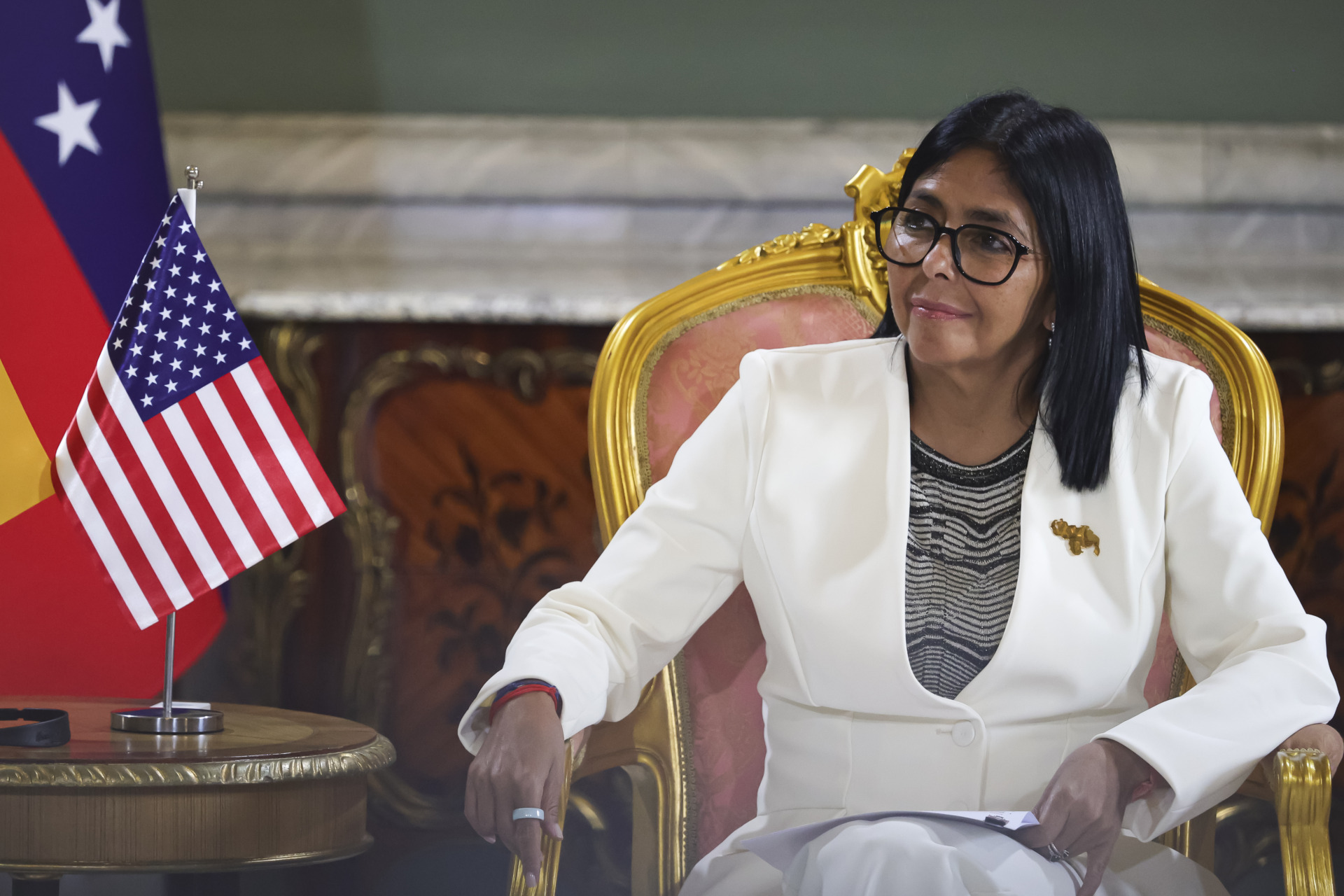
FEATURED IMAGE: Venezuela's interim president Delcy Rodríguez looks on during a press conference regarding the oil agreement reached by the US government and Venezuela on September 2, 2026 in Caracas, Venezuela (Photo by Jesus Vargas/Getty Images)