A diver spotted a flash of orange and purple at 20 meters down. Scientists can't agree on what she found. Meet the Lundy mystery →Some sea slugs turn their prey's weapons into their own. How? See how aeolids steal weapons →One rival theory could explain away the creature's vivid color and tiny size. Does it hold up? Weigh the color variant theory →Scientists need ordinary divers to help settle this novel nudibranch mystery. Here's how you could join in. Submit your iNaturalist photos →
Off the coast of England’s North Devon sits Lundy, a granite island known for its remarkable biodiversity. Over the years, the island has been recognized as nationally important for the United Kingdom’s wildlife. Designated a Site of Special Scientific Interest, Lundy stands as the UK’s first statutory Marine Nature Reserve and was later declared a Marine Conservation Zone in 2010. In its waters you’ll find everything from Atlantic grey seals and basking sharks to corals like red sea fingers and pink sea fans. In 2026, a diver named Maggs Ashton discovered something incredible: a potentially new nudibranch species.
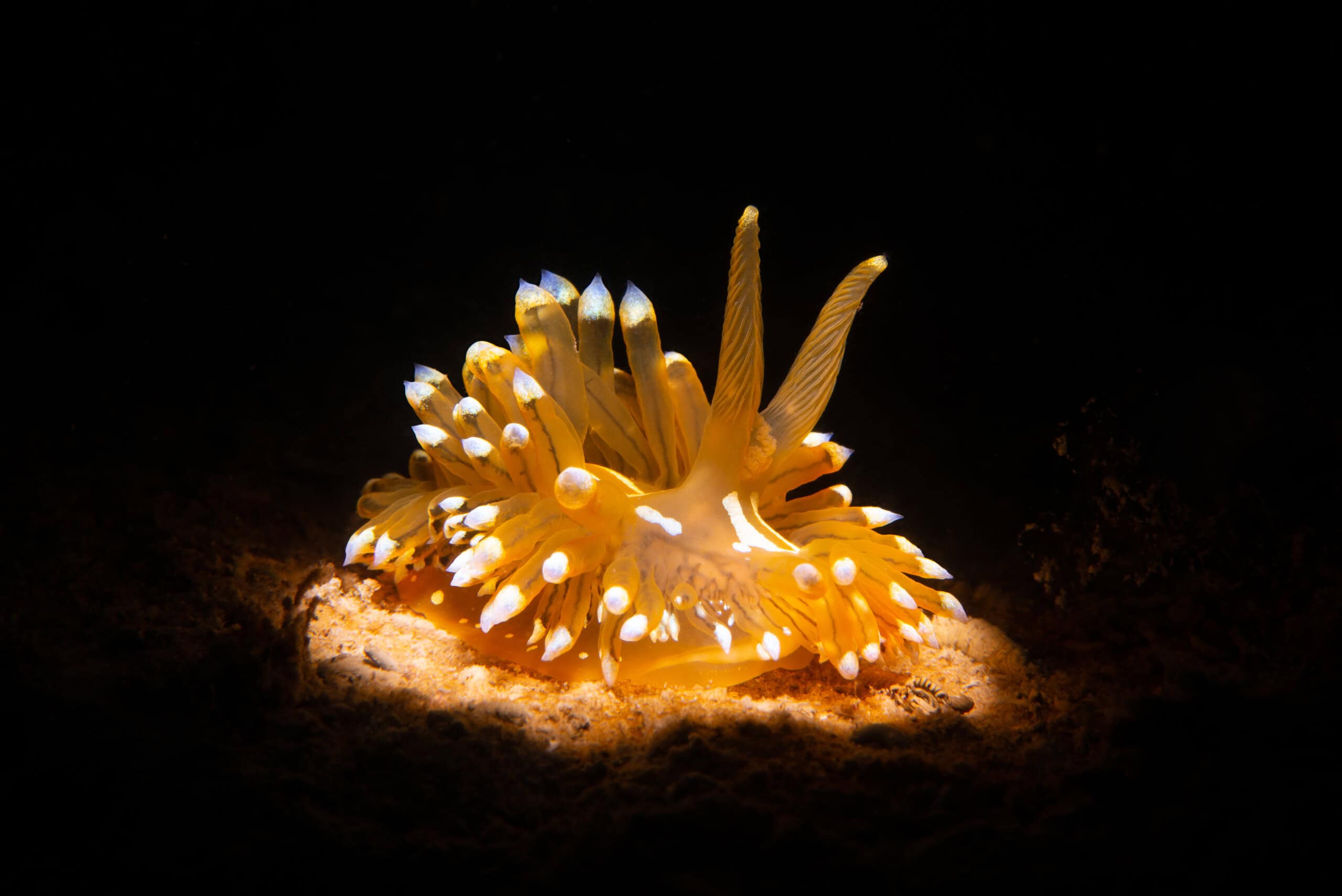
Ashton was diving when she noticed a pop of orange and purple. Upon closer inspection, she noticed a stunningly colored sea slug, approximately 20 meters (about 66 feet) under the water. Since then, some scientists have shared their belief that the nudibranch is an undiscovered species, while others believe it closely matches an existing species. So, what do we know about this creature so far?
What is a Nudibranch?
Nudibranchs are soft-bodied marine mollusks belonging to the class Gastropoda. Unlike other gastropods, such as snails, nudibranchs have a significantly reduced external shell or lack one entirely. Two main nudibranch groups exist: aeolid nudibranchs and dorid nudibranchs. Aeolid nudibranchs have plumes or appendages known as cerata, which help them breathe. Dorid nudibranchs are relatively smooth, with feather-like gills for respiration near the end of their backs.
There are over 3,000 nudibranch species worldwide, and their differences abound. Nudibranchs find their homes in cold, warm, shallow, or deep water. Some might deploy camouflaging techniques to blend into their surroundings and protect themselves against predators. Others, like the Spanish shawl nudibranch, are vivid in color. Nudibranchs may range in color from red, blue, and orange to fuchsia and yellow.
The Spanish shawl nudibranch uses its coloration to signal to predators that it might not be safe to eat.
©worldswildlifewonders/Shutterstock.com
Nudibranchs have a varied diet. Depending on where they live, they might eat seaweed, anemones, coral, bryozoans, fish eggs, barnacles, and even other sea slugs. Interestingly, aeolid nudibranchs are immune to the stinging cells (nematocysts) of anemones and other cnidarians like jellyfish. If an aeolid nudibranch eats an anemone or other cnidarian, it can move those nematocysts into the cerata. As a result, the nudibranch can sting predators if necessary.
The Lundy Nudibranch: New or Not?
It’s a wonder that Ashton ever spotted the tiny nudibranch in Lundy’s waters, given that it is just 15 millimeters long (approx. 1.5 cm or 0.59 inches). But she did, and the photo she snapped quickly became the talk of the marine science community.
Experts disagree on whether this is a new species. Bernard Picton, a marine naturalist and former curator of marine invertebrates at National Museums of Northern Ireland, has stated he believes the Lundy nudibranch to be a previously undescribed species from the genus Lomanotus. Lomanotus nudibranchs tend to have elongated bodies with frills or flaps. While some are less flashy in color, there are known Lomanotus species whose red and yellow shades really stand out.
However, other scientists, such as those from the UK Archive for Marine Species and Habitats Data (DASSH) believe that the nudibranch Ashton found could be a color variation of Antiopella cristata, sometimes called the crested aeolis or crystal sea slug. Antiopella cristata has already been observed around Lundy, as well as many other areas in the Atlantic Ocean and Mediterranean Sea.
Admittedly, the nudibranch photographed by Ashton is both smaller and more vibrantly colored than Antiopella cristata. However, given that juvenile Antiopella cristata can be as small as 4 millimeters long, there’s nothing to conclusively prove that the “new” Lundy nudibranch doesn’t fit that designation.
For the time being, there’s no determination yet as to whether the nudibranch is a new species or one we already know. That’s why DASSH is asking anyone who spends time around Lundy and spots the nudibranch to take a photo and submit it through the iNaturalist app for review. If you’ve ever wanted to contribute to a scientific discovery, this could be your chance!
About the Author
Jessica Lynn
Jessica Lynn is a writer at A-Z-Animals.com, where her primary focus is sharks, reptiles, and insects. Jessica has been writing for over 10 years and holds a Bachelor's degree in English from Virginia Commonwealth University, which she earned in 2014.
A resident of North Carolina, Jessica enjoys beachcombing for unique shark teeth, spending time on the water with her kayak, or relaxing at home with her cat.
Thank you for reading! Have some feedback for us?
Thank you for your feedback!
We appreciate your help in improving our content.
Our editorial team will review your suggestions and make any necessary updates.
There was an error submitting your feedback. Please try again.