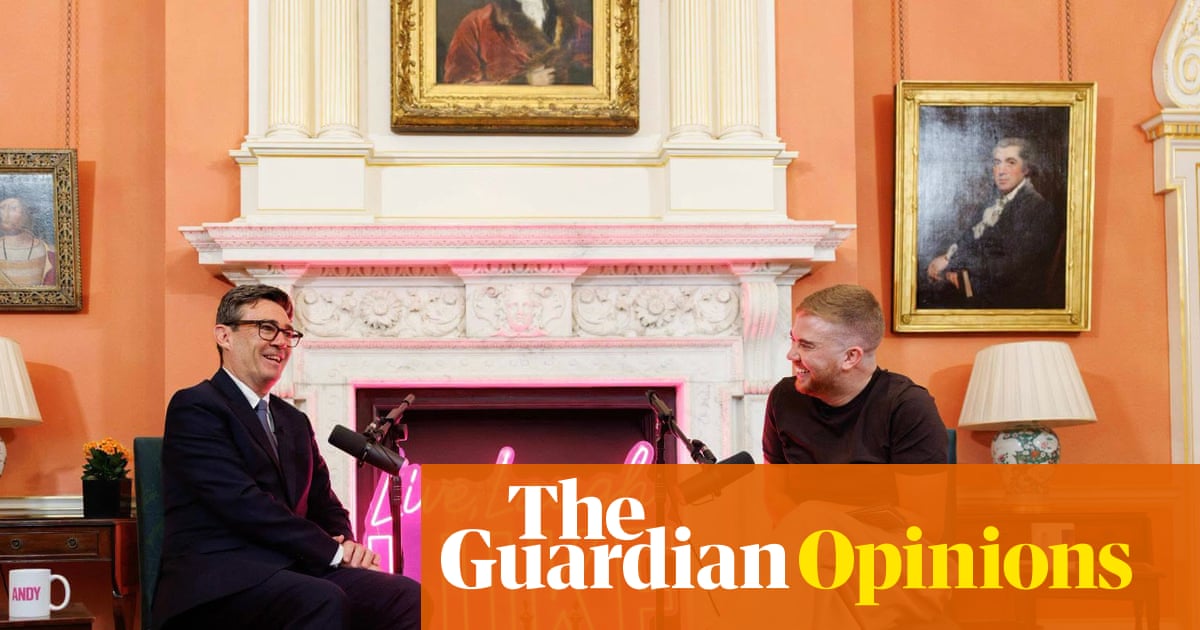
These are dangerous times to be a prime minister. So it is perhaps reassuring that the trouble into which Andy Burnham barrelled this week is so old school as to be almost soothing. Four months into his premiership, Burnham has arrived early at that rite of passage: the catastrophic attempt to engage with popular culture and subsequent category-5 storm in a teacup. After footage emerged of Influencers Behaving Badly at Downing Street, Burnham, in my view, has come out of the whole thing in surprisingly good shape.
To recap: earlier this month, Burnham held a reception for social media influencers, one of whom, Luke Hamnett, was permitted to film himself doing the Hugh Grant dance from Love Actually before sitting down to interview the prime minister. Meanwhile, self-described “presenter, podcaster, idiot” Max Balegde filmed himself outside the door of No 10 miming what, in the words of the Daily Mail as it geared up to go the full Judge Pickles, “appeared to be a viral meme song”. These words were “bomboclaat pussywagon chicken nuggets”, which, as the Telegraph took a breath from its own meltdown to explain, turns on “a Jamaican profanity popularised online”.
If you can absorb any of these details without laughing like a drain, you are a more serious person than me. But in any case, it isn’t the content so much as what the influencers represent that has launched Burnham’s opponents into orbit. I’m not familiar with the line “bomboclaat pussywagon chicken nuggets”, but for those of us with young children, it is instantly recognisable as the latest contribution to the “skibidi toilet” meme tradition of conjoining rude words a 10-year-old would find funny and putting them on endless repeat. This would be more embarrassing for Burnham were it not for one fact: between them, Balegde and Hamnett have more than six million followers across Instagram and TikTok, substantially more than the Daily Telegraph. We can be confident the average age of those followers is not 61.
Data as provoking as this obviously calls for a full-throated overreaction, and Kemi Badenoch didn’t disappoint. On Tuesday, the Tory leader requested an apology from the prime minister for turning No 10 into “his personal studio to carry out these silly TikToks”. All right, grandma! She went on to point out that, assuming Vladimir Putin and Xi Jinping had watched these videos, enemies of the UK would “see that our prime minister is not a serious man and they will think we are not a serious country”. I have to say this was my favourite part of the whole saga, evoking as it did the tail lights of a ship that sailed decades ago when we elected a former head of communications at Carlton TV, David Cameron, followed by fake model-bus enthusiast Boris Johnson and highly perishable Liz Truss to the top job in this very serious nation. Good one, Kemi!
Meanwhile, Burnham himself had to put a certain amount of damage limitation into place. While it stopped short of an apology, it did involve a spokesperson calling the Balegde video “clearly not acceptable” and it being removed from the influencer’s account. And just when you thought it couldn’t get any better, up popped Nigel Farage with what read to me like a very ambivalent condemnation, indicating that he too – and it pains me to say this, since it plays in his favour – had found the whole thing hilarious. “I wouldn’t let them behave quite the way that it happened,” he said when asked if, were he prime minister, he’d invite influencers to Downing Street. “It showed a slight lack of respect for the place and for the office and was really very inappropriate indeed.” Lot of qualifiers in that statement, Nigel; we can hear you laughing from here.
Michael Crawford, as Frank Spencer, goes rollerskating in Some Mothers Do ’Ave ’Em.
For the rest of us, I suspect Influencergate has provided a brief, luminous break from real news. If it has a vibe of Michael Crawford on runaway skates flying down a hill – to cite a reference followers of Hamnett and Balegde probably won’t get – there is also a serious part: it’s entirely sensible for Burnham to court influencers in an effort to engage young people in politics. As a cautionary tale, we might look to the US and the disastrous decision made by Kamala Harris during the last presidential election not to appear on Joe Rogan’s podcast and talk to parts of the country old media can’t reach.
In Burnham’s case, the charge isn’t that he sucked up to political enemies, but rather that he engaged in a puff piece at the expense of more robust political interviews. (Hamnett opened the encounter with the remark: “I’m so proud you’re prime minister”, and it got friendlier from there.) And yet there’s no indication the prime minister will stop talking to higher-end hacks and, for my money, he has come out on top – partly for the sheer entertainment value of watching the Tories try to grab the moral high ground and partly because of a quality in Burnham himself.
At the top of Hamnett’s interview, with a bloody great neon sign advertising his podcast jammed into the Downing Street fireplace and the influencer sitting there in slacks, (Prada!) trainers and a daffy look, you can see something happening in Burnham’s expression. It advances, slowly, from affable, to sheepish, to what looks to me like an “oh, God” moment when he understands there’s a good chance all this nonsense will go south. Ironically, it’s the thing politicians dream of; an instant in which the audience, with a smile, thinks we can all relate to that.
skip past newsletter promotion
after newsletter promotion
Emma Brockes is a Guardian columnist