AI-generated songs are flooding streaming services, threatening to drown out human artists. But now, one major platform is fighting back with an industry-first crackdown.
Tidal, the platform partially owned by Jay-Z, is preparing to purge millions of songs it identifies as entirely AI-generated in one of the music industry's most aggressive moves yet against artificial intelligence.
The crackdown will begin on December 9, with the company pledging to remove the offending tracks from its catalogue by the start of the new year.
The move comes after an astonishing surge in AI-created music, with Tidal revealing that 43 percent of tracks distributed to it over the past 90 days were identified as entirely machine-generated.
Robert Andersen, Tidal's lead at parent company Block, said the existing measures were no longer enough to tackle the problem.
Writing on X on Tuesday, he revealed that 96 percent of AI-generated songs had received not a single stream in the previous three months.
'Something more drastic needs to be done,' Andersen wrote, announcing that the platform would begin removing every track it determined was 100 percent AI-generated.
He estimated that the crackdown would affect millions of songs and see Tidal reject between 80,000 and 85,000 tracks every day.
Tidal, which is partially owned by Jay-Z, is preparing to remove millions of songs it identifies as being entirely computer-generated, in one of the toughest crackdowns on artificial intelligence by a major music streaming service
A few months ago, @Tidal tagged and demonetized all wholly AI-generated tracks to protect the authenticity of real artists. But that’s enough, as 43% of tracks distributed to us in the last 90 days have been detected as AI-generated. Something more drastic needs to be done…
— rsa (@rsa) November 24, 2026
The company also said that 27 million songs in its catalogue, representing around 6.3 percent of its total, had been tagged as entirely AI-generated.
In one particularly striking example, 60 percent of the songs uploaded to Tidal on November 6 were identified as being completely made by AI.
Despite the staggering volume, the vast majority appear to be finding little appetite among listeners.
Tidal said it had also removed 65,000 tracks suspected of impersonating real artists, a growing problem in which AI-generated songs can be uploaded under the names of established musicians.
The company argues that such tracks risk diverting streams and royalties away from genuine performers while making it harder for fans to discover the music they actually want to hear.
Under the new rules, music made entirely using AI tools will be rejected, although tracks created with some AI assistance will still be permitted.
However, Tidal has indicated that it could eventually widen its crackdown to include music it considers substantially AI-generated, raising questions about where the line will be drawn.
Andersen urged other streaming services to follow its lead, as the industry grapples with an avalanche of computer-created content. Spotify and Apple Music have so far opted for a different approach, allowing AI-generated music while introducing measures to identify and label it.
Spotify said in October that it had removed more than 50 million tracks it classified as AI-generated 'slop and spam' from users' recommendations this year.
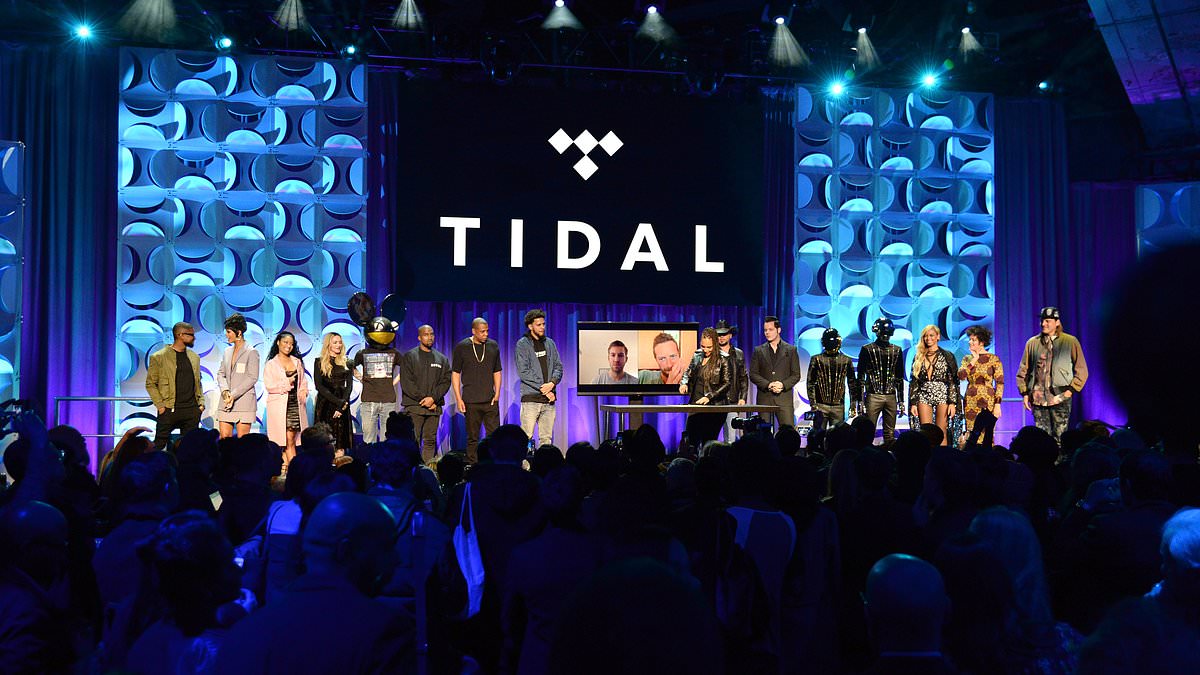
Usher, Rihanna, Nicki Minaj, Madonna, Deadmau5, Kanye West, JAY Z, and J. Cole onstage at the Tidal launch event
Rapper Jay-Z acquired Aspiro, the Swedish company behind the streaming service, for a reported $56 million in 2015, before relaunching Tidal as an artist-owned platform
Separately, the company has reported removing more than 75 million 'spammy tracks' from its platform altogether for serious or repeated violations of its rules.
Bandcamp has also taken a tougher stance, announcing a ban on music generated wholly or substantially using AI earlier this year.
The debate has sparked plenty of discussion online, with many music fans welcoming Tidal's decision as a way to protect human creativity from being drowned out by an endless stream of machine-made material.
One Reddit user compared the flood of AI content to the 1980s video game crash, when an overwhelming supply of low-quality games threatened to overwhelm the industry.
Another suggested that online platforms needed something similar to an 'organic' certification for music, allowing listeners to distinguish human-created work from AI productions.
Others warned that the sheer volume of computer-generated material was making it increasingly difficult to find original content, with one commenter arguing that curated collections were needed more than ever.
However, the policy also raises tricky questions for musicians who use AI as just one part of their creative process, rather than relying on it to produce an entire song.
For now, Tidal appears determined to put human artistry first, insisting that musicians should be able to share their work without having it buried beneath tracks nobody asked for.
Tidal revealed that 43 percent of tracks distributed to it over the past 90 days were identified as entirely machine-generated
Tidal is headquartered in New York and has built its reputation on high-quality audio streaming and a focus on supporting musicians
The company was originally launched in Scandinavia in 2010 under the name WiMP, before expanding into the US and UK as Tidal in 2014.
Rapper Jay-Z acquired Aspiro, the Swedish company behind the streaming service, for a reported $56 million in 2015, before relaunching Tidal as an artist-owned platform alongside high-profile musicians including Beyonce, Rihanna, Madonna and Alicia Keys.
In 2021, payments giant Square, now known as Block, agreed to pay $297 million for a majority stake in Tidal, with Jay-Z joining its board and other artist shareholders retaining their stakes.
Tidal is headquartered in New York and has built its reputation on high-quality audio streaming and a focus on supporting musicians.
The Daily Mail has contacted the company for comment and is awaiting a response.