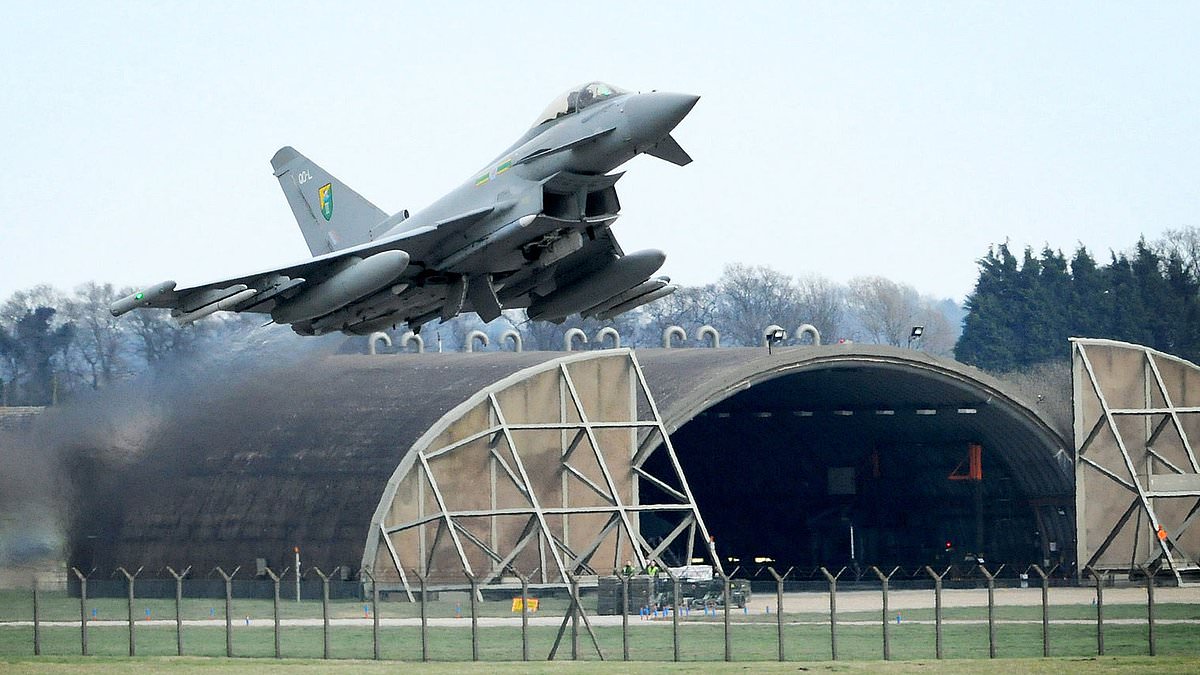
The RAF is moving fighter jets into hardened bunkers overnight to protect them from drone attacks.
The air force is also believed to be looking at plans to install reinforced anti-drone nets around larger warplanes that cannot fit inside the reinforced bunkers.
Similar defences are already used to protect military kit, critical infrastructure and roads in Ukraine from Russian air attack.
The plans, first reported by Sky News, look to bring Britain back to a Cold War footing, when fighter jets were regularly safeguarded inside reinforced shelters.
It comes after a flurry of incidents at British bases in recent weeks, including a suspected Iran-backed plot to attack RAF Fairford, an American airbase.
The threat prompted the Pentagon to evacuate bomber aircraft from the site, in Gloucestershire, and triggered a major security review at other UK bases.
Weeks later, the Americans were forced to evacuate from a second UK airbase, RAF Lakenheath, after reports of unauthorised drone activity.
Air Chief Marshal Sir Harv Smyth, the head of the RAF, this week warned he was now preparing for a scenario where 'there is no sanctuary at home, you are fighting from the UK but you need to get on the move'.
The RAF is moving jets into hardened bunkers overnight to protect them from drone attacks (pictured is a Typhoon fighter jet taking off from RAF Coningsby, with a pictured shelter, rear
The defence chief said the RAF had been 'dispersing' aircraft around the UK while a new runway was built at the Scottish base Prestwick.
'We need to do more of that, this idea of just being as ready as we can with all of the tools that we have optimised for what we think the fight might be,' he told the Freeman Air and Space Institution on Tuesday.
Air Marshal Greg Bagwell, a former deputy commander of the RAF, said the latest defensive measures were needed to protect the nation's fleet of F-35 stealth jets and Typhoon fighter planes.
'If there is an increased threat, whether from sabotage or drones, then all of that makes good sense,' the veteran commander told the Daily Mail.
He added: 'We've known these bases are single points of failure. This is not something that is that new. However, with the state of the world these days you can't be too careful.
'It's good practice. We did it in the 1980s and '90s because that's how we would have fought Russia if they were 100 miles to the east.
'I'm not suggesting we're at that stage now but we are moving back into a more hardened posture... and it's the way we will probably have to fight in the future.'
Downing Street previously insisted British air bases were safe and their security was a 'top priority'.
The measures are being implemented to protect British warplanes from drone attack
RAF Akrotiri, a British airbase in Cyprus, was struck by a suicide drone in March, prompting calls for better air defences to be installed across UK military sites.
Ben Obese-Jecty, a Tory defence spokesman, questioned whether the new defences were enough to protect the RAF's fleet of larger jets, like Voyager refuelling tankers.
'The threat picture has changed and we need to change with it,' he told the Mail. 'We cannot afford to look at this and think that the threat is not very real.
'Even with the defences in place, they can still be penetrated. They had air defences at Akrotiri that were still penetrated.'
MI5 and the Ministry of Defence (MoD) on Tuesday warned British companies building and sending military equipment to Ukraine that they were now at risk of being 'targeted' by Russian saboteurs.
The agencies claim the Kremlin is seeking to use 'proxy actors', such as homegrown criminals, to carry out attacks on its behalf to try and 'undermine support for Ukraine'.
Russian spies could seek to intimidate individuals involved in British defence firms or firebomb facilities in 'low-sophistication' sabotage attacks, according to the National Protective Security Authority which is part of MI5.
The MoD was approached for comment.