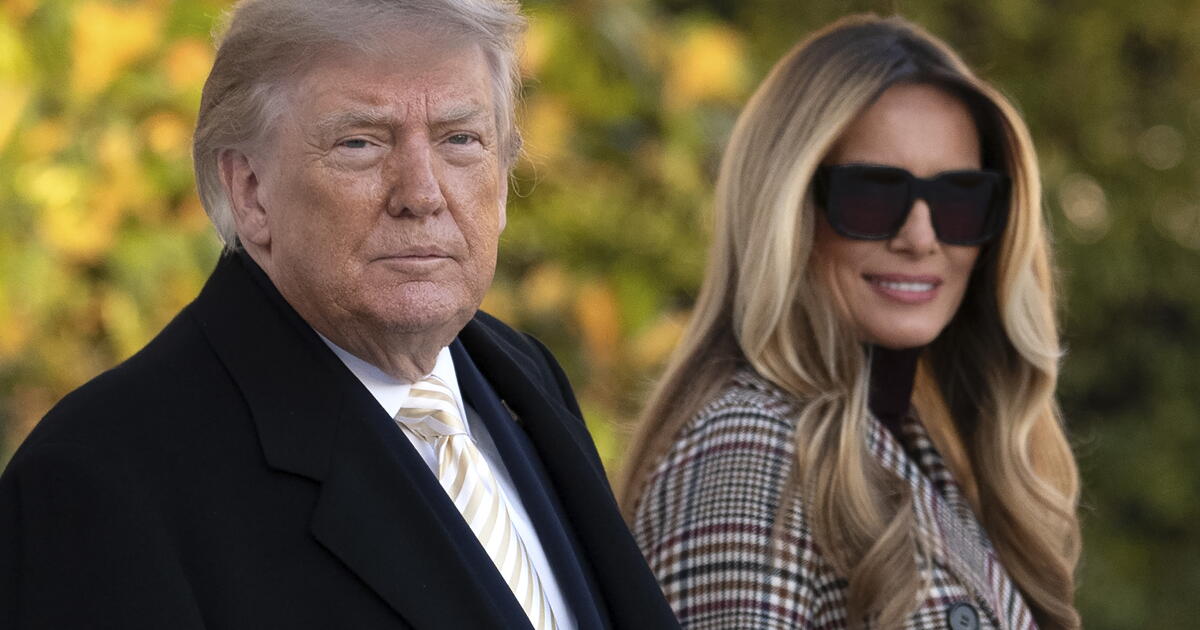
WASHINGTON — In May 2017, just months into his first term, President Trump welcomed Russians into the Oval Office. At that meeting, he disclosed highly classified intelligence collected by Israeli partners that risked compromising a coveted allied source.
He went on in the years to come to resist security protocols around his personal communications, plowing through the clearance process for his close aides and family. He shared classified reconnaissance imagery on Twitter. He removed some of the most sensitive secrets in the U.S. government after leaving office, storing them in a bathroom at Mar-a-Lago, and at an event there openly discussed the whereabouts of U.S. nuclear submarines.
Now, the president is once again under fire for dismissing counterintelligence concerns, this time over a Chinese espionage campaign targeting Nvidia, the world’s largest AI chipmaker and one of the nation’s most valuable companies.
This week, Trump succeeded in persuading Nvidia’s board to reinstate Jensen Huang as its leader, despite his admission to engaging in an affair with an alleged Chinese spy. The president cited the stock market’s reaction to Huang’s firing as one of his leading motivations.
“I would have hoped the president had other tools for stimulating the AI-driven stock market than rewarding Chinese high-tech espionage,” said John D. Woodward Jr., a former CIA officer and senior Defense Department official now at Boston University.
Intelligence officials sounded an alarm last year over the Huang affair, raising concern at the CIA and prompting Marco Rubio, the national security advisor and secretary of state, to issue a warning to Trump. The president requested more information, but chose not to act after a preliminary review failed to identify a smoking gun that Huang had passed valuable information to the mistress, officials said.
Still, intelligence officials told lawmakers this week that Huang’s love interest, named Alice Huang, did in fact pass information to Chinese officials while the affair was ongoing.
Alice Huang had been a top executive at Megaspeed International, a Singapore-based firm accused of purchasing advanced Nvidia chips to then siphon to China, bypassing U.S. export restrictions.
Advanced computer chips are the core of a competition between the United States and China as the dueling superpowers sprint for supremacy in artificial intelligence.
Trump has repeatedly said there is no acceptable alternative to an American victory in that race. But concern has grown across party lines that Trump has grown reticent to confront China over its espionage attempts targeting U.S. companies at the technological frontier.
“Let me get this straight,” Mitt Romney, a former Republican senator from Utah and the 2012 GOP presidential nominee, wrote on social media this week. “We rushed AI along without regulating safeguards in order to stay ahead of China and at the same time, we sold China the very chips they’d need to get ahead of us.”
“Smells of profit, corruption and perhaps worse,” he added.
But Trump has been dismissive of intelligence concerns before.
Throughout his first term, Trump repeatedly rejected the unanimous assessment of U.S. intelligence agencies that Russia had interfered in the 2016 election to help him win. Most notoriously, at a 2018 news conference in Helsinki alongside Vladimir Putin, Trump said he trusted the Russian president’s word over the conclusions of his own intelligence community.
“My people came to me, Dan Coats came to me and some others, they said they think it’s Russia,” Trump said at the time, referring to his director of national intelligence. “I have President Putin — he just said it’s not Russia. I will say this: I don’t see any reason why it would be.”
“So I have great confidence in my intelligence people,” he added, “but I will tell you that President Putin was extremely strong and powerful in his denial today.”
Last spring, on his first of two visits to China this year, Trump told reporters that espionage from Beijing did not concern him.
“They’re talking about the spying. Well, we do it too,” Trump said aboard Air Force One, shortly after White House staff threw burner phones off the plane before takeoff. “We spy like hell on them, too.”
In an interview with CNBC on Monday, Trump said that the Nvidia co-founder and chief executive has been “exonerated” in a preliminary “study” of the episode. Huang did not pose a threat to national security by leading the company, Trump told the board.
“They did ask for assurance on the national security threat, and we gave them assurance, at least with everything we know,” Trump said, “and we know a lot.
“He’s apologized for indiscretion, which was unfortunate,” he added. “That was probably — that’s what brought it to such a level. Because sex sells, fellas!”
More to Read