When the world is falling apart, the artist retreats to the studio. It’s an old story, and Anselm Kiefer has always loved the old stories, drawing for his monumental and reliably blockbuster paintings on narrative traditions ranging from Norse mythology to German Romantic poetry. So it makes sense that an artist who has dedicated his life to the question of what art means after the end of European civilisation – which is to say, after the Holocaust – should now seek out the solitude of the studio to make sense of what’s coming.
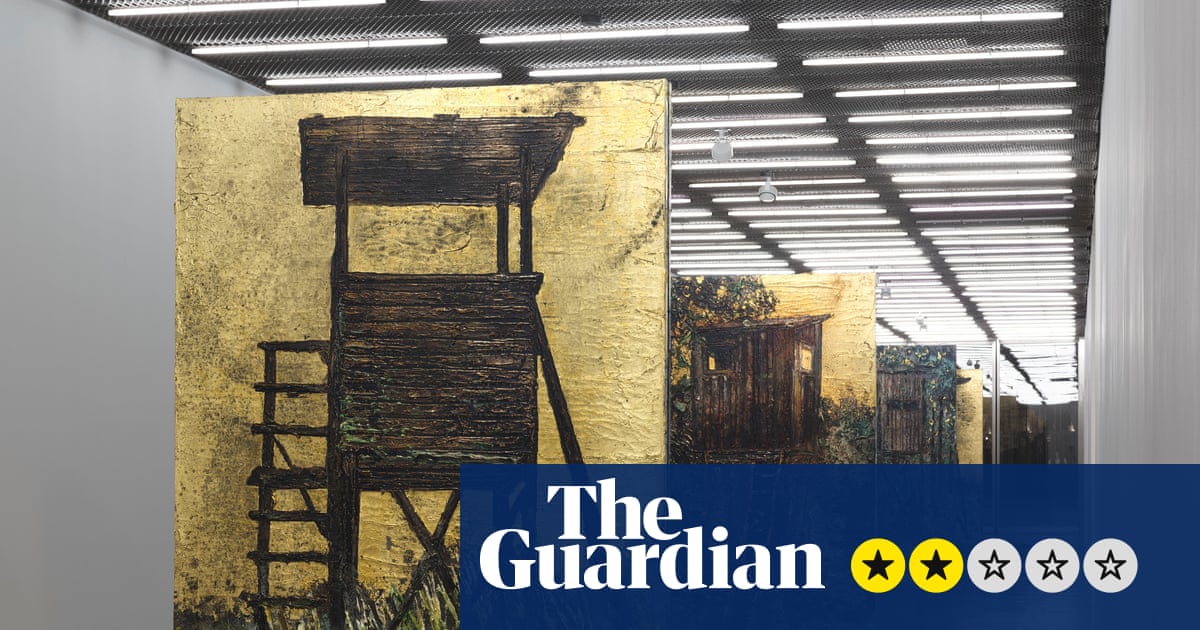
Kiefer’s exhibition at the same gallery a decade ago had the title Walhalla, after the beer hall in the sky in which dead Vikings drink away the afterlife. Now comes the more modest (you would think) subject of the artist’s studio, depicted here in a suite of lustrous landscapes and a simple wooden cabin in the forest. Rendered in flat gold leaf, the sky in these paintings gleams like a tarnished halo in an old altarpiece, while the verdigris grass pushes roughly off the canvas. Here is the place where heaven meets the earth and is transmuted – by the alchemy of this painter’s touch – into quietly numinous paintings containing elements of both.
A vision of communion with nature … Anselm Kiefer, Am Rhein, 2026. Photograph: Theo Christelis/Anselm Kiefer/White Cube
If you can put aside the fact that Kiefer’s own studio is a vast warehouse complex on the outskirts of Paris, these paintings present a very German vision of communion with nature. They also evoke the most famous hut in modern philosophy: the Black Forest hideaway where Martin Heidegger formulated his argument that “authentic” culture must be rooted in the native landscape. The flipside of this idea, that nature is not just a scenic backdrop to human history but a living participant in it, would have, let’s just say, consequences for German painting after 1945. Here is the challenge that Kiefer has spent his career meeting: how to paint the landscape as an unspoilt refuge from society when it is littered with mass graves?
Given that his forests are haunted by these horrors, it is inevitable that a series of paintings of hunters’ lookouts, displayed back to back on trolley wheels, should call to mind camp watchtowers, their high windows like unblinking eyes. And that an eight-metre-tall canvas of a building’s interior collapsing into a bonfire of real charcoal planks (affixed to the canvas and painted with brilliant licks of flame) should imply more than the destruction of an artist’s inventory. Here is a world of fire and ash, burning so that it might be reborn. The dark glamour, the virtuoso handling of the paint and the sheer scale are seductive.
Yet the power of the studio paintings derives more from their marvellous combination of colours and textures than their symbolism. For a hermetic artist, who magpies from esoteric theories as scattered as alchemy, string theory and Kabbalah in a search for hidden correspondences that can sometimes manifest as a generalised profundity, this focus on a subject qualifies as restraint. I was wondering whether this might even herald a new and (relatively) pared-back late style when I came to a painting of a naked man resembling the artist lying in a blasted landscape, learning from the handout that it was titled (in Latin, no less) On the Third Day He Rose Again, and thought: aha. Faint hope.
Heady stuff … Anselm Kiefer, Pietà, 2026. Photograph: Theo Christelis/Anselm Kiefer/White Cube
It is not surprising that an octogenarian artist’s thoughts should turn to mortality, and everyone must make their own private sense of that approaching horizon. It’s your funeral, as they say. But the enormous paintings that end this show – featuring solitary men staring morosely into pits, lying in open graves, and being miraculously resurrected – link the archetypal figure of the artist to the martyrdom of Christ and the genocides of the 20th century. Even for someone as indifferent to appearing pretentious as Kiefer, this is heady stuff.
In fairness, the idea that the death of the artist might redeem humanity is – I think – intended as bleakly ironic: one man gazing blankly into what could be a mass grave is identified as Narcissus. But at worst, it seems crass. Two paintings in the same room are dedicated to the poets Paul Celan and Ezra Pound. Here it is important to know that Celan, who was Jewish, wrote the line that is quoted in Kiefer’s painting while he was imprisoned in a forced labour camp and his parents were being murdered. Pound, at this time, was living in Italy and broadcasting violently antisemitic propaganda on behalf of the fascists. It is not enough to place them together without context, as if their incorporation into Kiefer’s intricately networked but generally obscure artistic universe constitutes some magical resolution of these tensions.
Kiefer has stated his commitment to “ambivalence”, which I understand to mean that his role as an artist is to memorialise the horrors rather than unravel the contradictions that produced them. But when art reproduces the past rather than processes it, we are bound to get stuck in a loop – and we are now living through another conspiratorial age in which the profusion of myths and alternative belief systems serves to obscure clear truths.