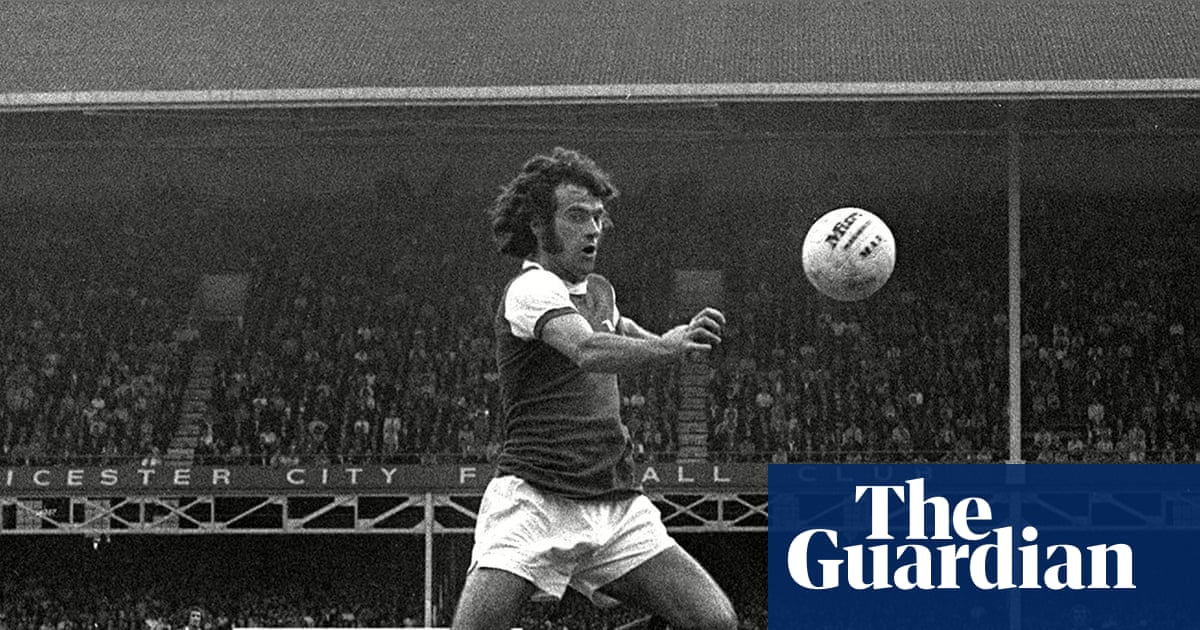
The footballer Peter Storey, who has died aged 81, was a tough-tackling midfielder for Arsenal when they won the double of the First Division championship and the FA Cup in 1971.
Arsenal were only the fourth team to achieve the double at that point (it has since been won another nine times), and Storey, who appeared in 49 of the 51 league and FA Cup games that season, played as big a role as anyone in securing the honours with his defensive solidity, ball-winning skills, “good engine”, sound distribution and reliable occasional penalty taking.
Those attributes garnered him 501 appearances for Arsenal overall – putting him eighth on their all-time list – and made him popular not just at Highbury in a famous team that also featured Bob Wilson, Pat Rice, Frank McLintock and Charlie George, but with the England manager Alf Ramsey, who handed him 19 international caps between 1971 and 1973 in midfield and defence. By 1977, however, Storey’s footballing career was finished at the relatively young age of 32, and he soon experienced a precipitous fall from grace.
In 1975, while still a player, he had taken on the lease of the Jolly Farmers pub in Islington, north London, not far from Highbury. After leaving football he ran the establishment full-time, a move that exacerbated an existing propensity to heavy drinking. The Jolly Farmers was also a hangout for criminal elements, including members of one of the UK’s biggest crime enterprises, the Adams family, and Storey began to fall in with a number of unsavoury contacts, ushering in a drink-fuelled decline that involved a conviction for running a brothel and a three-year prison sentence for taking part in a money-counterfeiting conspiracy.
Born in Farnham, Surrey, Peter was the son of Nellie (nee Cawson), a shop assistant, and Edwin Storey, a carpenter. Growing up on the Longacre council estate in the nearby village of Ash, he went to Yeoman’s Bridge secondary school (now Ash Manor school) and there, through appearances in county schools football, caught the attention of Arsenal, the team he supported.
He went to Highbury as an apprentice in 1961, and made his first-team debut in 1965 under the manager Billy Wright, at left-back in a First Division match against Leicester City. Immediately establishing himself in the side, by 1967 he was switched by a new manager, Bertie Mee, to right-back to accommodate Bob McNab, appearing in that position in two losing League Cup finals, against Don Revie’s Leeds in 1968 and Swindon in 1969.
Storey resting an injured foot at home in 1971. Photograph: James Gray/ANL/Shutterstock
Moving not long afterwards into midfield, he claimed his first winner’s medal in the Inter-Cities Fairs Cup (the precursor to the Uefa Cup) in 1970 as Arsenal beat Anderlecht 4-3 over a two-legged final to claim their first trophy in 17 years.
By then a well-oiled machine, the team went on to win the 1971 league title by one point ahead of Leeds, although Storey missed the crucial last two games of the campaign with an ankle injury. Recovered in time for the FA Cup final, he put in an effective performance for 64 minutes before being substituted, then watched from the bench as George scored an extra-time winner to deliver the double with a 2-1 victory over Bill Shankly’s Liverpool. Earlier in the competition Storey had rescued Arsenal from a semi-final exit against Stoke City by putting two goals past the mighty Gordon Banks – one a crisply struck half-volley and the other an ice-cool penalty in stoppage time. Stoke had been 2-0 up, and in the resulting replay were defeated comfortably.
After the double, Arsenal were unable to maintain any meaningful momentum, and Storey, too, began to find things more difficult. Hampered by his drinking habits, by 1975 he was struggling to hold down a first-team place, leading to fallouts with Mee and then Mee’s successor, Terry Neill.
Neill let Storey go on a free transfer in early 1977 to Second Division Fulham, where he joined a cast of enthusiastic imbibers in Bobby Moore, George Best and Rodney Marsh, each also at the end of their careers. After less than a year at Craven Cottage, Storey signed off with a last match in September 1977, before turning his attention more fully to the Jolly Farmers.
Later admitting that he was “attracted to the brash, flash lifestyle enjoyed by smartly dressed thieves who frequented my pub”, he readily became involved in criminal activity.
Within two years of his playing retirement, Storey had been found guilty of keeping a brothel, for which he received a suspended sentence. In late 1980 he was convicted of conspiracy to produce counterfeit gold coins, and was sent to Wandsworth prison for three years. Released before serving the full sentence, he then set up a minicab business, but in 1982 narrowly avoided being sent back to jail after trying to steal two cars he had initially bought for his firm on hire purchase. He was jailed again in 1990, for 28 days, for the illegal importation of pornographic videos.
After his second period behind bars Storey worked as a minicab driver for a firm run by the Adams family, then as a chauffeur in Turkey. Less turbulent times arrived with his fourth marriage, in 2000, to a Frenchwoman, Daniele Scorcelletti, with whom he lived more quietly for many years near Toulouse, partly on the proceeds of selling his football medals for £20,000.
His warts-and-all autobiography, True Storey: My Life and Crimes As a Football Hatchet Man, was published in 2010.
Each of Storey’s first three marriages ended in divorce, the first being to Susan Thompson in 1969. He had a daughter, Natalie, from his second marriage, to Catherine Macdonald, and three sons, Peter, Anthony and Jamie, from his third marriage, to Gillian Ashby.