SummaryCompaniesTaiwan charges five for plotting attack on comedianHuang had lampooned Chinese President Xi JinpingChina has dismissed accusations of involvement in attackTaiwan wary about rise of China's 'transnational repression'
TAIPEI, Nov 25 (Reuters) - Even a stand-up comedian now comes with a security detail to watch the exits and scan the crowd as he fires off jokes in democratic Taiwan, claimed by China as its own territory despite never having governed it.
In the spotlight at a Taipei club, Huang Yi-Hao put a simple question to an audience of fans and plainclothes officers, the last group there to ensure the night ended only in laughter after he drew threats for jesting about China's leader.
The Misinformation Monitor newsletter rounds up international misinformation narratives, with a "Real or Fake?" quiz in every edition. Sign up here.
"How come I'm the one who gets hit by a car, while Jensen Huang gets the beautiful female spy?" the comedian asked, referring to the alleged affair the founder of chipmaker Nvidia
(NVDA.O), opens new tab
had with a suspected Chinese spy.
Then he dropped the punch line: "Because Chairman Xi doesn't want other women anywhere near me."
Poking fun at himself and Chinese President Xi Jinping is a part of the comedy routine for Huang, not related to the Nvidia tycoon, who returned to the CEO role this week.
But his performances took a serious turn after Taiwan prosecutors uncovered a plot by five people to "break his arms and legs" with a car in punishment for Huang's jokes about Xi.
Letting off the five without heavy punishment would amount to "allowing the Chinese Communist Party to extend its violent black hand directly into Taiwan's streets," prosecutors warned in legal documents reviewed by Reuters.
The five were indicted on charges ranging from criminal intimidation to attempted assault, the papers showed.
Huang suffered slight injuries when he was hit by a car in September after a Chinese national allegedly paid a Taiwan man T$250,000 ($7,300) to make sure he was unable to perform.
"We do not see this as merely a personal matter for Huang Yi-hao," Chiu Chui-cheng, who heads Taiwan's Mainland Affairs Council, told Reuters.
"It is a challenge to our defence of free speech and a free, democratic way of life."
China's Taiwan Affairs Office did not respond to a request for comment. Last month, it dismissed Taiwan's accusations of involvement in the attack.
The government of Taiwan's ruling Democratic Progressive Party was fabricating allegations to smear China, stir up anti-China sentiment and seek political gain ahead of local elections this weekend, it added.
"The same trick is performed every year, and the audience has long grown tired of it," spokesperson Chen Binhua told reporters.
FRONTLINE FIGURE
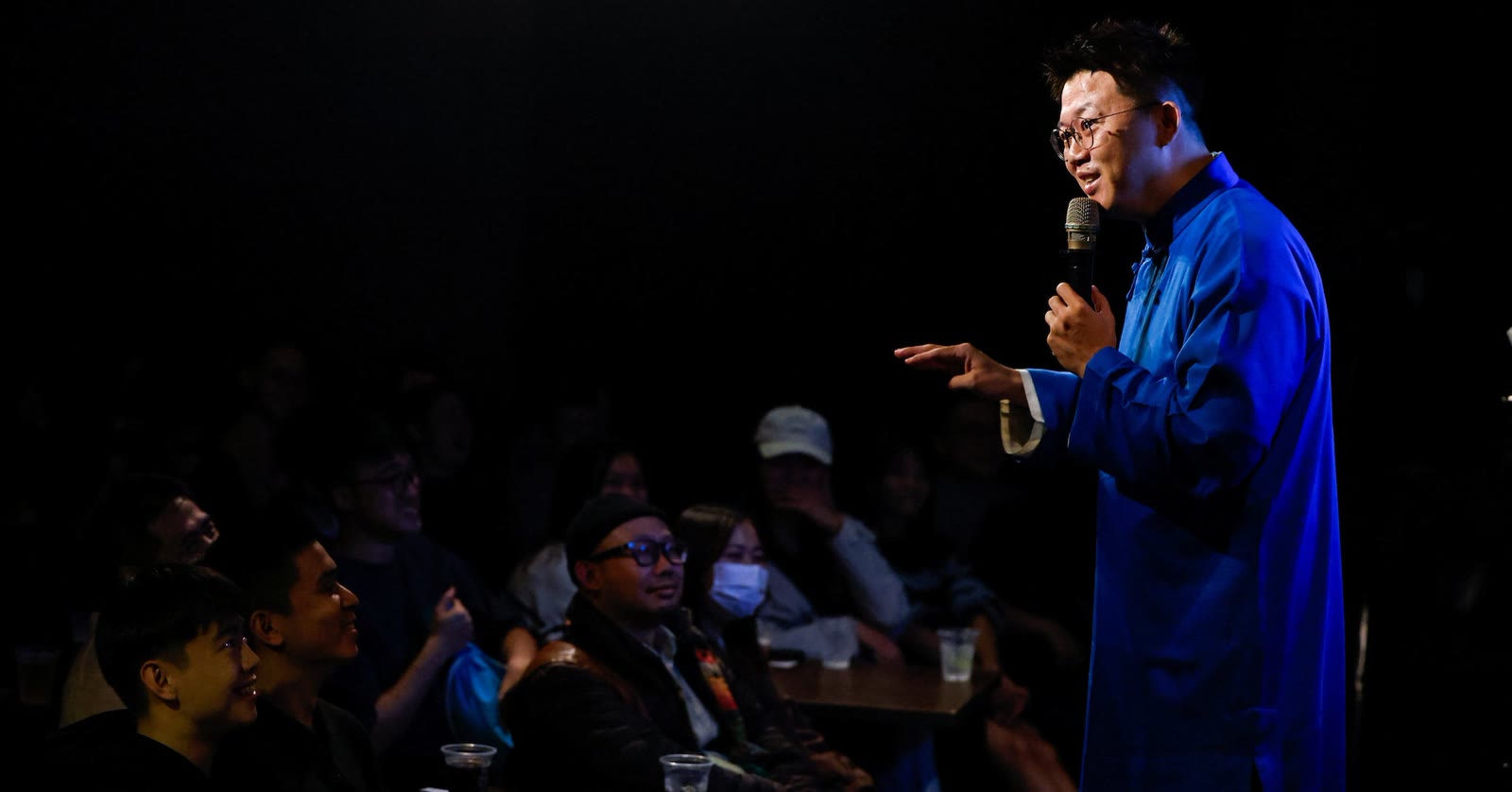
Item 1 of 5 Taiwanese comedian Huang Yi-hao performs during a stand-up comedy show at Two Three Comedy Club in Taipei, Taiwan, November 19, 2026. REUTERS/Ann Wang/File Photo
[1/5]Taiwanese comedian Huang Yi-hao performs during a stand-up comedy show at Two Three Comedy Club in Taipei, Taiwan, November 19, 2026. REUTERS/Ann Wang/File Photo Purchase Licensing Rights, opens new tab
Huang stands on the frontlines of efforts that Taipei, which rejects China's sovereignty claims, characterises as "transnational repression" by Beijing.
The campaign ranges from intimidation and violence to information warfare and even tie-ups with organised crime to target those in Taiwan whom China views as "separatists" or politically suspect, it says.
Over the past three years, 131 people have fallen victim to such Chinese repression, the Mainland Affairs Council says, even though its legal system is independent of China.
They include journalists, artists and politicians such as Puma Shen, who is running for Taipei mayor in the face of a Chinese police investigation for "separatism".
"Mainland China uses such trans-border repression to keep asserting jurisdiction over Taiwan, in an effort to achieve the so-called political effect of 'governing before unification,'" Chiu said.
He was referring to Beijing's goal of bringing Taiwan under its control, by force, if necessary.
Chiu said past Chinese tactics ranged from physical attacks, and surveillance to business sanctions, criminal prosecutions and digital harassment, including doxxing, or online exposure of personal details, from addresses to family ties.
DIVIDING TAIWAN SOCIETY
Taiwan protects freedom of speech, but China tolerates no criticism of government leaders.
Huang says he was targeted for his use of "guankou," a rapid-fire technique of traditional Chinese comedy, to criticise Xi's rule, in a performance that went viral online last year.
The familiar format made the video recognisable for Chinese audiences, who could then relate to it, he said.
Yet the attack has already achieved some of its purpose in dividing society, Huang said. Some responded to the incident by calling for a stronger defence of freedom, but others urged people to keep their heads down and avoid politics.
"Some would say: 'Don't talk politics, and they won't bother you,'" Huang said, while adding that others claimed he had staged the attack himself.
Had the plot succeeded, the comedian said, he would probably have gone onstage in a cast, turning even that into material about China's activities.
"In this world, what matters most isn't how long you live, but whether you've burned brightly," he said.
($1=T$32.8060)
Reporting By Yimou Lee, Angie Teo, Fabian Hamacher and Yi-chin Lee; Additional reporting by Ann Wang; Editing by Clarence Fernandez
Our Standards: The Thomson Reuters Trust Principles., opens new tab
Yimou Lee is a Senior Correspondent for Reuters covering everything from Taiwan, including sensitive Taiwan-China relations, China's military aggression and Taiwan's key role as a global semiconductor powerhouse. A three-time SOPA award winner, his reporting from Hong Kong, China, Myanmar and Taiwan over the past decade includes Myanmar's crackdown on Rohingya Muslims, Hong Kong protests and Taiwan's battle against China's multifront campaigns to absorb the island.