WASHINGTON — Immigrants detained in California facilities are facing increasingly significant delays in sending and receiving legal mail. As a result, some have lost appeals, been denied bond or been deported, advocates say.
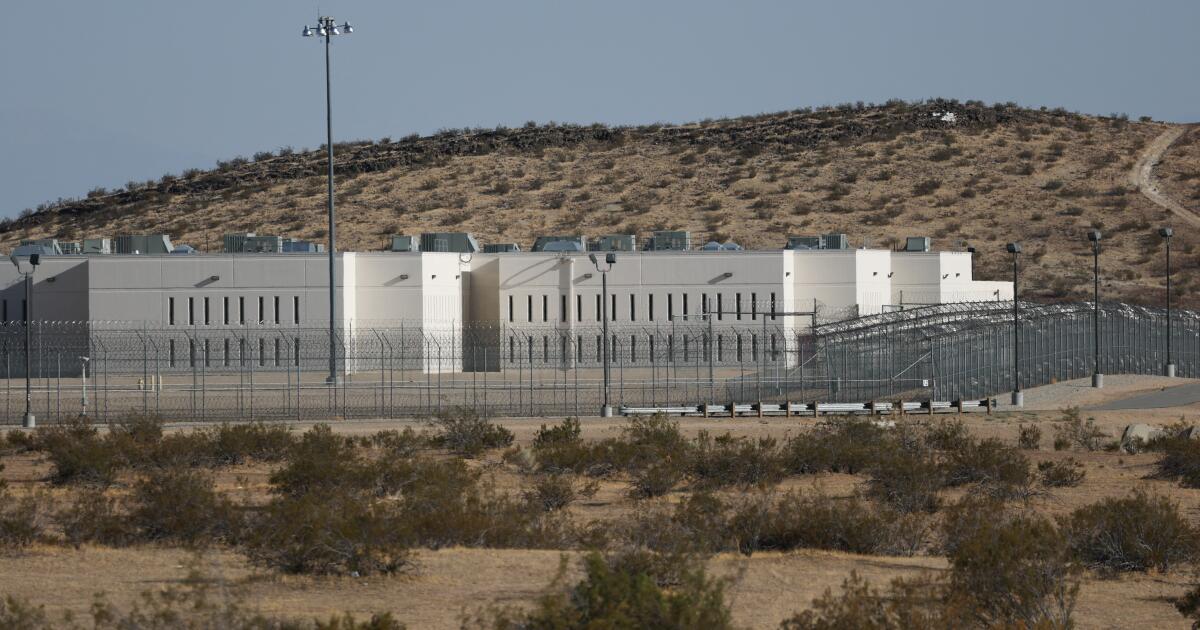
The delays are outlined in a report released Wednesday by the California Collaborative for Immigrant Justice, which provides legal consultations to unrepresented people at the four Immigration and Customs Enforcement facilities in Kern County: the California City Detention Facility, Mesa Verde ICE Processing Center in Bakersfield, and two in McFarland, the Golden State Annex and Central Valley Annex.
The report also found that there are too few computers for the number of people seeking to fight their deportations without a lawyer, and that facilities provide outdated legal forms and case law databases, as well as place caps on how much paper, envelopes and postage they can use.
The long waits for mail have become one of the biggest issues across facilities, the immigrant justice collaborative found. In recent months, facilities have routinely delivered incoming mail to people days or weeks after it arrived, and outgoing filings often sit for days before being mailed out, the report says.
For detainees who lack legal representation, the limitations and delays are particularly challenging because they can’t rely on someone outside the facility to print and mail legal paperwork for them. And though detainees who are considered indigent are supposed to receive free postage, the justice collaborative found that’s not always the case.
The report says that stamps are sometimes sold out and that detainees must pay for express or certified mail for to ensure their documents have a chance at arriving on time.
A Department of Homeland Security spokesperson said mail processing times are in compliance with established policy and that claims regarding mail delays and access to computers and legal materials are false.
“Furthermore, claims that the facility does not provide enough computers, paper, envelopes, and postage are completely UNFOUNDED,” the spokesperson, who was not identified, wrote in an emailed statement. “Detainees’ access may be limited if they are maliciously involved in property destruction on more than one occasion.”
The GEO Group, a private prison corporation that operates the Mesa Verde, Central Valley and Golden State facilities, referred questions to the Department of Homeland Security. A spokesperson for CoreCivic, which operates the California City facility, said detainees have access to legal mail, printing and legal research consistent with federal standards.
In an emailed statement, the spokesperson, who was not identified by name, said that law library computers are “mostly always” available and that people in restrictive housing also retain access to legal materials and mail. “We are not aware of any individual at the facility being removed because of a delay in legal mail,” the spokesperson wrote.
The justice collaborative alleges that the lags are by design, because the private prison companies that operate the facilities with taxpayer money exploit opportunities to maximize profit, in part by understaffing and undersupplying the mail and legal services.
“These private prison companies are profiting off their detention, profiting off the barriers that they impose on people trying to fight their cases,” said Mariel Villarreal, an attorney at the collaborative.
The CoreCivic spokesperson rejected the allegation. “The suggestion that legal mail or legal resources are restricted to increase profit is untrue,” the spokesperson wrote. “CoreCivic has no role in decisions about whether an individual is detained, released, granted bond or removed, or in the timing or outcome of immigration proceedings.”
Detainees at two facilities said they lost access to legal research, communications and stamps after they staged protests or complained about conditions, the report says.
Immigrants are afforded three chances to fight removal from the U.S.: before an immigration judge, the Board of Immigration Appeals, or BIA, and a federal Circuit Court of Appeals. Removal orders issued by an immigration judge are automatically paused to give immigrants time to appeal to the BIA.
But immigrants can be removed if ICE places them on a deportation flight before a Circuit Court receives their appeal.
On Dec. 17, a new federal rule will take effect that cuts the timeline in most cases for appealing to the BIA from 30 days to 10. Priya Patel, another attorney at the collaborative who spearheaded the report, said the change is likely to exacerbate the mail issues, especially for those who can’t afford expedited mail.
Patel said she and her colleagues confirmed with the family members of two former detainees at the Central Valley Annex and one former detainee at the California City Detention Facility that they were deported as a result of mail delays. There are probably more such cases, she said, because some detainees are too afraid to share their experiences.
Where possible, Patel said, she confirmed anecdotes by checking tracking numbers, the date stamps on envelopes and court records.
At Central Valley Annex, one person mailed evidence for his legal case by regular mail 10 days before his hearing, on Sept. 18. The immigration court did not receive it on time and ordered him removed, according to the report.
The man then gave facility staff a filing on Oct. 6 to mail to the BIA, based in Virginia. When Patel spoke with him on Oct. 19, he told her the board had not received it. She looked up his case online and it didn’t show a pending appeal.
At the California City facility, one person’s appeal placed in the mailbox for express mailing on Sept. 13 reached the BIA on Sept. 21 — four days after their Sept. 17 deadline. The appeal was denied.
In another case, the BIA sent a detainee a letter on Aug. 31, telling him he had until Sept. 21 to file key paperwork. It arrived a day after the deadline. He lost his appeal and is now seeking review in the U.S. 9th Circuit Court of Appeals.
Sen. Alex Padilla (D-Calif.), who is ranking member of the Senate Judiciary Committee’s Subcommittee on Immigration, Citizenship, and Border Safety, said he is aware of the issues with access to legal materials.
“A government that locks people up, controls every channel they have to the courts, and then deports them for missing deadlines it intentionally made impossible to meet is denying the very process the Constitution promises,” he said.
The Times interviewed six California ICE detainees, who shared their experiences with mail delays and echoed the collaborative’s findings.
Some shared handwritten logs detailing when they gave their mail to facility staff for shipping and when the court received it. They said they submitted grievances about the delays with no meaningful response.
One detainee at the California City facility said he and others in his dormitory have, in an attempt to establish proof, begun holding up their envelopes in front of facility cameras to show when the mail left their possession.
Alejandro, another California City detainee who asked to be identified by his first name only, said the facility implemented a new practice this month for incoming mail. Detainees are now given the contents of their mail but not the envelopes.
“Those envelopes have the date of when the post office got the mail,” he said. “That’s the evidence we could have that demonstrates that the issue is right here — not the post office.”
The Homeland Security spokesperson said the practice of distributing mail without its original envelope “was implemented to prevent the introduction of contraband, including controlled substances, into the facility.”
“It was never intended to conceal mail-processing delays, and that practice has since been discontinued,” the spokesperson wrote.
Luis Castillo, 43, who is also detained at the California City facility, said he handed his immigration appeals board filing to an officer at the facility on Sept. 23 for standard shipping. He said his appeal deadline was Oct. 1.
But Castillo said the envelope wasn’t mailed until much later. Court records show the board denied his appeal on Oct. 14. A document from the board, stamped Oct. 16, states that his appeal was rejected for arriving late.
The CoreCivic spokesperson said the company is reviewing the handling of Castillo’s correspondence.
Castillo, who said he was arrested by ICE in December 2025 after living for several years in New York, has appealed to the 9th Circuit. It’s his last chance to fight deportation to Peru.
“I had hope that the BIA would review my case, because I had included evidence and everything,” he said. “Sadly, they couldn’t review it because my envelope arrived late. They simply denied it.”
Of the mail delays, he wondered aloud: “I’m not sure if it’s a trick so they can deport us faster.”
More to Read