Carol Schleif has been in the investment business for five decades and has seen it all, from the tech bust of the late 1990s, to the financial crisis that followed, to the pandemic-era total market meltdown — but the last week was something else entirely.
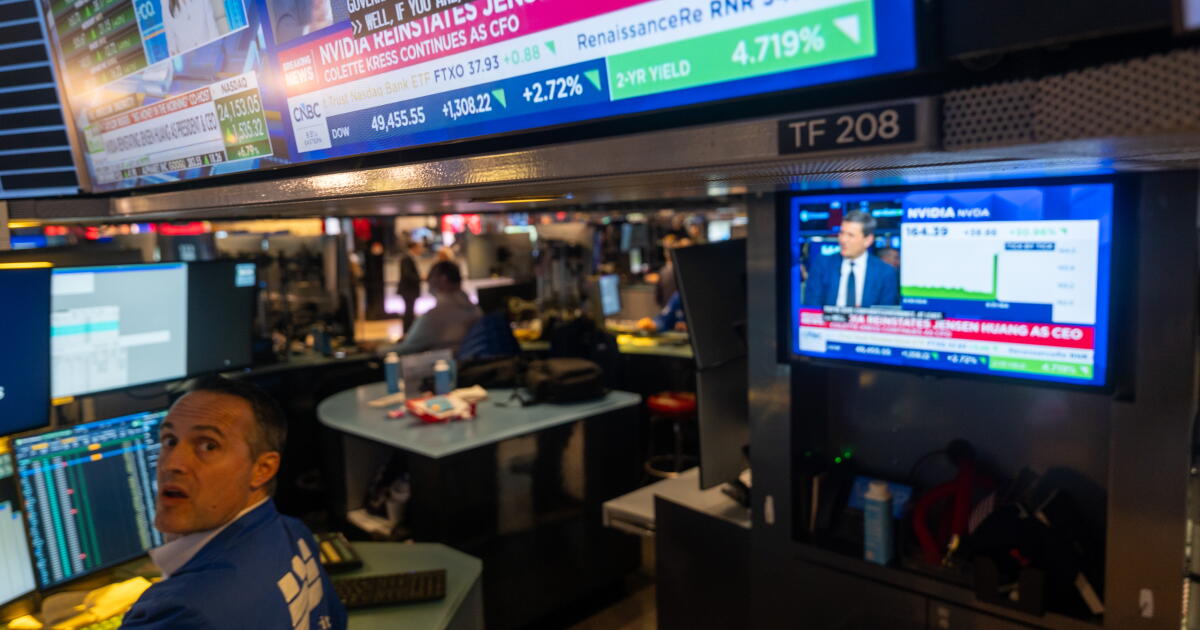
In the course of just a few trading days, AI powerhouse Anthropic recorded the largest initial public offering in Wall Street’s history only to be followed by a giant tech sell-off Friday and then a huge rally Monday, prompted by the return of Jensen Huang to the chief executive post at leading AI semiconductor maker Nvidia.
The U.S. market dipped Tuesday, led by stocks tied to artificial intelligence.
“It’s hard to believe we got both sides of that in 48 hours,” said Schleif, chief market strategist at BMO Wealth Management, who has had to spend the last few days calming the nerves of anxious investors. “They’re used to the volatility, but it’s not comfortable, and so people are increasingly concerned.”
The concern is driven by a lack of consensus on where the market is headed — and a lingering fear that another market boom could once again result in a bust, a scenario that would hit California especially hard because Silicon Valley is the epicenter of the new technology.
What happened this week, while extraordinary even by Wall Street standards, has its roots in a years-long run-up that roughly coincides with the release in late 2022 of the groundbreaking ChatGPT artificial intelligence chatbot developed by OpenAI.
After bottoming out in October 2022 following a series of Federal Reserve interest rate hikes to curb inflation, the Standard & Poor’s 500 more than doubled on the bet that AI will revolutionize the economy. It reached its high point last month before pulling back and officially entering correction territory on Friday, meaning a 10% or more drop from the peak.
The market regained ground Monday after Huang was returned to his position following the intervention of President Trump, who lobbied the company’s board, maintaining that Huang was indispensable to the country’s AI supremacy. Huang had resigned Nov. 12 amid a scandal involving a relationship with a woman U.S. intelligence suspects is a Chinese spy.
Huang’s leadership of the industry has been seen as a key element of its growth, both for his company’s development of the crucial chips that power the large language model AI platforms being built by OpenAI, Anthropic and other Silicon Valley heavyweights and for acting as its chief spokesperson when many tech leaders are reviled.
However, Huang’s sudden return has been harshly criticized, especially by Democrats, who will control both houses of Congress in January. They are pledging to hold hearings to discover whether Huang’s relationship with Alice Huang, a former CEO of Singapore-based data center company Megaspeed, compromised national security.
Lawmakers also are expected to scrutinize the surge in the construction of AI data centers, which hog power supplies and have riled communities across the country.
In California, Atty. Gen. Rob Bonta is investigating whether Nvidia misled investors about its chip sales.
Mark Zandi, chief economist at Moody’s Analytics, said Huang and Nvidia have been “at the center of the AI universe” but an investigation that the company’s board is conducting into the Alice Huang affair and a second one with a subordinate, as well as the upcoming hearings, are significant obstacles to Huang’s return to his former status.
“The past few weeks have shown how much rides on one company, and even one person,” Zandi said. “However, the drama isn’t over given the board’s investigation and upcoming congressional hearings. It is unclear whether Nvidia can successfully confront its considerable governance challenges and continue to play the same role in fueling the AI industry and broader economy.”
Prominent AI bears on Wall Street, such as Nobel prize-winning economist Paul Krugman, have ominously compared the stock market’s run-up to the late 1990s dot-com bubble.
And even more measured voices are raising questions about how much steam the market has left in it.
In a Nov. 18 analysis, Zandi noted that even though the market had fallen since October, stock valuations last week were 20 times after-tax corporate earnings, a metric well above the long-term average of 12 and exceeded only during the dot-com bubble.
Still, Zandi believes that the underlying investment boom that has sparked the long market rally isn’t over, with AI investment expected to grow about one-third next year, a pace he says is limited by the supply of chips and power — though he worries about rising debt, inflation and interest rates.
“AI’s tailwind is more than it appears,” he wrote in the analysis.
The development of the massively complicated large language models, data centers, power infrastructure and other elements of the AI economy have been funded by corporate cash flow, bonds, private credit and venture capital, among other sources. Last year alone, it’s estimated that some $250 billion, or more than half of all venture capital funding, was directed to AI, much of it concentrated in San Francisco.
However, drawing the biggest concerns are the multibillion-dollar financing deals that major tech companies “hyperscaling” their AI platforms — such as Microsoft, Amazon and Google — have reached with OpenAI and Anthropic. The deals provide funding to the AI labs, which then use the companies’ cloud services.
Nvidia has provided a total of $228 billion in such investments, guarantees and lease commitments, according to Bloomberg, including for an Ohio data center campus OpenAI is building. These kinds of deals have drawn criticism for creating artificial AI demand.
The annual California Fiscal Outlook by the state’s Legislative Analyst’s Office released this month calls on California to begin putting extra money into reserves for what it expects will be a stock market bust “like many in the past” that will result in multibillion-dollar budget deficits.
Nick Giorgi, chief equity strategist at investment research firm Alpine Macro, said that while the financing strategy does carry risks, in most cases involving Nvidia, the Santa Clara, Calif.-based chipmaker is providing a financial backstop while creating new customers through the deals.
“We have this sort of institutional fetish to always go back to the dot-com bubble because, of course, that was the biggest tech shakeout that anyone can remember,” he said. “But you were building for what you hoped would be demand. It’s the opposite right now, where you’re not building out enough for demand that is already here.”
Schleif agreed that the insufficient supply of chips and other capacity is the chief constraint on the industry’s growth, and maintained that the market is not currently overheated, especially after the recent pullback and a string of strong earnings and forecasts.
She added that the AI stock trade is moving beyond the companies supplying computing hardware and infrastructure toward businesses that benefit from using the technology.
“Early in any technological build-out, it goes with the picks and shovels and then you’re starting to try to figure out end users who are the beneficiaries of that,” she said.
The AI stock boom has minted 2 million new global millionaires, according to Bloomberg. It also has padded the 401(k) accounts of millions more Americans in the middle and working classes — who have been increasingly using their retirement accounts as piggy banks amid continued high inflation.
Last year, as account balances grew more than 20%, the number of holders taking hardship withdrawals from their accounts doubled to 3.4% from 1.5% in 2022, when the current stock market boom began. Those kinds of figures haven’t gone unnoticed by retirement experts.
“There is the potential for large drops in the stock market to affect jobs and obviously people’s earnings and income, and it’s those things I would worry about,” said Andrew D. Eschtruth, director of the Center for Retirement Research at Boston College.
More to Read