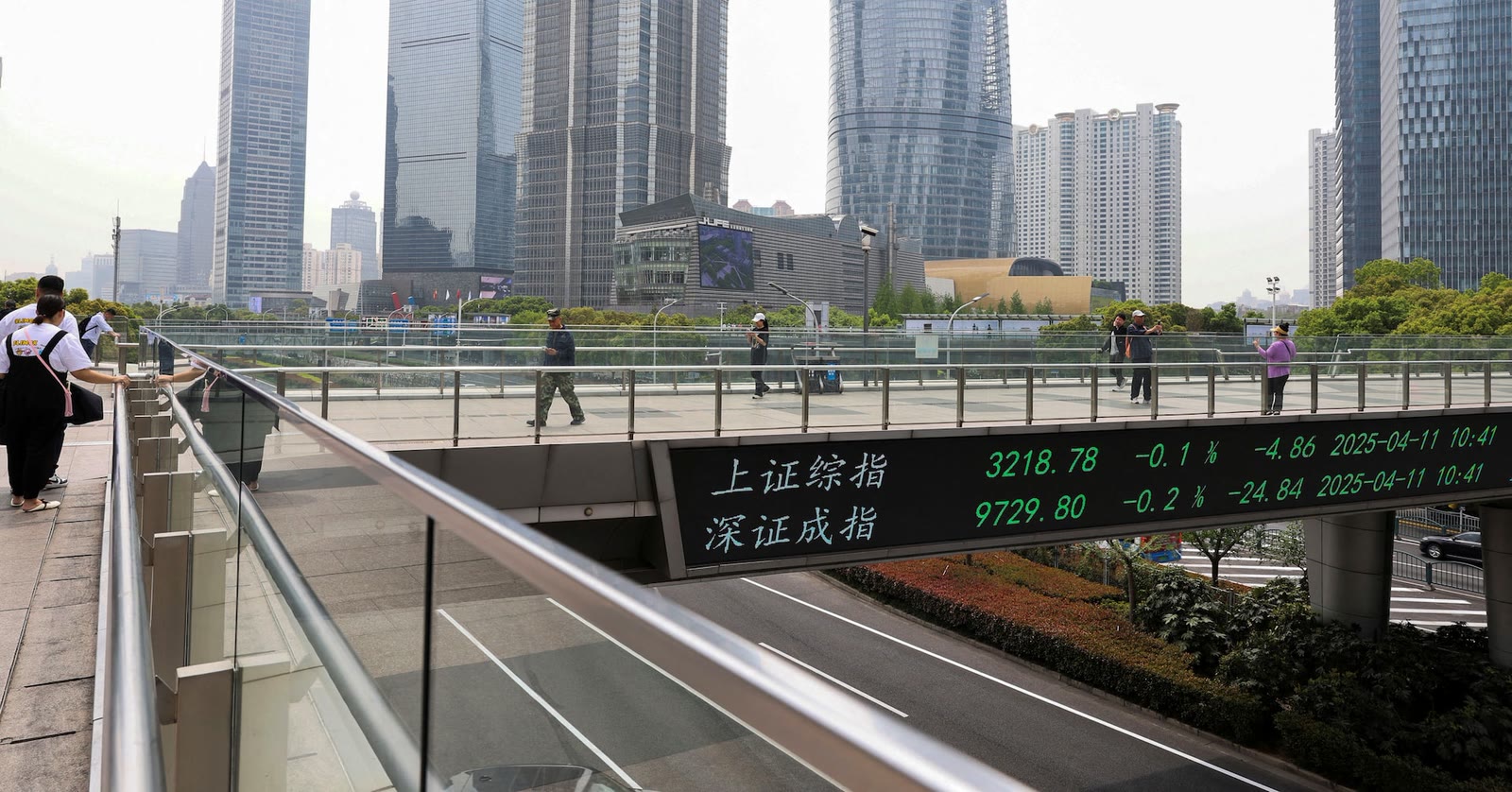
An electronic board shows Shanghai and Shenzhen stock indices as people walk on a pedestrian bridge at the Lujiazui financial district in Shanghai, China April 11, 2025. REUTERS/Go Nakamura REFILE - QUALITY REPEAT Purchase Licensing Rights, opens new tab
LONDON, Nov 25 (Reuters) - Private capital investment in emerging markets increased 19% through the third quarter to $143.2 billion, driven by Chinese tech and growing demand for infrastructure according to the Global Private Capital Association.
The total is close to the $158.3 billion invested in all of 2025, underscoring strong appetite for tech and AI despite recent market volatility around companies such as Nvidia and Anthropic.
Get a look at the day ahead in European and global markets with the Morning Bid Europe newsletter. Sign up here.
Private capital is an increasingly important source of funding for emerging economies, helping bridge investment gaps as stretched public finances and high borrowing costs constrain traditional sources of finance.
Private capital going into China hit $64.3 billion, nearly double the full-year 2025 total and the highest since 2022
"The amount of funding going into not only AI-related startups and China, but also in the areas of robotics, aerospace...we've seen that really accelerate this year," said Jeff Schlapinski, GPCA's managing director of research
GPCA represents private investors managing more than $2 trillion in assets in the developing world and tracks private credit, private equity, venture capital and infrastructure and natural resources investment
Outside China, infrastructure investment was the core driver of capital with $5.2 billion going into Africa and $10.7 billion into Central and Eastern Europe, both already above full-year 2025 total
Investments flowed into fossil fuels, telecoms and data centres with investors are now raising dedicated pools of capital for infrastructure in growth markets
"In an environment of global uncertainty, high inflation, high interest rates, I think a lot of allocators are gravitating to hard assets," Schlapinski said
The trends broadly mirrored those in developed markets; Prequin, which tracks global data, showed increased private equity and credit funding this year, with particular focus on AI and infrastructure
Middle East investment, by contrast, fell sharply to $2.4 billion through the third quarter from last year's $21.6 billion
"There's been a more cautious and selective environment overall," Schlapinski said, as investors assess the economic fallout from the war
Reporting by Libby George, editing by Karin Strohecker
Our Standards: The Thomson Reuters Trust Principles., opens new tab
Libby George is a London-based journalist on the Reuters emerging markets team. She was part of a team named as Pulitzer finalists in 2023, and who won the Selden Ring Award for International Investigative Reporting, for a series of stories revealing abuses by Nigeria’s military. After launching her career as a political journalist in Washington, D.C., she joined Reuters in 2015 covering oil, and from 2019-2023, she was senior correspondent and acting bureau chief based in Lagos, Nigeria.