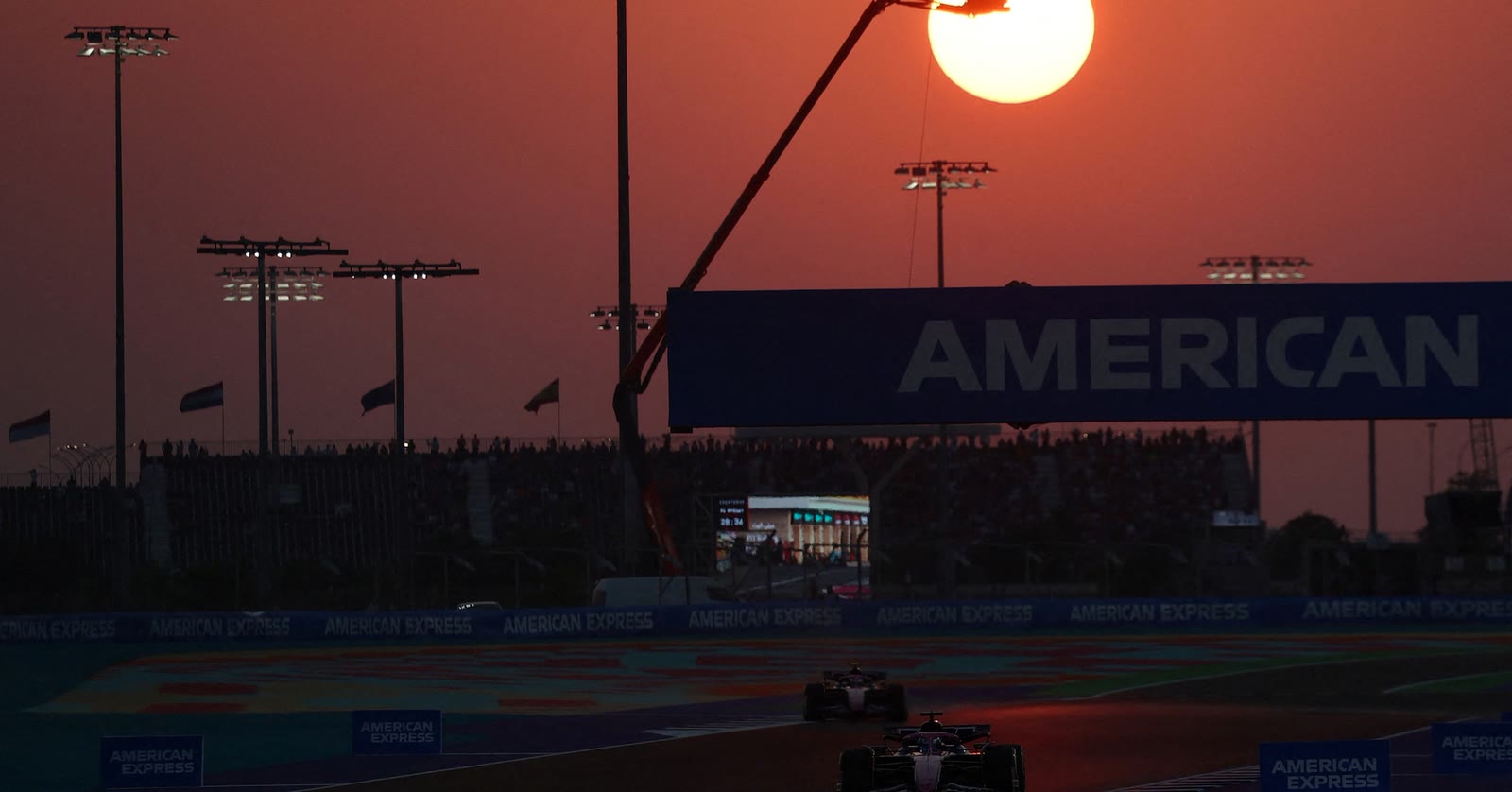
DOHA, Nov 25 (Reuters) - Lights out and away we go in Doha, against the odds.
Qatar's Formula One Grand Prix goes ahead this weekend, after months in which it was not clear the race would happen at all, given the war.
The big question is who will turn up.
The race normally draws a glittering crowd of celebrities and global fans to Doha. Last year's guests included David Beckham, tennis champions Novak Djokovic and Serena Williams, comedian Kevin Hart, chef Gordon Ramsay and actor Jessica Alba, and Metallica headlined the post-race concert.
This year, Jason Derulo takes the stage on Sunday night. We will be watching to see how many international visitors make it, with the war continuing on Qatar's doorstep: attacks at sea this week and a new wave of strikes on nearby Bahrain.
So far, the most noticeable visitors are not A-listers but Saudi drivers. Doha's streets have been heavily congested this week, at times gridlocked, with a clear rise in Saudi-registered cars. They have arrived from a kingdom under fire. Saudi schools are on autumn break and Houthi missile and drone attacks have led to online learning orders in specific areas, most notably Riyadh.
This week, a Houthi drone hit Riyadh's tallest tower for the second time in less than a week, wounding at least 11 people. The group has also threatened Jeddah and other Red Sea ports.
In this week's Gulf Currents, we go to Aden, where Houthi forces are about 60 km from Yemen's temporary capital and its defenders are digging in. We also ask what has happened to the trillions of dollars the Gulf pledged to US President Donald Trump, now that the Iran war is squeezing regional economies.
NEWS BRIEFING
Saudi Arabia is budgeting for a narrower 2027 deficit of 3.6% of GDP, from 4.9% this year, despite its escalating war with Yemen's Houthis. The finance minister said the kingdom will not be "blackmailed by missiles" and can withstand a prolonged conflict, even as Vision 2030 projects are scaled back.
Iraqi Prime Minister Ali al-Zaidi has ordered federal authorities to manage oilfields in four provinces controlled by Kurds, and to take over Kurdistan's border crossings. Kurdish premier Masrour Barzani called the move "in no way acceptable". It pits Zaidi, already confronting Iran's most powerful militia proxy, Kataib Hezbollah, against two entrenched powers that defy Baghdad.
Two former Petrofac executives were involved in the payment of bribes of about $23 million to secure contracts worth around $3.4 billion in the UAE, prosecutors told a London court. Prosecutors accused Marwan Chedid and George Salibi of helping disguise the payments with false invoices to secure ADNOC work. Both deny charges of bribery. The trial is due to run until March.
GULF'S TRILLIONS PLEDGED TO THE US: A SIGNAL, NOT A CHEQUE
With fighter-jet escorts, parading camels and a promised $400 million Qatari 747, Donald Trump was feted across
Riyadh, Doha and Abu Dhabi in May 2025 like no other.
He left claiming a historic haul: a $600 billion investment commitment from Saudi Arabia, a 10-year, $1.4 trillion investment framework from the UAE, and $1.2 trillion of "economic exchange" with Qatar. He still boasts about the trillions the Gulf spends in the US.
So where is the Gulf money?
The pledges did their political job, but the picture has changed. The Iran war is squeezing Gulf economies, Republicans lost both chambers of Congress in November’s midterms, and Trump faces a lame-duck final two years. Who will check the pledges, and can the Gulf pay out?
“The Gulf ‘pledges’ largely represented things the Gulf states were already doing and would have done irrespective of administration, including investing sovereign wealth in the world’s largest debt and equity market and buying US aerospace and defense equipment,” said Justin Alexander, director of Khalij Economics.
“To the extent that they pledged more in the hope of beneficial policies from Washington, that has not turned out well for them.”
It is not clear those pledges have brought the Gulf Arab states what they had hoped for, in trade or in security.
Even approved deals lag: the $24.3 billion F-35 sale to Saudi Arabia cleared congressional review in October, but no contract has been signed and the jets are years away.
The 2026 Iran war has shown that Washington cannot reliably protect Gulf Arab states from Iranian or Houthi attack. Iran has fired more than 7,000 missiles and drones at Gulf states since February, the secretary-general of the Gulf Cooperation Council told the UN Security Council on Friday, including nearly 2,850 at the UAE, about 1,230 at Saudi Arabia and about 740 at Qatar by early June. Houthi strikes have hit Riyadh's airport and tallest tower and led to most international flights to the capital being cancelled.
The war has hit Gulf economies and states may need to tighten their belts. The IMF projects the six Gulf economies will shrink 4.8% in 2026, with Qatar’s contracting by 15.6%.
Even the firmest Gulf pledges, in aviation and defense, look shakier. Will battered Gulf airlines delay or even cancel Boeing orders? Defense orders will continue given limited alternatives, Alexander said, but most states want to diversify their security partners over time.
Trump got the signal he wanted in 2025. The cheques may never arrive.
CHART OF THE WEEK
"The extraordinary freight environment has primarily been driven by the continued recovery in Middle Eastern crude oil flows, combined with severe inefficiencies across the transportation chain," Belgian shipping company CMB.Tech said in a statement.
Crude tanker spot rates
reached record levels in early October, opens new tab
, as Gulf producers boosted September exports by relying on shuttle voyages and ship-to-ship transfers to move crude out of the Strait of Hormuz.
LAST WAVE: YEMEN'S ADEN BRACES FOR HOUTHI PUSH
Houthi forces are bearing down on Aden, the Yemeni port city wrapped around an extinct volcano, and are now within 60 km across open desert. Missiles and drones have, for weeks, struck the temporary capital of Yemen's internationally recognized government. Residents fear an assault, which would bring the first serious fighting since the street battles of 2015.
But Yemen's military said on Tuesday the Houthis will not capture the city.
"I'll speak to you frankly. The situation is not where we want it to be. But it's not as dire as reported," Colonel Majed Abdullah Al-Nuzaily, spokesperson for Yemen's armed forces, told reporters.
"Aden is a red line," he said.
Defenders there have set up checkpoints, pulled in reinforcements, dug trenches and put earth barricades on the roads to the front line. At one checkpoint this week, soldiers searched cars under the flags of the former state of South Yemen, which unified with the north in 1990.
"Rockets are being fired into this city in a frightening way," said Tariq Abdul Rahman, a former soldier jolted awake by blasts in his three-room home. With a family of nine and little money, he does not know whether to stay or flee to the countryside.
Editing by Alexander Smith
Our Standards: The Thomson Reuters Trust Principles., opens new tab
Andrew Mills is Deputy Bureau Chief for the Gulf at Reuters, based in Doha. He leads coverage of Gulf diplomacy, geopolitics and regional conflicts, and helps steer coverage of a region that is a major economic power in which energy, business and finance intersect with government and geopolitics in nearly every story. He writes the Reuters Gulf Currents newsletter, which he launched. Previously, he spent nearly a decade as a journalism professor at Northwestern University and began his career at the Toronto Star, covering Canadian politics and the Middle East.
Link to newsletter: