Summary
China's Shenzhou-24 space flight launched successfully on Wednesday morning for the country's Tiangong space stationZeeshan Ali, the payload specialist, is part of the three-person crew and will be the first Pakistani in orbitThe mission is part of a broader China-Pakistan space cooperation pactOne Chinese astronaut from the previous Shenzhou mission is scheduled to stay at the space station for a year
If you can't see the content of video posts, please adjust your cookie settings.
We can now bring you a clip of the rocket launch:
Zhu at Jiuquan Satellite Launch Center, China, May 24, 2026. REUTERS/Maxim Shemetov
The rotation of astronauts for this mission will deviate from the pattern seen in previous Shenzhou missions.
Usually, China sends a three-person crew up to the Tiangong space station for a six-month stint.
When they arrive, they overlap for a few days with the three astronauts already on board, who then depart.
In this case, one of the Chinese astronauts who has been on board since May, Shenzou-23 commander Zhu Yangzhu, will stay on for another six months.
Instead, the Pakistani member of Shenzou-24, Zeeshan Ali, will spend only five to 10 days on board before returning to Earth with the two other Chinese members of the previous mission.
Zhu's planned year-long stay on board Tiangong would be one of the longest space missions on record - though still short of the more than 14-month record set by a Russian cosmonaut in 1995.
The Shenzhou-23 commander's extra-long mission will help Beijing study the impact on human physiology of a long stay in space as it works towards its ambition of a crewed moon landing by 2030.
An image taken by the NASA Artemis II crew on April 6, 2026. NASA/Handout via REUTERS
The Shenzhou-24 space flight is not a lunar mission, but it comes at a time when China and the United States are in an accelerating race to the moon.
The US is seeking to achieve a crewed moon landing in 2028 and to establish a long-term lunar presence as a stepping stone to eventual human exploration of Mars.
China has set a target of a human presence on the moon by 2030, and it plans to establish a research base there by 2035, jointly with Russia.
The US has warned about what it alleges are China's plans to colonize and mine lunar territory and resources.
Beijing denies those claims, saying it advocates peaceful use of outer space.
In April, four NASA astronauts made a historic trip around the moon as part of the Artemis II mission, flying farther from Earth than anyone before.
The success of that mission increased pressure on Bejing to meet or beat its own lunar exploration timetable.
Its uncrewed Chang'e7 lunar mission was delayed in August because of adverse weather linked to a tropical storm.
As we reported earlier, Ali will become the first Pakistani national to fly into orbit.
On Tuesday, he told reporters that he's not flying for himself.
"I carry the name of Pakistan on my shoulder, the hope of 250 million Pakistanis," Ali said.
Watch clips of the news conference below:
Video edited by Zoe Law
Chinese state broadcaster CCTV said the spacecraft has now successfully separated from the rocket and has reached its designated orbit.
It said the crew are in good condition.
Ali's role on the Chinese space station will be to conduct a series of experiments
According to details released by Pakistan's space agency, SUPARCO, he will work on four research projects:
RADIATION PROTECTION
Ali will explore the development of lightweight, graphene-based composite materials that could better protect spacecraft from radiation.
SELF-REPAIR
This project will examine self-healing carbon fiber composites that could automatically repair small cracks in spacecraft, improving their durability.
QUINOA SEEDS
The third experiment will study how quinoa seeds respond to conditions in space, exploring their potential as a food source for future missions.
LIFE BEYOND EARTH
The final project will examine the cultivation of microalgae and cyanobacteria for oxygen regeneration, carbon dioxide removal and potential food production to support life beyond Earth.
Muhammad Zeeshan Ali, Jiuquan, Gansu province, China, November 24, 2026. REUTERS/Tingshu Wang
Muhammad Zeeshan Ali is a 40-year-old Pakistan Air Force pilot.
He is set to become the first Pakistani to travel into orbit and the first foreign national to board China’s Tiangong space station.
Ali has the title "payload specialist", meaning he will carry out scientific experiments rather than operate the spacecraft. Ali's high-speed flying experience helped get him selected.
Pakistan's space agency SUPARCO screened a pool of pilots and scientists for medical fitness, psychological resilience and a tolerance for g-forces, according to Uzair Ansari, its director of artificial intelligence.
"You cannot easily find scientists who are familiar with travelling and facing high-level g-forces," he said.
To prepare for the flight, Ali trained for seven months in Beijing, during which he underwent intensive Chinese-language classes, learning Chinese songs and reading Chinese poetry. He also practised calligraphy and played table tennis.
"I'm not flying for myself. I carry the name of Pakistan on my shoulder," Ali told reporters.
He is expected to spend between five and 10 days aboard the station.
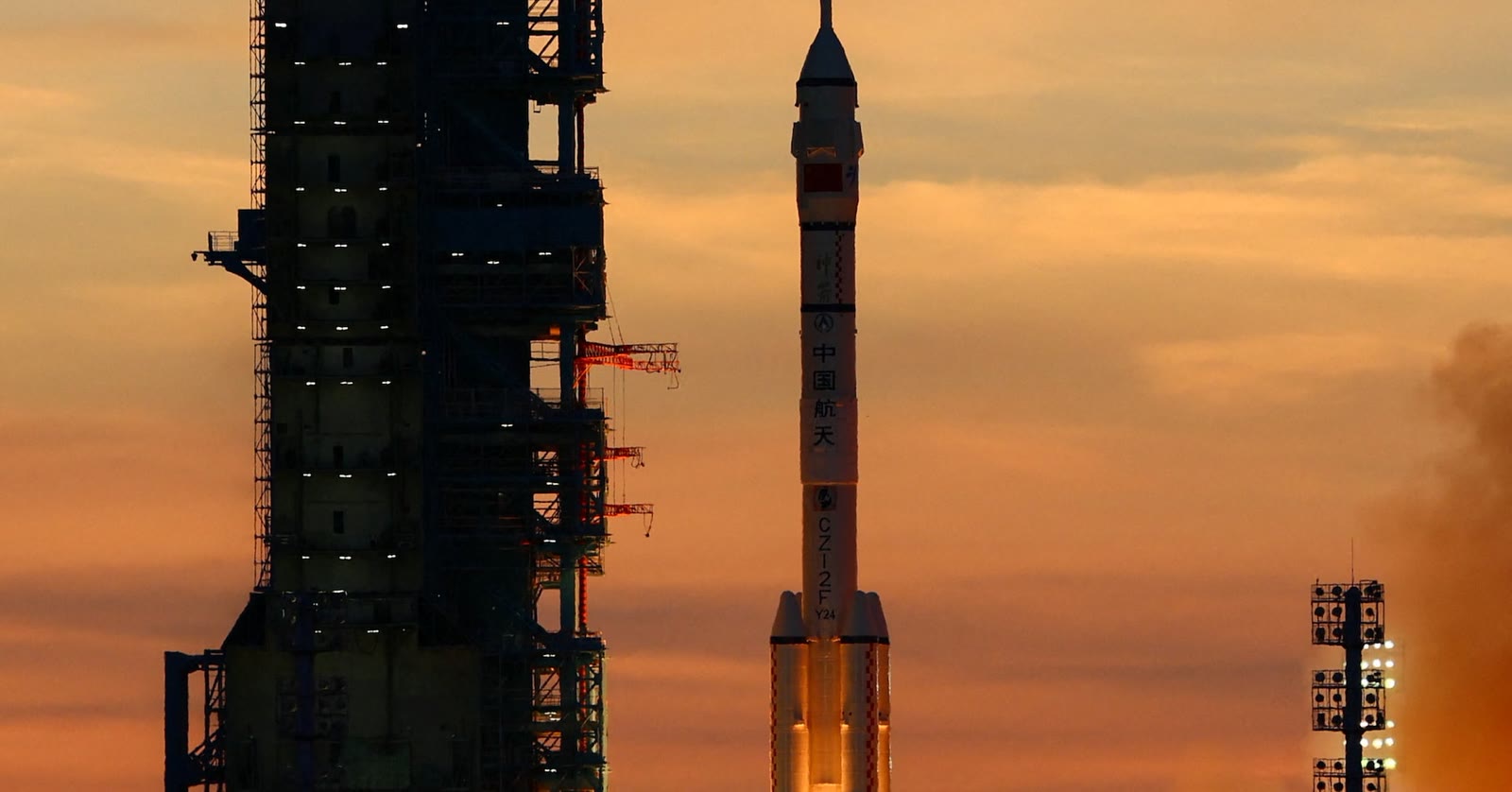
The rocket carrying the Shenzhou-24 spacecraft blasts off from Jiuquan Satellite Launch Center, China, November 25, 2026. REUTERS/Tingshu Wang
Xi and Sharif in Beijing, May 25, 2026. China Daily via REUTERS
Since Yuri Gagarin in 1961, citizens of about 50 countries have flown in space.
But only three nations — Russia, the US, and China — have launched their own crewed spacecraft.
China's invitation to Pakistan's Zeeshan Ali to join two Chinese astronauts on a mission to its Tiangong space station marks the first time China will transport a foreign astronaut.
The honor reflects broad cooperation between Beijing and Islamabad on space and other areas.
Their joint efforts have produced Chinese-launched Pakistani satellites, a joint satellite-navigation system and a Pakistani-built rover due to fly on China's Chang'e lunar mission in around 2028.
The two countries have also been consolidating their alliance as part of China's Belt and Road Initiative, a plan to develop trade routes to the rest of the world and grow China's economic power in the process.
In May, China and Pakistan announced they had reached a "new broad consensus" to beef up development of a joint economic corridor during a visit by Pakistan's Prime MInister Shehbaz Sharif to Beijing which included a meeting with Chinese President Xi Jinping.
The Jiuquan Satellite Launch Center, China, November 24, 2026. REUTERS/Tingshu Wang
Wednesday's launch involved China's Shenzhou-24 spaceship. Shenzhou means "divine vessel" in Chinese.
China launched its first unmanned spacecraft, the Shenzhou-1, in November 1999.
It carried out its first crewed mission in 2003, and since then Shenzhou crewed spaceflights have been a regular fixture of the country's space program.
Since 2021, they have included sending trios of astronauts to the Tiangong space station for six-month stays.
The Shenzhou missions are separate from China's uncrewed Chang'e lunar programme, named after the mythical moon goddess.
The launch took place at the Jiuquan Satellite Launch Center in northern China.
According to China Manned Space Agency, the site began functioning in 1998, and has the capacity to launch manned spaceship and space laboratory missions.
The launch used a Long March-2F rocket
We will continue to bring you visuals and updates from the launch.
Ali, Tang and Wu at the Jiuquan Satellite Launch Center, China November 24, 2026. REUTERS/Tingshu Wang
The three-person flight crew consists of China's Tang Hongbo and Wu Yi and Pakistan's Zeeshan Ali.
Tang, 51, will command the mission. A veteran astronaut, he first travelled to space aboard Shenzhou-12 in 2021 and later commanded Shenzhou-17 in 2023.
Wu, 39, will serve as the mission’s flight engineer.
Tang and Wu will remain on the space station for six months.
Ali, 40, is a Pakistan Air Force pilot who trained for seven months in Beijing.
He is set to become the first Pakistani national to fly into orbit and the first non-Chinese person to board Tiangong, where he will spend five to 10 days conducting scientific experiments.
Jiuquan Satellite Launch Center, China, November 24, 2026. REUTERS/Tingshu Wang
The Shenzhou-24 spaceship is scheduled for launch on Wednesday at 8:18 a.m. in China (0018 GMT).
The launch will use a Long March-2F carrier rocket, and will take place at the Jiuquan Satellite Launch Centre in northwest China.
The launchpad for the mission, China, November 24, 2026. REUTERS/Tingshu Wang
China is preparing to send a crew to its Tiangong space station that will include its first foreign astronaut.
Payload specialist Zeeshan Ali is set to become the first Pakistani national to travel to space.
Ali, 40, will join two Chinese astronauts aboard the Shenzhou-24 spacecraft, scheduled to launch from northwest China on Tuesday.
He is expected to spend five to 10 days at the station, conducting experiments as a payload specialist.
The mission comes as China seeks to position Tiangong as a hub for international space cooperation, while the NASA-led International Space Station faces possible retirement by 2030.
Follow our live coverage for the latest updates on the launch and what the mission means for China's ambitions in space.
To respect your privacy, some content on this site may not be visible due to your current cookie preference settings. Content provided through social media plugins and other services may set non-essential cookies, advertising and other tracking technologies. To enable all content, you may need to update your cookie preferences. You can manage your cookie preference settings by clicking on the 'Manage cookies' link located in the page footer on desktop or 'menu' > 'support & legal' > 'manage personal data' on the app.