W.H.O. workers were trapped for days in the maternity ward of a hospital by clashes between government and rebel forces in the Democratic Republic of the Congo (DRC).
The staffers were in DRC to help respond to the ongoing Ebola outbreak in the east of the country, which has become one of the deadliest in history.
The DRC’s ongoing turf wars among various militias and general distrust of international aid in the region have significantly hurt Ebola response efforts.
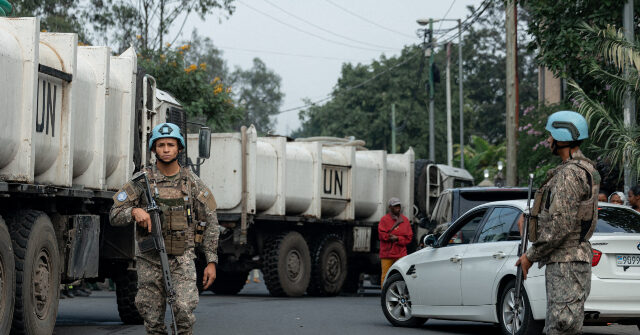
The U.N. mission to the Democratic Republic of the Congo (DRC) confirmed on Wednesday that it helped evacuate medical staff with the World Health Organization (W.H.O.) this week after they were trapped by deadly clashes between the DRC military and one of the country’s many heavily armed militias.
The crew members, the W.H.O. had previously informed, were in Ituri province to help with the response to the nation’s ongoing outbreak of Ebola Bundibugyo, a more uncommon strain for which neither a vaccine nor specific treatment exists. Ituri is at the heart of the Ebola outbreak, which the W.H.O. first declared a public health emergency in May but is believed to have begun much sooner, possibly at the beginning of the year. The latest statistics have documented over 11,000 cases of Ebola tied to the current outbreak and over 5,600 deaths; the fatality rate has recently hovered around 50 percent.
The United Nations Organization Stabilization Mission in the Democratic Republic of the Congo (MONUSCO) confirmed that its peacekeepers were involved in the rescue of ten health workers in Ituri who had barricaded themselves in the maternity ward of the Akwe General Referral Hospital to protect themselves from the ongoing battles between the Congolese military and Convention for the Popular Revolution (CRP), a militia seeking to overthrow the government in Kinshasa. The peacekeepers deployed on Sunday and were directly involved in the rescue, MONUSCO said in a statement.
The operation to help the Congolese military against the CRP, it explained, faced significant logistical challenges.
“Difficult terrain, poor road conditions and the fragile state of a wooden bridge prevented the peacekeepers from continuing along their initially planned route,” it shared. “They therefore explored alternative options while maintaining contact with the healthcare workers and the team assigned to receive them, in order to identify an accessible meeting point.”
The health workers, MONUSCO added, were being relocated to Bunia, the regional capital of Ituri, to continue their work on the Ebola emergency.
MONUSCO’s confirmation followed the head of the W.H.O., Tedros Adhanom Ghebreysus, issuing an announcement that the health workers in question were safe, but offering no specific details of what occurred. Tedros explained the W.H.O. workers were trapped alongside employees of the Congolese Ministry of Health, “where they were sheltering amid fierce conflict for over three days.”
Tedros had previously explained that the workers were trapped “in a maternity ward of the facility” where they were working.
The W.H.O. and other international humanitarian groups have struggled throughout the past year to provide adequate care to those affected by the Ebola outbreak in eastern DRC. The two largest challenges have been the local population’s general distrust of international humanitarian workers, which has resulted in targeted attacks on Ebola treatment centers, and the chaotic and incessant guerrilla warfare between the government and various warring militias. This week’s crisis was triggered by an advance by the CRP, a militia led by the rebel Thomas Lubanga. Lubanga was convicted in 2012 by the International Criminal Court (ICC) of crimes against humanity, specifically recruitment of child soldiers. He was freed in 2020, having served a full 14-year sentence, and returned to organizing an armed uprising.
The CRP announced on Tuesday, shortly after an advance on Bunia, that it would pause its violence temporarily, claiming that it was in fruitful negotiations with the DRC government, according to Al Jazeera. It is unclear at press time how long Ebola workers can rely on that pause to continue contact tracing and treatment efforts.
Even with a halt in the violence, significant damage has been done to public health efforts. The local outlet Radio Okapi reported on Monday that the clashes had triggered mass displacement of local populations in Ituri, sending potentially thousands fleeing to Bunia. Many are fleeing both the attacks and the economic consequences of them, Radio Okapi observed.
“This violence seriously disrupts economic life in the affected localities,” the outlet detailed. “Shops, stores, markets and pharmacies remain closed. Residents are limiting their movements for fear of new attacks, local sources note.”
The government has largely failed to track those potentially exposed to Ebola in eastern DRC in large part because of these displacements. Once lost to flight, residents of local villages become nearly impossible to track and may be spreading the virus in Bunia or larger population centers without any meaningful public health tracking.
Follow Frances Martel on Facebook and Twitter.