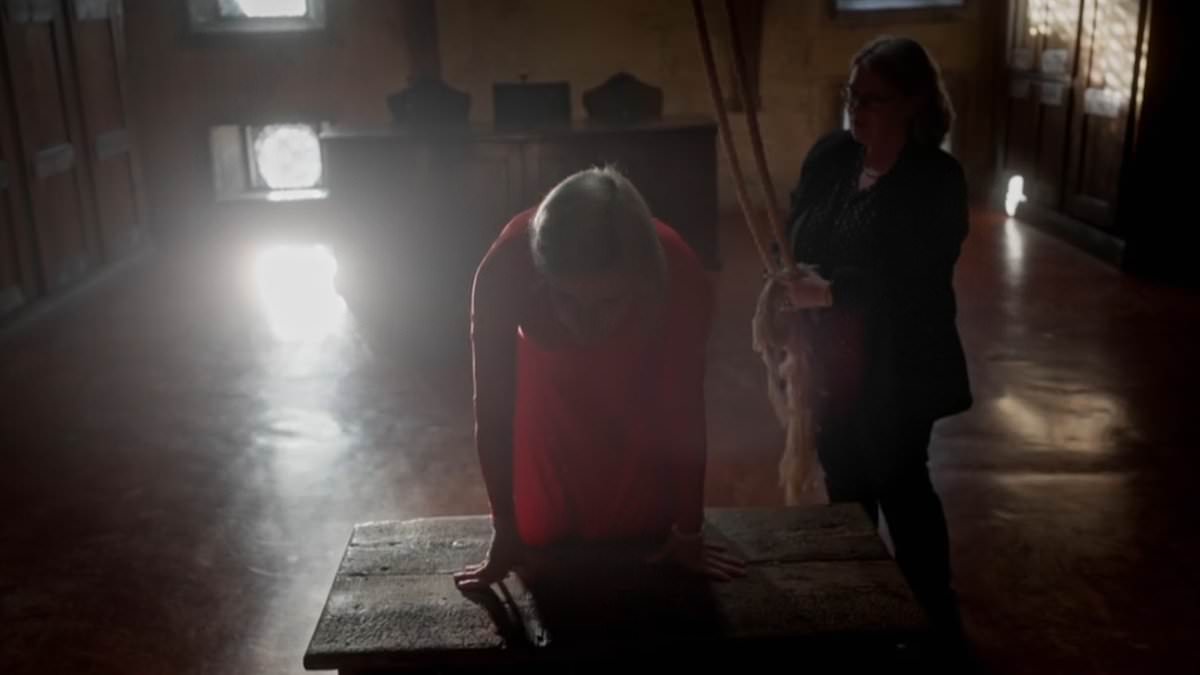
This is the moment television historian Lucy Worsley was placed in a notorious rope torture device used to interrogate prisoners in a dark Venetian palace chamber.
The chilling practice known as 'Dare La Corda', or the 'Giving Rope', was used to question those being detained at Doge's Palace in Venice from the 15th century.
Prisoners would be suspended and hoisted into the air by their wrists with their arms bound behind their backs, often resulting in dislocated shoulders or broken bones.
In her new documentary 'Lucy Worsley's Keys to the Castle', airing on BBC Two on November 23, the host was taken to the torture chamber while touring the palace.
Worsley is shown the device, before being invited to kneel down on steps. Her hands are then tied behind her back and a rope is attached to her bound wrists.
Her tour guide - British art historian Dr Susan Steer who specialises in medieval and Renaissance Venice - asks her: 'Lucy, would you care to kneel here?' Worsley replies: 'That feels quite vulnerable, doesn't it, because you've got nothing to hold on to?'
Dr Steer continues: 'Yes, it does. Can you put your hands behind your back? And then we're going to tie the rope.' The historian wails and says: 'I don't like this.'
Worsley appears terrified as Dr Steer goes on: 'And then the other end of the rope is attached to a crank and there's going to be a guy operating the crank.
Lucy Worsley (left) is shown the 'Dare La Corda' torture method at Doge's Palace in Venice
The television historian is told to kneel on a set of steps while Dr Susan Steer picks up the rope
Worsley's hands are tied behind her back and the rope is attached to her bound wrists
'Dare La Corda' was used to question those being detained at the palace from the 15th century
'Remember that it's still very dark and gloomy, you're terrified. Your interrogators are behind you, you can't see them, they want information. You fail to co-operate for a second - you're yanked up into the air and then you're dropped back down again.'
Worsley then raises her hands behind her back while standing still, asking: 'I go up like this, do I, if you do it really hard?'
Dr Steer replies: 'You do, you do. And there's a possibility that your shoulders could perhaps dislocate and on occasions people's arms even broke. It's pretty vicious stuff. And this becomes known as "Dare La Corda" - "Giving Rope".'
Describing the device as 'chilling', Worsley also says: 'So it's only a bit of rope, but it becomes a source of legend, an urban legend?'
Dr Steer adds: 'Oh yeah, people were really aware of the consequences of crime.'
Dare La Corda, also known as the 'Strappado', was a common judicial torture method used in Renaissance Italy, including at Doge's Palace until the 18th century.
The device would leave the prisoner's full body weight hanging from their shoulders and arms, which often caused torn ligaments and nerve damage.
Harsher forms of the torture would see prisoners hung for extended periods; raised and dropped suddenly; or weighted with heavy objects attached to the feet.
Authorities in the Republic of Venice used torture as an investigative tool to obtain confessions or corroborate testimony in serious criminal or political cases.
Worlsey is shown how prisoners would have been pulled up by the rope during interrogations
The rope was attached to a crank which would pull prisoners up into the air at the palace
Worsley says the device is 'chilling' and describes how it 'becomes a source of urban legend'
Worlsey visited Doge's Palace in her new documentary 'Lucy Worsley's Keys to the Castle'
The drawing of the 'Dare La Corda' or 'Strappado' by French artist Jacques Callot in 1633
Doge's Palace, which has been a museum since the 1920s and is a well-known landmark in the city, was once at the heart of the Venetian Republic's political power.
The building – which also had its own prison - was originally constructed in 810 before being rebuilt in 1340 and extended over the following centuries.
In the documentary, Worsley will also visit Blenheim Palace in Oxfordshire, the Palace of Versailles in France and Neuschwanstein Castle in Germany.
She will guide viewers through the architecture, design, art, personal treasures and artefacts found in the buildings and talk about the people who lived there.
Speaking about the series, Worsley said: 'This is my dream project, and I can't believe how lucky I am.
'I've had years of being behind the scenes at various castles and palaces and know how much fun it can be, and I really hope to share that with viewers.'
Amanda Lyon, executive producer at BBC Studios, added: 'Every building tells a story about the people that lived in it.
'We're thrilled to be working with Lucy and the custodians of the four palaces to look at these iconic buildings in a fresh and revelatory way.'
'Lucy Worsley's Keys to the Castle' airs in the UK on BBC Two from November 23 at 9pm GMT; and on PBS in the US from December 6 at 8pm Eastern Time