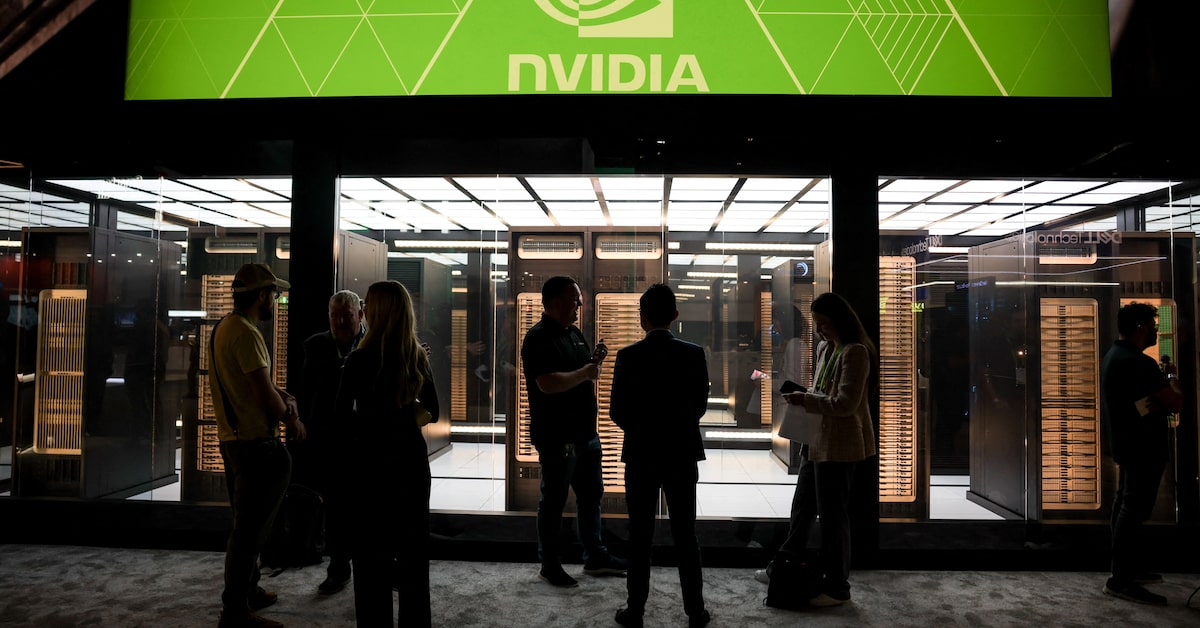
Guests tour the NVIDIA booth during the NVIDIA GTC global AI conference in San Jose, California, U.S. March 17, 2026. REUTERS/Carlos Barria
LONDON, Nov 26 (Reuters Breakingviews) - Jensen Huang is back. But the controversy surrounding the Nvidia
(NVDA.O), opens new tab
boss’s departure and dramatic reinstatement contains an uncomfortable lesson for the United Arab Emirates. Singapore’s suspected role in facilitating Chinese access to the $4 trillion group’s GPUs suggests that missteps involving one company can trigger restrictions affecting entire countries. While Abu Dhabi has escaped Washington's latest chip crackdown, its privileged access rests on unstable ground.
Earlier this month, Washington tightened chip-export controls on five countries, including Singapore and Malaysia, following its investigations into the suspected “diversion” of semiconductors. The US subsequently blacklisted Singapore-based cloud company Megaspeed, a key Nvidia customer. The new rules also restrict certain Chinese groups’ access to substantial computing power outside the US. The UAE, however, escaped the additional country-specific restrictions.
Given the back story, that’s quite striking. Abu Dhabi's AI champion G42 previously maintained ties with Huawei and other Chinese technology firms, alarming US officials. According to Kate Koren, who formerly worked at the US Commerce Department’s Bureau of Industry and Security, the UAE has long served as a conduit for restricted goods bound for Iran and Russia; Mishel Kondi, a senior analyst at research group C4ADS, calls it "a jurisdiction that carries meaningful risk". Kondi's research identified shipments of older Nvidia products from the UAE to Iran and Central Asia, but found no confirmed diversion of advanced AI chips to China. G42 and the UAE Ministry of Foreign Affairs didn't respond to requests for comment. Last year, G42
said, opens new tab
its security protocols were designed to prevent the diversion or misuse of chips.
Washington’s strategic bet on the UAE helps explain its favourable treatment. The US wants the Gulf state's ambitious push to become a global AI powerhouse, anchored by a 5-gigawatt data centre campus whose first phase alone involves $30 billion of investment, to rely on American rather than Chinese technology. Microsoft's
(MSFT.O), opens new tab
$1.5 billion
investment, opens new tab
in G42 back in 2024 helped underpin that shift. A preliminary deal last year envisaged annual imports of up to 500,000 advanced Nvidia chips, a fifth earmarked for G42 and the rest for American companies operating there. Washington formalised aspects of that agreement in July by easing export restrictions on advanced chips and other sensitive technologies.
Yet Washington's reservations are clearly written into this arrangement. Koren, who was involved in the discussions, recalled disagreements over G42's trustworthiness. When Washington eased restrictions in July, it only granted licence-free access to selected companies, including G42 and its cloud subsidiary Core42, rather than the entire UAE. That gives those companies an advantage over unapproved domestic rivals while allowing regulators to reconsider individual authorisations.
Under the
rules, opens new tab
, the benefiting Emirati groups must seek further approval if they have not become “US companies” by April 2027. Koren believes this requirement concerns where the companies are headquartered, though the precise terms are unclear. G42 has even explored selling a majority stake to American companies, Bloomberg
reported, opens new tab
in September. Either way, if G42 were to lose the privileges gained from the July deal it could require new licences, delaying chip deliveries and the revenue from data centres built around them.
The Iran war adds another complication. Iranian attacks prompted Abu Dhabi to reconsider the design of its flagship AI campus, strengthening the case for geographical diversification. Yet G42 cannot necessarily take its privileged access to US chips abroad. Its overseas ambitions already extend to Indonesia, one of the five countries now facing tighter chip controls. The remote access rules raise a different challenge: verifying who ultimately uses computing power can be even harder than tracking the chips themselves, according to Jacob Feldgoise, a researcher at Georgetown University's Center for Security and Emerging Technology. As G42 expands through partnerships with local players, it may increasingly have to rely on others to ensure compliance.
Washington has compelling reasons to keep Abu Dhabi close, particularly during the Iran conflict. But Singapore shows how quickly things can change once a jurisdiction is seen as porous. The irony is that the more successful G42's international expansion becomes, the harder it may become to preserve the American trust that made it possible.
Context NewsNvidia has told manufacturing partners such as Dell and Supermicro to stop shipping servers containing its chips to Malaysia, Singapore, Thailand and Indonesia, the Financial Times reported on November 26.It was unclear whether the halt would be temporary, as Nvidia and its partners work through compliance requirements under new US export controls, the newspaper said, citing three people familiar with the matter.The US on November 16 announced tighter export controls requiring licences for advanced AI chip shipments to Singapore, Malaysia, Thailand, Indonesia and Brazil, citing concerns about diversion to China.The rules also require licences for chips destined for data centres anywhere in the world providing more than 12 million aggregate TPP (total processing performance) to companies headquartered in China or other restricted jurisdictions, including through intermediaries.
Editing by George Hay; Production by Gokul G K
Our Standards: The Thomson Reuters Trust Principles., opens new tab
Yawen focuses on European energy and luxury companies, commodity markets, and real estate as a columnist for Reuters Breakingviews in London. Previously, she was a columnist with Breakingviews in Hong Kong, covering a broad spectrum of topics concerning the Chinese economy, financial markets, and regional companies. She initially joined Reuters News as an economics correspondent in 2016. She earned the title of Reuters’ Journalist of the Year in 2023 in the commentary category.