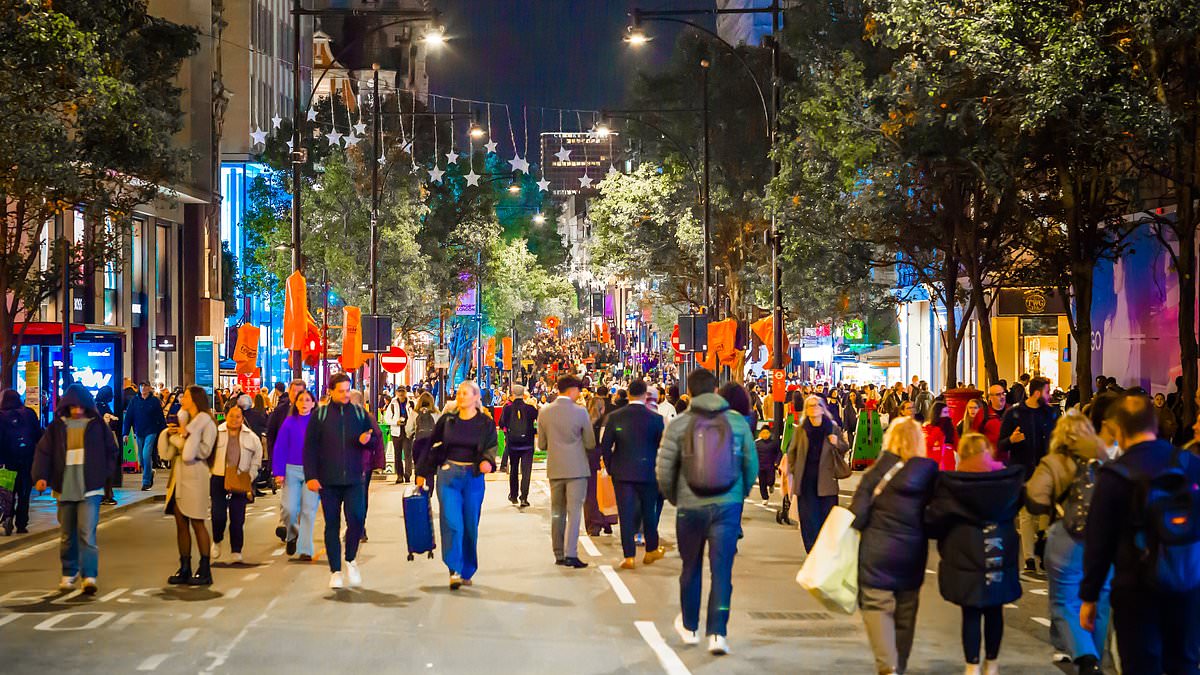
Sadiq Khan's pedestrianising of Oxford Street has hit the headlines in recent weeks, with reports of chaos dominating the surrounding streets.
Bicycles, cars, buses and taxis were banned from half a mile of Britain's most famous shopping street on October 26, with plans to install benches and trees as part of a revitalisation project that will cost £150million.
A string of other UK cities are implementing – or have already begun to trial – pedestrian zones.
So, which ones are in the works – and what do locals have to say?
What's happened to Oxford Street?
Oxford Street officially closed to vehicles last month
Sadiq Khan's controversial pedestrianisation of Oxford Street has sparked traffic chaos, with motorists facing lengthy queues as vehicles are diverted away from the road for the first time.
The London Mayor's long-awaited scheme came into force last month, banning cars, buses, taxis and cyclists from almost a kilometre of the capital's busiest shopping street.
London Mayor Sadiq Khan hailed the move to pedestrianise the busy shopping hub as 'a truly momentous occasion for the capital' – but cyclists have been flouting the new rules by sailing past the obstructive green bollards and signs installed.
One of the capital's residents best placed to assess the impacts of the new scheme is Bahrain 'Baha' Mujagata, who, at 21, is thought to be London's youngest black cab driver.
He described how the surrounding roads have already been overrun with traffic – and was already wistfully recalling 'how it was before.'
The driver said he was not against the pedestrianisation of Oxford Street in principle but that Mr Khan's effort was not the way forward.
Camden High Street, London
Parts of Camden High Street are under trial pedestrianisation
In May 2025, Camden Council launched a trial pedestrianisation of part of Camden High Street to create a safer, healthier and more enjoyable space for everyone.
This summer, it looked at making the trial permanent, as well as seeking views on a potential expansion of the traffic-free area.
In the most recent consultation, 57 per cent of those who responded agreed with the proposal to make the pedestrianisation permanent, with 51 per cent of those living in the Camden Town area agreeing.
Following this consultation and the wider improvements in the area, it has been agreed that the changes trialled are now permanent.
Councillor James Slater, cabinet member for Planning and Sustainable Camden, said: 'Camden Town is an important shopping and transport hub for local residents as well as being an internationally recognised destination that draws people in from across London, the rest of the UK, and the world.
'Since May last year, we have been trialling a traffic-free section of Camden High Street, in response to feedback that the dominance of motor vehicles on this stretch of road was creating a negative experience for residents and visitors.
'Pedestrians overspilling from the pavement as well as poor air quality meant we needed to act, so we launched a pedestrianisation trial.
'After 18 months, we asked this summer whether you wanted to see the pedestrianisation become permanent. Based on our consultation and the positive outcomes we have seen, we have made the decision to make it permanent.'
He added: 'We also heard that many of you are open to the idea of the pedestrianisation being extended over the Camden Lock bridge towards the junction with Chalk Farm Road.
'We will therefore be developing and testing a design for a potential extension over the next few months, and we will publish further information next spring to seek your views on it.'
Madeira Terrace, Brighton
Victorian Madeira Terrace and Madeira Lift are awaiting restoration
Madeira Terrace in Brighton has announced it will become pedestrian-first – getting rid of parking spaces.
Madeira Terrace is a Grade II-listed, 865-metre-long stretch of seafront arches and promenade on Madeira Drive in Brighton.
Work on Phase One, the first 28 arches and a new lift to improve access to the eastern seafront, began in November 2024.
It is anticipated the first restored section will open in 2026, the local council said.
Soon, the area will be largely pedestrianised – but there will also be six accessible parking spaces available.
Jacob Taylor, deputy leader of the council and vice-chair of the Seafront Development Board, said: 'We've invested significant time, money and care in restoring Madeira Terrace, and it's fantastic to see it taking shape.
'Now we're developing plans to activate this space and make it an exciting destination for residents and visitors.
'It's a key part of the regeneration of the eastern seafront and a vital connection between different venues, businesses and attractions.
'Opening up the space gives us the potential for markets, arts, culture and other activities to offer people ever-changing reasons to visit throughout the year.'
Not all locals are pleased, though. One took to Facebook to say: 'Yeah perfect for the anti-car city. Just enforce a congestion zone and you've done it all.'
Another wrote: 'Looks lovely for the summer, what happens for the rest of the year when it's hammering down with rain and windy as hell and there's no pedestrians, plus Brighton's extortionate business rates.You'd have to be mad to open a business there but the idea is nice.'
A third chimed in: 'This looks lovely but you need a place for traffic. Making tourists rely on trains when trains can have engineering work is silly.'
Donegall Place, Belfast
Donegall Place in Belfast is set to be pedestrianised
Belfast city centre is set for major pedestrianisation plans.
Under the Eastern Transport Plan 2035, there will also be a city centre-wide 20mph (32km/h) speed limit. It is currently under public consultation.
Pedestrian spaces include Donegall Place, Castle Place and parts of Castle Street and High Street. Hill Street in the Cathedral Quarter is under an experimental scheme too.
Stormont's Infrastructure Minister Liz Kimmins said it would create a 'modern transport system that better serves residents, businesses and visitors alike'.
Proposals involve 'expanded pedestrian-priority streets and a new civic spine', the Department for Infrastructure said.
But the local reaction thus far has been mixed. One Belfast resident told the BBC: 'If you pedestrianise the streets you can kill it, particularly at night - the nighttime activity can sometimes disappear.
'I like to feel the activity with a mix of traffic and pedestrians and if it doesn't have that a city can die.'