A giant hidden planet could be lurking at the edge of our Solar System, scientists have claimed.
The mysterious world may have remained undetected beyond Neptune for billions of years despite humanity's increasingly sophisticated search of the cosmos.
The proposed world, nicknamed ‘Planet X2’, would be around 1.5 to two times the mass of Earth and orbit hundreds of times farther from the sun than our planet.
Its gravity could account for the oddly tilted and elongated orbits of distant icy bodies which have long puzzled scientists.
‘Imagine discovering, after decades of mapping our Solar System, that another planet has been hiding from us all this time,’ Dr Patryk Sofia Lykawka, of Kindai University in Japan, said.
‘If this planet exists, it could change how we understand the history of our Solar System and how its most distant objects came to follow such unusual orbits.’
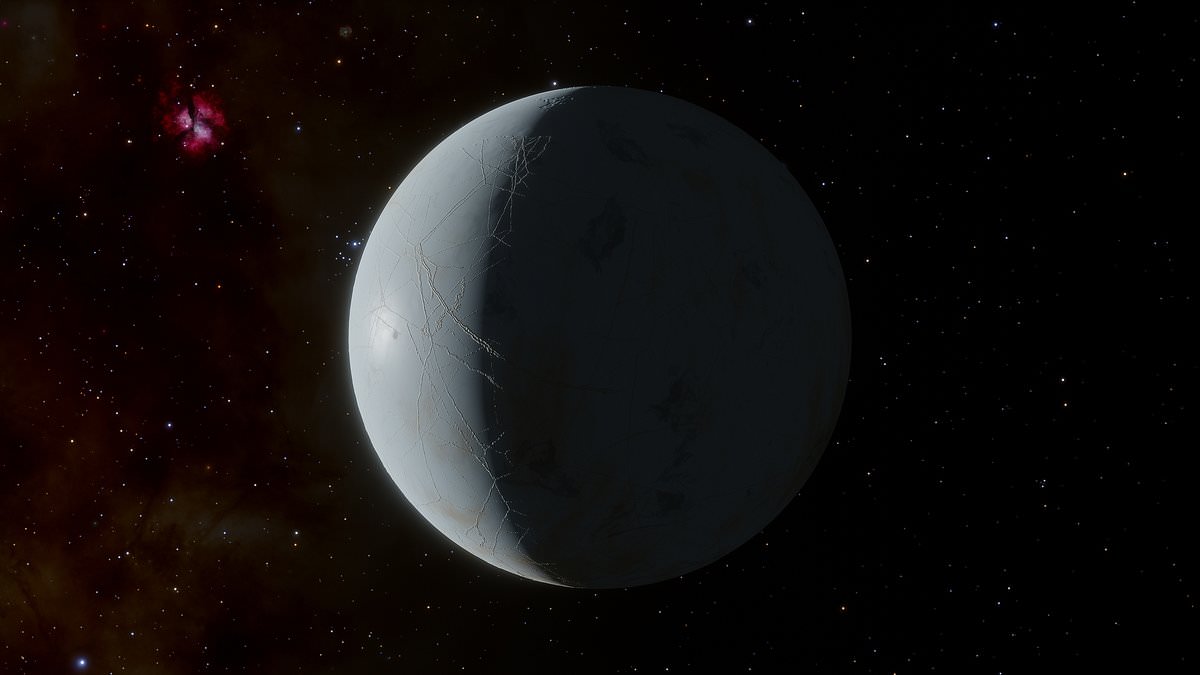
An artist's impression of the hypothetical Planet X2, which could be hiding beyond Neptune. If this planet exists, it could 'change how we understand the history of our Solar System'
The proposed world, nicknamed ‘Planet X2’, would be around 1.5 to two times the mass of Earth and orbit hundreds of times farther from the sun than our planet
Beyond Neptune lies a vast region filled with frozen remnants from the Solar System's formation, known as trans-Neptunian objects.
Most travel around the sun in relatively predictable paths within the Kuiper Belt.
But over the past two decades, astronomers have identified a growing number of far-flung objects with unusually stretched and tilted orbits that defy easy explanation.
Among the most puzzling is Sedna, an icy world whose elongated journey takes it far beyond the realm of the known planets.
Some scientists have suggested these strange movements could be the result of an unseen planet exerting a gravitational influence from deep space.
To investigate the idea, researchers ran computer simulations spanning the entire 4.5-billion-year history of the Solar System.
The models tested how a hidden planet with different masses and orbital paths might affect distant icy objects over time.
Their simulations suggested a previously undiscovered world could explain many of the strange orbital patterns astronomers observe today.
The simulations suggest that a hypothetical distant planet, dubbed Planet X2, could help explain the unusual elongated and tilted orbits of icy objects far beyond Neptune, represented by the red and magenta orbital paths
Scientists say there could be a hidden planet beyond Neptune. Pictured: Our current understanding of the planets in our Solar System. Left to right: Mercury, Venus, Earth, Mars, Jupiter, Saturn, Uranus, Neptune
The team's simulations indicate Planet X2 could be up to two times Earth's mass and follow a highly elongated orbit hundreds of astronomical units from the sun.
Even at its closest approach, the planet would remain at least 200 times farther from the Sun than Earth, making it exceptionally difficult to spot.
Researchers found its gravity could gradually pull distant objects away from Neptune's influence and tilt their orbits to extreme angles.
The findings offer an alternative to the better-known Planet Nine theory, which proposes a much larger and more massive world lurking in the outer Solar System.
While the new model does not perfectly match every known observation, scientists say it successfully reproduces several of the unusual features seen among distant icy bodies.
Dr Lykawka said: ‘Our model reproduces several of the unusual orbital patterns observed among distant icy objects, although there are still differences between the model and observations that we need to investigate further.’
The idea builds on a centuries-long hunt for hidden worlds, including the search for the original ‘Planet X’ that ultimately led to Pluto's discovery in 1930.
Scientists now hope a new generation of powerful telescopes will finally reveal whether another planet is indeed waiting to be found in the darkness beyond Neptune.
The paper has been published in Monthly Notices of the Royal Astronomical Society.
Professor Jonti Horner, a co-author of the study from the University of Southern Queensland, said future observations, including those from the Vera C Rubin Observatory's Legacy Survey of Space and Time, could help researchers test predictions about the distant Solar System and search for the undiscovered planet.
‘The exciting thing is that we now have an opportunity to put this idea to the test,’ he said.
‘As the Rubin Observatory surveys the sky, we will find new clues that help us understand the distant reaches of the Solar System – and whether another planet is still waiting to be discovered.’
Planets of the solar system: The basicsMercury
Distance from Sun: 58 million km
Orbital period: 87 days
Surface area: 74.8 million km²
Radius: 2,440 km
Mass: 3.285 × 10^23 kg (0.055 M⊕)
Length of day: 176 days
Moons: None
Venus
Distance from Sun: 108.2 million km
Orbital period: 225 days
Length of day: 116 days and 18 hours
Moons: None
Surface area: 460.2 million km²
Radius: 6,051 km
Mass: 4.867 × 10^24 kg (0.815 M⊕)
Earth
Distance from Sun: 148.13 million km
Orbital period: 365 days
Surface area: 510 million km²
Radius: 6,371 km
Mass: 5.972 × 10^24 kg (1 M⊕)
Length of day: 24 hours
Moons: The moon
Mars
Distance from Sun: 228 million km
Orbital period: 687 days
Surface area: 55.91 million mi²
Radius: 2,106 miles
Mass: 6.39 × 10^23 kg (90.107 M⊕)
Length of day: 24 hours, 39 minutes, and 35 seconds
Moons: Phobos, Deimos
Jupiter
Distance from Sun: 782.34 million km
Orbital period: 12 years
Surface area: 61.42 billion km²
Radius: 69,911 km
Mass: 1.89813× 10^27 kg (317.9 M⊕)
Length of day: 9 hours and 56 minutes
Moons: 95 formally recognised moons
Saturn
Distance from Sun: 1.434 billion km
Orbital period: 29 years
Surface area: 42.7 billion km²
Radius: 58,232 km
Mass: 5.683 × 10^26 kg (95.16 M⊕)
Length of day: 10 hours and 42 minutes
Moons: 82 with formal designations; innumerable additional moonlets
Uranus
Distance from Sun: 2.913 billion km
Orbital period: 84 years
Surface area: 8.1 billion km²
Radius: 25,362 km
Mass: 8.681 × 10^25 kg (14.54 M⊕)
Length of day: 17 hours and 14 minutes
Moons: 28 known moons
Neptune
Distance from Sun: 4.4702 billion km
Orbital period: 164.8 years
Surface area: 7.6 billion km²
Radius: 25,362 km
Mass: 1.024 × 10^26 kg (17.15 M⊕)
Length of day: 16 hours and six minutes
Moons: 28 known moons