Damaged electrical goods returned to UK supermarkets are ending up in a 'megadump' in Ghana, a new report has found.
Faulty home appliances, such as toasters and slow cookers, that were returned to stores including Tesco, Argos and Asda, have appeared at Agbogbloshie, one of the world's largest e-waste sites, in Accra, according to an investigation by Unearthed and Greenpeace Africa.
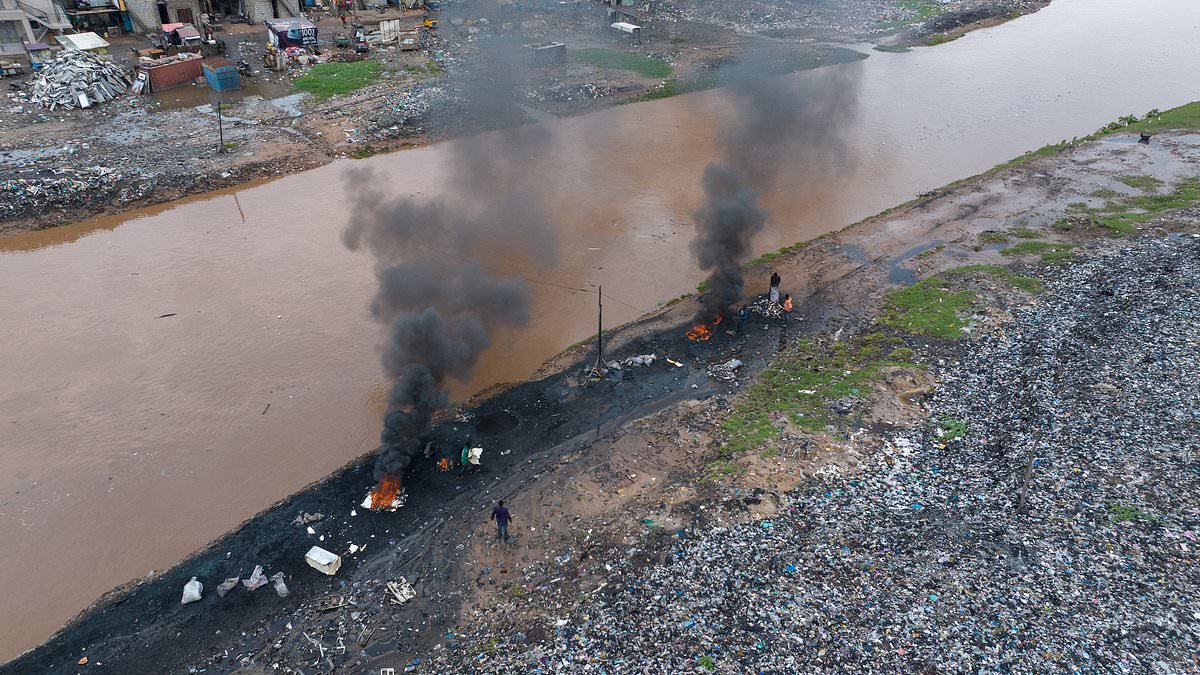
Images show mountains of household items being burned and stripped down at the dump by workers, who do not appear to wear protection like gloves and masks, according to the report.
Among the items found at the Accra dump were Tesco own-brand slow cookers and toasters.
It is illegal to export damaged electrical goods to Africa under UK export legislation.
Tesco said today it had suspended its third-party electronic waste management providers while it completed a full investigation into their practices.
'We're extremely concerned about these claims … We remain committed to removing or reducing the waste across our operations wherever we can, and we work closely with experts to ensure we handle materials responsibly, in line with legal requirements and our own robust standards,' Tesco said.
Similarly, Argos own-brand Cookworks products, as well as slow cookers, toasters and food slicers, were found at Agbogbloshie.
An aerial view of the Agbogbloshie e-waste dumpsite
Fires burning plastic waste from information e-waste processing are seen at the Agbogbloshie dumpsite
Items from British stores are visible in a pile of items at Agbogbloshie e-waste dump site
'As a responsible retailer, we have processes in place for products returned to Argos. We take these findings seriously and are reviewing the information provided to establish what further action is needed to ensure our requirements are met,' Argos said in a statement.
The investigation also discovered that dozens more British items with return labels, including several marked as faulty, were being sold in secondhand shops in neighbouring areas.
According to the report, shopkeepers said they had bought the items from brokers in the UK.
All major UK retailers that sell electrical items operate a take-back scheme, which requires them to accept and recycle old items customers return.
The goods should be logged as e-waste and, under the Waste Electrical and Electronic Equipment Regulations, should be passed on to approved processors.
They can only be exported if the shipper can prove they will be handled in high-quality facilities.
The investigation traced the route by which the products could have ended up in Ghana.
When recently purchased items are returned to shops for a refund, whether they are faulty or not, they can enter the liquidation market, along with other consumer returns, according to the investigation.
Smoke rises as electrical items are burned at the Accra waste dump
Among the items found were toasters and slow cookers from British supermarket chains
Multiple George Home toasters, from Asda, sit in a pile of e-waste at Agbogbloshie e-waste dump
A Tesco kettle for sale in a secondhand electronics shop in Accra after it was returned to Tesco
A George Home toaster, with Asda receipt attached, found in a pile of e-waste at Agbogbloshie e-waste dump
An Argos Cookworks black toaster found at Agbogbloshie e-waste site in October
Many of the items Greenpeace found in Agbogbloshie and second-hand stores had stickers labelling the goods as 'untested return'.
The investigation also claimed that returned goods are often sold off in bulk, at a fraction of their original price.
Greenpeace UK's chief scientist, Dr Doug Parr, said: 'Customers will be appalled to learn that, instead of being repaired or recycled, these faulty returns ended up in a notorious megadump leaching toxic run-offs that poison entire communities. This isn't the circular economy, but long-range fly-tipping, and it's shameful.'