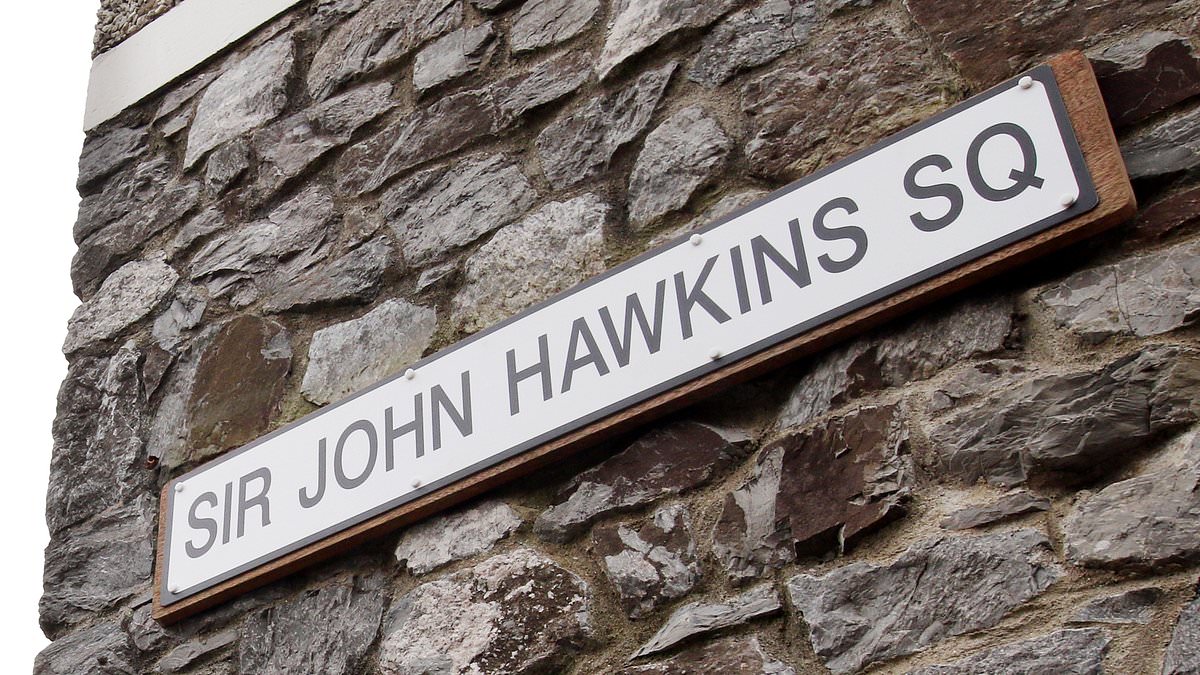
A sign bearing the name of England's first slave trader has been put back up in a town square despite previous protests over his role in the slave trade.
The Sir John Hawkins Square sign was removed by Plymouth City Council in 2020 following Black Lives Matter protests. Sir John was a cousin of Sir Francis Drake, a leading figure in Queen Elizabeth I's navy.
But he was also England's first slave trader, pioneering the route taking enslaved west Africans across the Atlantic to be sold in the Caribbean.
‘Woke’ councillors planned to rename it Justice Square, or Jack Leslie Square, after a 1920s footballer for Plymouth Argyle, the only black professional player in England at the time.
But the square has now regained its original Sir John Hawkins Square signs, after the council feared it would be unable to satisfy new 2023 legislation requiring local authorities to secure ‘sufficient local support’ for name changes.
Instead of erasing the square’s controversial name, the council plans to display a QR code next to the signs, enabling curious onlookers to be directed on their mobile phones to information about buccaneer Sir John’s slave trading.
Council cabinet member Councillor John Stephens said: 'Thousands of men, women and children suffered as a result of the voyages Sir John Hawkins organised and profited from. Recognising that truth is not about erasing history.
'It is about understanding its honesty, and if we are rightly prepared to celebrate people like [late local councillor] Brian Vincent for the positive difference they made to the city, we must also be prepared to acknowledge the harm caused by figures such as Hawkins and ensure the public understand the full story.'
A Plymouth square named after a man who enslaved up to 1,400 Africans has had its name reinstated following six years of legal tussles
Sir John Hawkins first sailed for Africa from Plymouth in 1562 - where he kidnapped 400 Guineans and took them to the West Indies to be sold
Signs for Sir John Hawkins Square were removed in 2020 (pictured then) and had remained blank for years amid legal and legislative tangles
The square, between Higher Lane and Palace Street, was constructed and named in the 1980s when the next door Plymouth Magistrates Court was built.
Council committees of the era put his name forward in an attempt to find a name suitably fitting with the city's Elizabethan heritage for the area.
Sir John was born into a seafaring Devon family in Plymouth in 1532, and soon joined the family business, overriding a career interruption when he killed a local barber in a fight, before winning a royal pardon.
He sailed from Plymouth in 1562 with three ships, kidnapping at least 300 Africans in Guinea and taking them to the West Indies to be sold.
The family coat of arms accordingly soon featured an African slave, and a second slaving voyage in 1564 was endorsed by Elizabeth I, with investors from her court.
The Royal Standard fluttered from Sir John’s fleet of four ships as it left Plymouth a few hundred yards from his future square, with 400 people captured and traded for gold and silver in the Caribbean.
But a third slaving trip in 1567 alongside his cousin Sir Francis Drake ended in chaos. Sir John was wounded and fled the Caribbean with a handful of men after suffering massive losses at the hands of a Spanish fleet.
He then became Treasurer of and a Vice-Admiral in England’s young navy, improving the designs for its galleons, and secured his revenge by helping fight off the Spanish Armada in 1588.
He died at sea fighting the Spanish in the Caribbean, off Puerto Rico, in 1595, and left a mixed legacy of philanthropy and enslavement.
His voyages were among the earliest made by English slave traders, and Sir John is now widely regarded as the country's first of his kind.
A bronze plaque that once bore Sir John's likeness (pictured in 2020) has been replaced with another that no longer features his image
Join the discussion
Should cities remove the names of historical figures linked to slavery, or focus on educating people about them instead?
What's your view?
Plymouth City Council chose to honour the slave trader because of his historical contributions to the city: he had been its mayor, represented it in Parliament and was a powerful figure among the merchants who shaped the town in the 16th century.
But the Black Lives Matter protests of early 2020, triggered by the murder of Black man George Floyd by White police officer Derek Chauvin in Minnesota, prompted a rethink.
Council bosses debated whether to continue honouring Sir John after a statue of slave trader Edward Colston was toppled and chucked into the Avon in Bristol.
But it sparked a huge row after the council initially proposed to rename the square after Black football pioneer Jack Leslie, a Plymouth Argyle player who almost became the first Black player to be capped for England.
Local businessman Danny Bamping took the authority to court in a bid to keep Sir John's name, even as the threat of paying its legal costs hung over his head. It would ultimately cost him thousands.
He lost the case, failed to file his appeal with the High Court, lost a subsequent bid for a judicial review, abandoned an appeal against that review, tried twice more to appeal the original case and tried to seek another judicial review.
Each time, he was told to pay the council's costs, and in April 2023 was handed a civil restraining order banning him from taking the authority to court for two years.
In November of that year, the council began the process of renaming the common Justice Square, but paused the process less than a year later after the law on renaming streets changed.
The new signs then appeared this week. However, a plaque that once bore Sir John's likeness outside The Merchant's House on the square has been replaced with another that no longer has his image.
Cllr John Stephens, of Plymouth City Council, said the QR code would be available in due course.
He added: 'These codes will help residents understand the people whose names appear across our city and ensure that history is presented honestly, completely and in context.'
Sir John Hawkins: The first English slave trader
Sir John Hawkins was an English naval administrator and commander and the chief architect of the Elizabethan navy.
Born in 1532 in Plymouth, he was a merchant in African trade before becoming the first English slave trader.
He sparked conflict with the Spaniards by transporting slaves from Guinea, West Africa, to the Spanish West Indies.
In one voyage he was forced to seek shelter near Veracruz in Mexico, and was attacked by a Spanish fleet in the harbour, but managed to escape.
Early in his career, he led an expedition to capture 300 Africans in Sierra Leone and transport them to Spanish plantations in the Americas.
There he traded them for pearls, hides, and sugar. His missions were so lucrative that Queen Elizabeth I sponsored his subsequent journeys and provided ships, supplies and guns.
He notified the government of a plot by the English Roman Catholics, with help from Spain, to depose Queen Elizabeth and seat Mary Stuart, Queen of Scots, on the throne.
He took over from his father-in-law as treasurer of the navy in 1577 and played a part in designing ships that were used to fight against the Spanish Armada in 1588, during which he was third in command.
In 1593, Hawkins' son Richard was captured by the Spanish in the South Atlantic. In response, Hawkins raised a fleet and set sail.
The rescue attempt was hampered by the Spanish, who had increased their presence in the area. Hawkins died on November 12 in San Juan, off the coast of Puerto Rico.
Source: Britannica