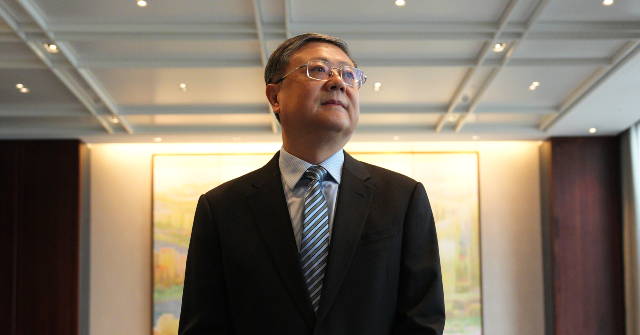
Shanghai Communist Party chief Chen Jining is under investigation for alleged corruption, a stunning purge of a Politburo member widely viewed as a rising technocrat with a potential path to higher office.
Shanghai party officials responded with declarations of absolute loyalty to Xi Jinping and deleted Chen from government websites.
An official identified only as Ma was sentenced to death for allegedly serving as a paid foreign intelligence asset.
China’s political purges kept rolling on Tuesday, with announcements that the Communist Party secretary in Shanghai is under investigation for corruption, and a death sentence was issued for another official accused of spying for a foreign power.
China’s Central Commission for Discipline Inspection, the chief anti-corruption agency for the authoritarian regime, said on Tuesday that Shanghai party chief and Politburo member Chen Jining is suspected of “violating party discipline,” which is political shorthand for corruption.
Chen, 62, has been Party secretary in Shanghai since 2022. His previous positions included the top post at China’s Ministry of Environmental Protection, where he developed a reputation as a technocrat and environmental scientist.
Last year, Chen attended a major event for artificial intelligence (AI) startups in Shanghai. Last month, he hosted Apple chairman Tim Cook and invited him to “make full use of Shanghai’s strengths” as a tech hub and financial gateway between China and the outside world. He was making significant public appearances as recently as a week ago.
Sixty-two is fairly young by the standards of Chinese Communist leadership and Chen was widely regarded as a “rising star” comfortably perched atop one of China’s most important cities with his eyes on even loftier positions. Maximum dictator Xi Jinping was once the party chief of Shanghai, as was Premier Li Qiang, and Xi’s predecessor Jiang Zemin. Chen looked like a plausible successor to the aging Xi.
Chen’s downfall astounded China-watchers, who have already seen three other members of the Politburo purged since last year. Bloomberg News compared his ouster to an “earthquake,” while Eurasia Group senior analyst Mingda Qiu said the Politburo purge is “unprecedented.”
“The takedown again shows that Xi Jinping’s anti-corruption campaign has no limits,” Qiu said.
“It is a warning to all technocrats, as Chen was a rising star among technocrats and had no apparent failures in a technocratic way. So, the message is: adhere to strict party discipline and demonstrate unquestionable loyalty to Xi or else,” Steve Tsang of the SOAS China Institute in London told NBC News.
Chen’s colleagues in the Shanghai Communist Party were quick to throw him under the bus, publishing a rather panicky joint statement of “absolute loyalty” to Xi on Wednesday after holding a late-night meeting to discuss Chen’s downfall.
The Shanghai Communist Party’s house newspaper, the Jiefang Daily, quoted the local party elders applauding Xi and the Central Committee in Beijing for their determination to “persistently advance comprehensive and strict party governance.”
The Jiefang Daily said the dousing of Shanghai’s rising star “sends a strong signal that the anti-corruption campaign will not pause or retreat, and that the fight against corruption is a protracted, all-encompassing battle.”
The Shanghai government got busy erasing Chen from its websites on Wednesday morning, including the webpage that touted his big meeting with Cook, which appears to have been completely deleted.
Meanwhile, a publication called Gold Wall Press linked to China’s powerful intelligence apparatus said on Monday that an official surnamed “Ma” has been sentenced to death for working as a paid operative of a foreign government.
According to the report, Ma “frequently” met with an intelligence operative code-named “Kailin” who originally expressed a desire to learn Chinese. When Ma supposedly balked at performing riskier acts of espionage, another foreign agent threatened to report him to Chinese officials.
Gold Wall Press said the “shocking” case “serves as yet another wake-up call” about the efforts of “cunning” foreign adversaries to recruit Chinese assets. Although the cunning adversary was not named, some purported details of the Ma case were reminiscent of the CIA’s attempts to recruit Chinese intelligence sources.