The shortest route between the poles isn't the one these birds take, and there's a smart reason why.One tracked bird's single round trip left the already-staggering average in the dust.This bird may see more daylight than any other animal alive. How it pulls that off is stranger than you'd guess.Researchers strapped tiny devices to a handful of terns and found the trip home runs on a very different clock than the trip out.
Meet the seabird with the longest migration of any animal. The Arctic tern journeys each year from the Arctic to Antarctica and back again. Its annual round trip covers approximately 44,000 miles as it chases daylight across both hemispheres, experiencing more sunlight than any other animal. A landmark 2010 tracking study revealed a meandering pattern as the birds took advantage of rich feeding grounds and wind patterns along their route.
Arctic terns sit on ice shelves to take a rest during their long journey across the seas.
©J. Luiz Vieira/Shutterstock.com
Scientists Discovered Arctic Terns Fly Farther Than Expected
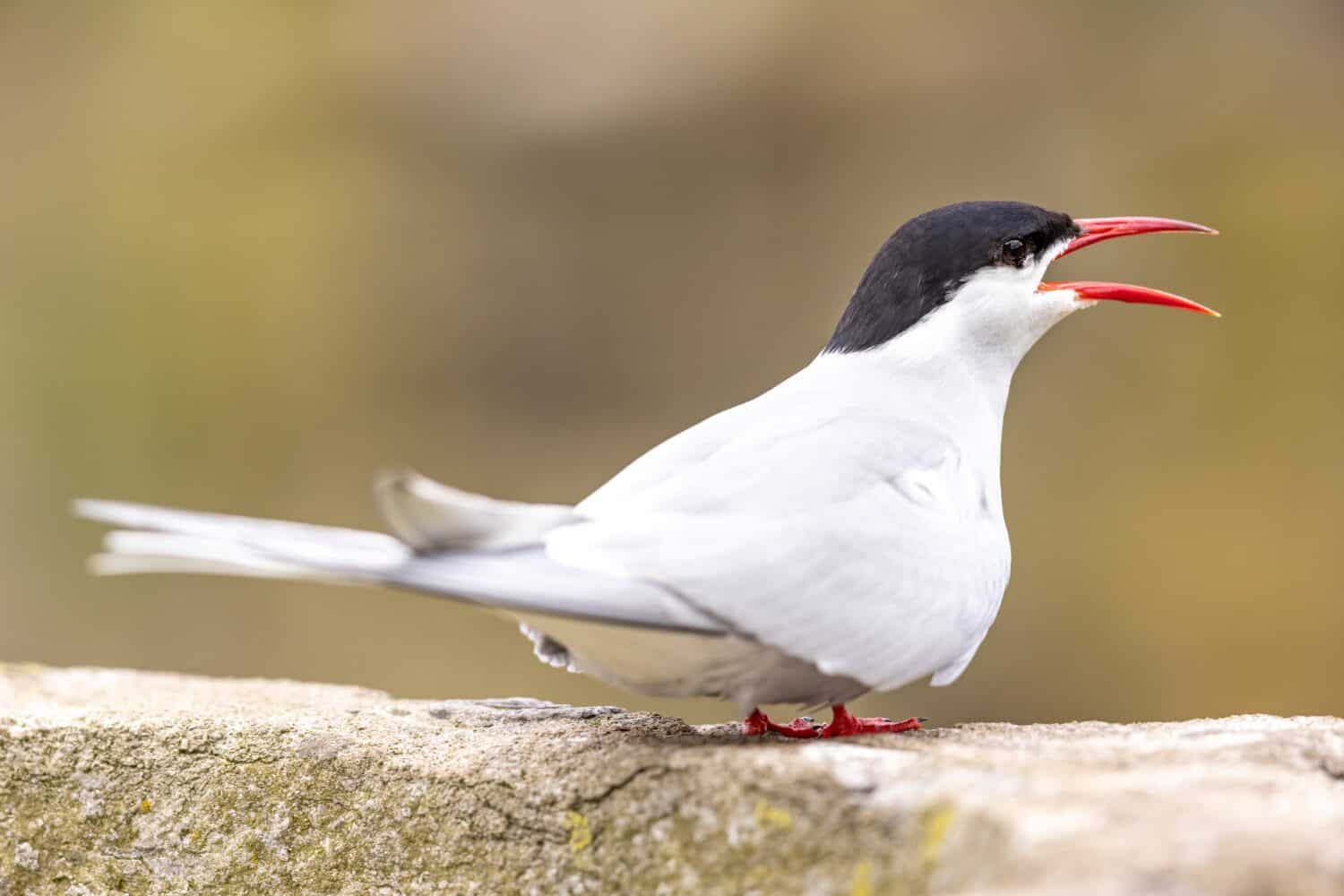
The Arctic tern (Sterna paradisaea) is 15 inches long with a 31-inch wingspan and weighs a mere 3 to 4.4 ounces. Arctic terns eat a diet of primarily fish, mate for life, and live in big, noisy colonies. This medium-sized tern is famous for its staggeringly long migrations across every major ocean. Its lightweight, streamlined body is designed for gliding vast distances, conserving energy on the long journey.
A 2010 study published in the Proceedings of the National Academy of Sciences tracked 11 Arctic terns using lightweight geolocators. Scientists followed the birds’ paths as they traveled from their breeding grounds in Greenland and Iceland to the shores of the Weddell Sea in the marginal ice zone around Antarctica, and back again.
Proceedings of the National Academy of Sciences, 2010
Tracked 11 Arctic terns with lightweight geolocators from breeding grounds in Greenland and Iceland to the Weddell Sea and back; the birds took an indirect route, covering nearly twice as many miles as previously estimated.
Carsten Egevang at the Greenland Institute of Natural Resources, lead author of the paper, said in a press release, “This study on seabird migration has given us an incredibly detailed insight into how long-distance migrants behave at times of the year when it’s normally impossible for us to follow them.”
Arctic terns travel from one pole to the other in their round trip migration.
©ASPhoto2013/Shutterstock.com
What the researchers found was astounding. The birds did not fly in a straight line. Instead, they took an indirect route, covering nearly twice as many miles as previously estimated. The terns also had a long stopover in the middle of the North Atlantic Ocean before continuing on their way. Amazingly, the return trip north didn’t take much longer than a month, while the southbound journey took the tracked terns around three months.
Arctic Terns Use Global Wind Systems to Guide Their Migration
You might think the best travel route is the shortest distance between two points. However, this isn’t true for a bird flying thousands of miles over open water. Arctic terns use global wind systems to conserve energy and also stop over at productive ocean areas teeming with fish to refuel for the grueling flight ahead.
Richard Phillips from the British Antarctic Survey and co-author of the study said in a statement, “They paused in their southward migration to spend time in highly productive waters in the middle of the Atlantic Ocean.”
Rather than fighting against winds, the terns followed wind patterns that gave them more chances to glide instead of spending a lot of effort flapping their wings. Phillips said, “The indirect ‘S-shaped’ return journey in spring indicates that Arctic terns take full advantage of the prevailing global wind systems to reduce energetic costs on their long flight north.”
Why Do Arctic Terns Migrate Between the Poles?
A more recent study from 2019, which analyzed data from eight Arctic tern tracks, determined that food availability, prevailing winds, sea ice cover, and molt habits are major ecological and evolutionary factors in their migration.
Over millions of years, Arctic terns evolved to migrate following the summer sun. Summer brings advantages such as calmer seas and a bright ocean surface, making it easier to spot fish. The terns nest in the Arctic during the northern summer when the sun is above the horizon 24 hours a day.
Here the birds nest on the ground near the water. The females lay around one to three eggs, which they camouflage in shallow ground scrapes. The polar summer is short, and terns usually raise one brood per year.
Covered in soft down at hatching, Arctic tern chicks are raised by both parents
©AndreAnita/Shutterstock.com
When the seasons begin to change, the birds fly south to the Antarctic, where they spend another summer, this time in the Southern Hemisphere, with nearly constant daylight. Because of this unique journey, Arctic terns likely experience more daylight than any other animal.
An Arctic Tern Can Travel Millions of Miles in Its Lifetime
Arctic terns have a long lifespan for a bird that travels to the extreme reaches of the Earth. They can live for 30 years or more. With an average distance of around 44,000 miles each year, the average Arctic tern may fly more than 1.3 million miles in its lifetime.
60,000
miles
Nearly 60,000 miles on a single round trip: the longest recorded annual migration for an individual Arctic tern, tracked from England to Antarctica and back
The longest recorded annual migration for an individual Arctic tern was tracked by researchers at Newcastle University. The tern traveled from the coast of England to Antarctica, and then back again. The small bird, weighing only a few ounces, flew nearly 60,000 miles on a single round-trip migration.
About the Author
Jennifer Geer
Jennifer Geer is a freelance nature writer who loves uncovering fascinating stories about animals and the natural world. At A-Z Animals, she writes about wildlife behavior, scientific discoveries, conservation, and unusual animal encounters. She holds a master’s degree in psychology and has been writing professionally for over seven years.
Connect:
Thank you for reading! Have some feedback for us?
Thank you for your feedback!
We appreciate your help in improving our content.
Our editorial team will review your suggestions and make any necessary updates.
There was an error submitting your feedback. Please try again.