SummaryMore than three-quarters of FAA systems flagged as vulnerableLegacy network failure triggered nationwide ground stop, Duffy saysBillions committed to modernization, but watchdog warns of planning gaps and delays
CHICAGO, Nov 13 (Reuters) - A communications failure that halted flight departures across the United States on Friday has renewed scrutiny of the country's aging air traffic control network, raising questions about its resilience even as the government spends billions of dollars to modernize it.
The Federal Aviation Administration ordered a nationwide ground stop, preventing aircraft from departing US airports, following "a communication issue impacting all Air Route Traffic Control Centers," Transportation Secretary Sean Duffy said in a post on X.
The Misinformation Monitor newsletter rounds up international misinformation narratives, with a "Real or Fake?" quiz in every edition. Sign up here.
Duffy later attributed the outage to a problem with the FAA's legacy network, saying switches and routers had become overloaded with data and went down. It was not immediately clear what caused the equipment overload.
The FAA lifted the ground stop after more than four hours, but Duffy warned that it would take time for air traffic operations to return to full capacity.
More than 1.5 million passengers were scheduled to depart US airports on roughly 11,000 flights after 4 p.m. ET (2100 GMT), shortly after the ground stop began, according to aviation analytics firm Cirium.
The shutdown came on the same day the White House and Transportation Department sought another $30.1 billion from Congress to upgrade airports and air traffic control, including $10.1 billion for air traffic control modernization.
Much of the system's underlying weakness has been documented for years.
The Government Accountability Office reported in 2024 that the FAA had classified 51 of its 138 air traffic control systems as unsustainable and another 54 as potentially unsustainable. Together, they accounted for more than three-quarters of the systems reviewed.
FAA Administrator Bryan Bedford told Reuters in September that the agency's more than 300 air traffic facilities operated as technological silos, relying in some cases on decades-old computers and telecommunications systems that cannot communicate seamlessly with one another.
Some obsolete equipment requires replacement parts obtained through online auction websites or made using 3D printing.
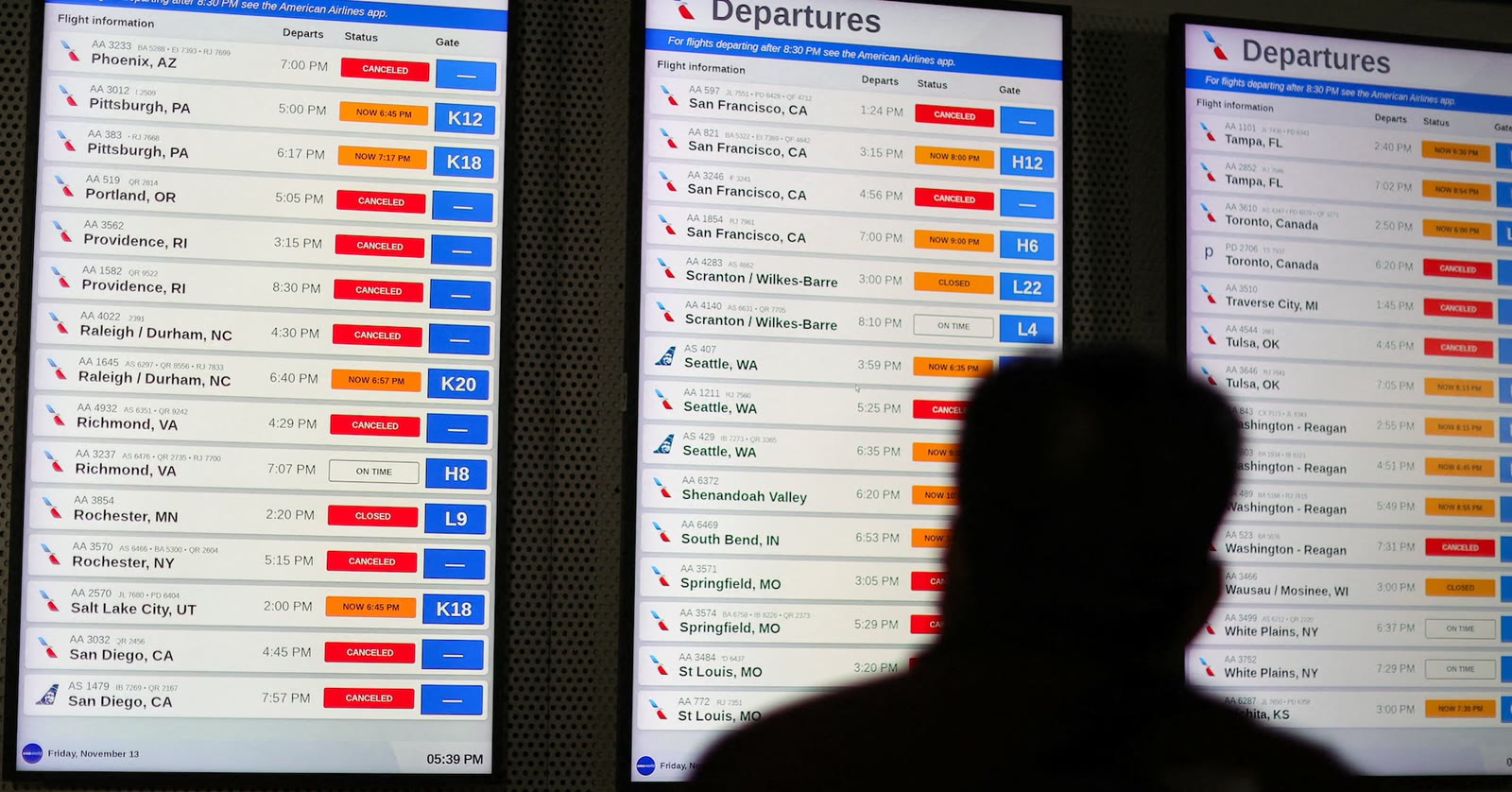
Item 1 of 3 A person looks at a departures board showing cancelled flights at Chicago O'Hare International Airport, after the US Federal Aviation Administration issued a national ground stop "due to extraordinary circumstances and reasons for safety" following the agency's earlier report of serious air traffic control communications issues, in Chicago, Illinois, US, November 13, 2026. REUTERS/Jim Vondruska
[1/3]A person looks at a departures board showing cancelled flights at Chicago O'Hare International Airport, after the US Federal Aviation Administration issued a national ground stop "due to extraordinary circumstances and reasons for safety" following the agency's earlier report of serious air... Purchase Licensing Rights, opens new tab Read more
BACKUP SYSTEMS UNDER STRAIN
An incident in September demonstrated how one communications failure could be compounded by another.
After error messages appeared on a telecommunications circuit serving a Philadelphia air traffic control facility, the FAA's contractor switched to a backup fiber-optic line. A construction crew then accidentally severed that line in New Jersey, contributing to widespread disruption. About 9,500 US flights were delayed or canceled that day.
"When it fails, we just don't have the redundancy that we would get if we had a modern architecture," Bedford said at the time.
Friday's shutdown was the first nationwide ground stop since January 2023, when a failure of the FAA system that distributes critical safety notices to pilots halted departures for less than two hours and disrupted more than 10,000 flights.
Congress approved $12.5 billion in July 2025 to modernize the country's aging air traffic control infrastructure, including telecommunications and radar systems. The administration said Friday that 68% of the FAA's legacy copper telecommunications network had been replaced with high-speed fiber.
But Bedford warned in September that replacing aging copper wires with fiber-optic cables alone would not prevent future outages without a modern telecommunications network.
The overhaul faces challenges beyond securing money.
In September, the Government Accountability Office warned that the FAA lacked a reliable cost estimate and an integrated master schedule for its air traffic control modernization program.
Instead, as of May, it had 11,389 separate project schedules that were not coordinated, raising the risk of repeated work at the same facilities, delays and cost overruns.
The FAA aims to complete the first phase of modernization by December 2028. But the GAO warned that inadequate planning increased the risk of delays, potentially leaving the agency dependent on outdated systems prone to failure for longer.
Reporting by Rajesh Kumar Singh; Editing by Stephen Coates
Our Standards: The Thomson Reuters Trust Principles., opens new tab
Rajesh Kumar Singh is the U.S. Aviation Correspondent at Reuters, based in Chicago, where he reports on airlines, aircraft manufacturers, and regulatory developments that shape the global aviation industry. Prior to this role, he covered U.S. manufacturing and trade policy, including the U.S.–China trade wars, where his work delved into the disruption facing American businesses and the strategic responses of major corporations. He began his career with Reuters in India, where he reported on a wide range of issues covering the country's economic complexities—from its recovery after the global financial crisis to the challenges of inflation and governance.