Order Jamie Glazov’s new book, ‘United in Hate: The Left’s Romance with Tyranny, Terror, and Hamas’: HERE.
From Religious Debate to Personal Faith:
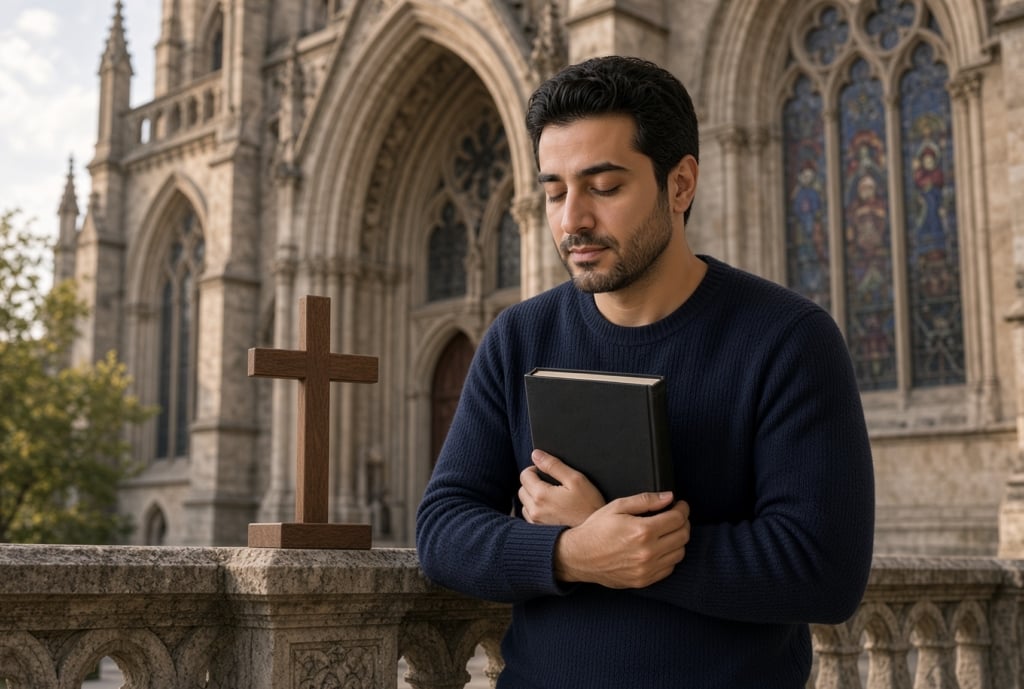
In 2009, Robert Spencer and I stood on opposite sides of a public controversy involving Rifqa Bary, an Ohio teenager who had converted from Islam to Christianity. At the time, I practiced Islam and believed it could coexist with American constitutional freedoms. Today, I am an Iranian-American Christian who recognizes Jesus Christ as my Lord, Savior, and God.
My journey did not happen overnight. I left Islam in 2013 after years of examining its teachings. Five years later, I experienced a spiritual vision associated with the biblical Road to Emmaus. In 2019, I embraced Christianity.
Now Playing
Up NextKABBALAH'S SECRET DOCTRINE | 2 Part Special
58:50Now Playing
Up Next
Mama's Divinity
9:07Now Playing
Up Next
Mama's Divinity
9:07Now Playing
Up NextKabbalah Emperor's International Noahide Court (Oddman Out)
1:52:05Now Playing
Up NextBiblical Management: Lessons in Leadership from the Old and New Testament
12:41Now Playing
Up Nextখ্রিস্টান শিক্ষক vs ড. জাকির নায়েক | কুরআন ও বাইবেল নিয়ে যুক্তির লড়াই | কে জিতবে? #ইসলামিক_ভিডিও
44:00Now Playing
Up NextSyria: Christian churches and religious minorities in Syria.
11:24Now Playing
Up NextSyria: Ancient Christian Site Reopens in Aleppo.
2:34Now Playing
Up NextSaudi Arabia: Muslim pilgrims perform farewell tawaf before departing Mecca.
2:38Now Playing
Up NextJudas Priest From Humble Beginnings To Metal Fame
9:06
There is a profound difference between knowing about Jesus Christ and coming to recognize Him as the living God. This is my testimony.
My Family’s History in Iran and America
I was born in Tehran in 1973, during the reign of Mohammad Reza Shah Pahlavi. My father, Dr. Rokneddin Darvish, served as an officer in Imperial Iran and in SAVAK, the Shah’s intelligence and security organization. He earned two PhDs, one in sociology and one in psychology.
In 1974, my father came to the United States on an Imperial Iranian scholarship. He later spent most of his working life as a government psychologist, including service at the Utah State Prison and the American Fork Training Center. His education, public service, and experiences under two different political systems shaped my understanding of human behavior, authority, and liberty.
Our family also suffered under the Islamic Republic that emerged from the 1979 revolution. My uncle, Shoja Khalil Khan Darvish, was executed in 1981. For us, the consequences of political and religious persecution were deeply personal.
Despite that history, I practiced Islam during college and continued until 2013. I distinguished my faith from the government that had persecuted my family. Over time, however, I began to question teachings about apostasy and religious authority.
Rifqa Bary and Freedom of Conscience
The 2009 Rifqa Bary controversy raised difficult questions about religious conversion and family authority. Robert Spencer and I took opposing public positions. Although I was associated with CAIR’s position at the time, I privately supported Rifqa’s right to become a Christian.
I consoled her parents but told them that America was a free country and their daughter had the constitutional right to choose her faith. Religious freedom, I believed, must include the freedom to leave a religion.
I did not know then that I would soon face that question myself. Four years later, I left Islam. Six years after that, I became a Christian.
Why I Left Islam
My decision in 2013 followed prolonged reflection on Islamic theology, history, and jurisprudence. I struggled particularly with traditional legal teachings concerning apostasy, religious minorities, and the relationship between religious authority and individual liberty.
The Quran states that there is no compulsion in religion (2:256). Yet influential classical legal traditions prescribed punishment for apostasy. I recognize that Muslims interpret these traditions differently and that many defend freedom of conscience. Nonetheless, I could no longer reconcile the teachings I had encountered with my convictions.
Leaving Islam did not immediately make me a Christian. I continued studying scripture and searching for God. I knew that Islam regarded Jesus as a prophet and that Christianity proclaimed His divinity, crucifixion, and resurrection. But I had not yet personally recognized Him as my Savior.
My Road to Emmaus
In 2018, I experienced a spiritual vision connected to Luke 24:13–35, the account of two disciples traveling to Emmaus after Jesus’ crucifixion. I can describe my experience only as seeing through the eyes of Jesus Christ Himself.
It was more than an intellectual meditation on scripture. I understood it as an intensely personal encounter that changed how I perceived Christ.
In Luke’s account, the two disciples walk beside the resurrected Jesus without recognizing Him. They are grieving, confused, and trying to understand what happened in Jerusalem. Scripture tells us, “But their eyes were holden that they should not know him” (Luke 24:16).
They speak with Jesus and hear Him explain the scriptures, yet they do not know who accompanies them. Only later, when He breaks bread, does recognition come: “And their eyes were opened, and they knew him” (Luke 24:31).
That moment speaks directly to what I experienced. For years, I had investigated religion through history, theology, and argument. I could explain what Muslims believed about Jesus and what Christians said about Him. But in my vision, understanding became something more personal.
I came to recognize Jesus not merely as a prophet, teacher, or historical figure, but as the living God.
I cannot scientifically prove my vision or reproduce it for anyone else. I can only describe what I experienced and its effect on my life. I understood myself to be seeing through Christ’s eyes. That experience was my own Road to Emmaus.
When My Eyes Were Opened
After their encounter, the disciples asked, “Did not our heart burn within us, while he talked with us by the way?” (Luke 24:32). Their words capture the difference between studying a faith and personally recognizing the One at its center.
The Gospel of John says, “In the beginning was the Word, and the Word was with God, and the Word was God” (John 1:1), and “the Word was made flesh, and dwelt among us” (John 1:14). Those words came to express what I believed: Jesus Christ was not simply a messenger from God. He was God incarnate.
The Christian proclamation of His crucifixion and resurrection was no longer only a theological proposition I could analyze. It became central to my faith.
Why I Became a Christian
In 2019, I embraced Christianity. I had left Islam six years earlier, but those two decisions were not the same event.
I left Islam because I could no longer accept its teachings as I understood them. I became a Christian because I came to know Jesus Christ as my Lord, Savior, and God.
My family’s experience under the Islamic Republic and my own spiritual journey also strengthened my commitment to religious liberty. Muslims, Christians, Jews, members of other faiths, and people of no faith must all be free to follow conscience without coercion. That includes the right to change one’s religion.
Robert Spencer and I once disagreed publicly about a young woman’s conversion. I could not have imagined that my own life would eventually take a similar turn.
The disciples on the Road to Emmaus knew about Jesus before their eyes were opened. For years, so did I. In 2018, my understanding changed; in 2019, I embraced the faith that experience had brought into focus.
My journey was not simply from Islam to Christianity. It was from searching for God to recognizing the living Christ.
That is my testimony.
Want even more content from FPM? Sign up for FPM+ to unlock exclusive series, virtual town-halls with our authors, and more—now for just $3.99/month. Click here to sign up.
In order to eliminate spam comments that have historically flooded our comments section, comments containing certain keywords will be held in a moderation queue. All comments by legitimate commenters will be manually approved by a member of our team. If your comment is “Awaiting Moderation,” please give us up to 24 hours to manually approve your comment. Please do not re-post the same comment.