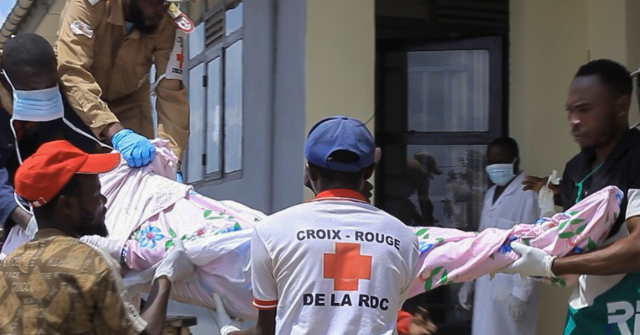
Local authorities in North Kivu, Democratic Republic of the Congo (DRC), reported a harrowing attack by the Islamic State-linked Allied Democratic Forces (ADF) this weekend that resulted in the mass escape of Ebola patients at a local hospital, their whereabouts now unknown.
The ADF terrorists reportedly killed at least 33 people, sources told Reuters, and set a health center on fire. Witnesses in local media reported that the noise of gunshots and violence alarmed individuals confirmed to be carrying Ebola and some suspected Ebola patients at a local hospital, prompting them to run out of the facility. The ADF is an armed militia with ties to the Islamic State that is reportedly seeking to establish a “caliphate” in the DRC. It is one of the largest and most brutal of the armed guerrillas at war in the region.
Christian Kakule Vulembera, the head doctor at the affected Kelele Hospital Center, told Reuters that at least one person who fled was confirmed to have Ebola and five individuals were in quarantine as “suspected” cases. The local outlet Radio Okapi, also citing Vulembera, added some details in its reporting: the gunshots began to be heard in the hospital at around 11 p.m. local time and “caused panic,” such that the quarantined population of the hospital fled.
“Around midnight, the hospital emptied of its patients. All the patients left, including those who were in isolation for suspected Ebola virus infection,” Vulembera recalled.
Hospital officials reportedly do not know the whereabouts of those who escaped and have expressed alarm at the possibility that they may have fled into communities where Ebola cases have not yet been documented, expanding the geographic scope of infections.
Community leaders reportedly held a meeting on Saturday, the day after the attack, to demand the national government take more action to stop ADF attacks in their community. They objected, in particular, to what they saw as a lack of coordination among various security institutions, such as the armed forces and the United Nations mission in the country, MOLUSCO.
“We believe that this time, the army and its military partners, notably MONUSCO, UPDF [Ugandan People’s Defense Forces], and Wazalendo, as well as the commanders deployed in the regions of Beni, Lubero, Mambasa, and Irumu, must combine their efforts to carry out simultaneous operations against these rebels,” community leader Bravo Vukulu reportedly said at the meeting.
“We are fed up, we are tired,” he lamented.
Representatives of the U.N. Mission in the country visited local communities in Ituri province, which neighbors North Kivu, on Thursday to oversee MONUSCO operations. Locals described MONUSCO activities as not necessarily military, however, as many of them are focusing on teaching locals to wash their hands and engage in other activities that limit the spread of diseases.
“Ebola has strongly affected our entity. We saw helicopters landing here with medicine and other equipment needed for the response. Thanks to this assistance, the situation began to improve,” one local, Ringo Uringi, told Radio Okapi.
The World Health Organization (W.H.O.) declared a public health emergency in May as a result of an outbreak of Ebola Bundibugyo in the DRC. W.H.O. Director-General Tedros Adhanom Ghebreysus conceded in June that the outbreak may have begun as early as in January, but the remoteness of the epicenter of the disease — North Kivu and Ituri provinces in the eastern DRC — and the restless and violent situation in the area have made it difficult for health workers to catalogue and treat Ebola cases.
As of the end of last week, the African Centers for Disease Control (Africa CDC) has documented over 10,600 cases of Ebola tied to the current outbreak — the vast majority in the DRC but a small number in Uganda, Nigeria, Kenya, and France. Over 5,200 people have died of the disease, a fatality rate of about 50 percent. The Africa CDC has documented that over 85 percent of individuals confirmed to be carrying Ebola were discovered outside of contact tracing protocols, meaning health officials are largely failing to properly follow up with exposed people or identify infection routs.
Eastern DRC has for years been a hotspot for armed conflict as criminal militias, including the ADF and dozens of others, fight for control of the local “artisanal” slave-driven mining industry. Locals also have traditionally distrusted international humanitarian aid and health workers in general, accusing them of fabricating Ebola as an excuse for mass killings in the name of “population control.” As a result, even the limited amount of health aid that enters the region is often targeted for attack by both armed militias and alarmed locals who believe that attacking the health workers will protect their families from being killed. Complicating matters further is the fact that the strain of Ebola spreading in eastern DRC is Bundibugyo, a less common strain than the Zaire and Sudan strains fueling previous outbreaks and for which there is no fully developed vaccine product or cure.
Follow Frances Martel on Facebook and Twitter.