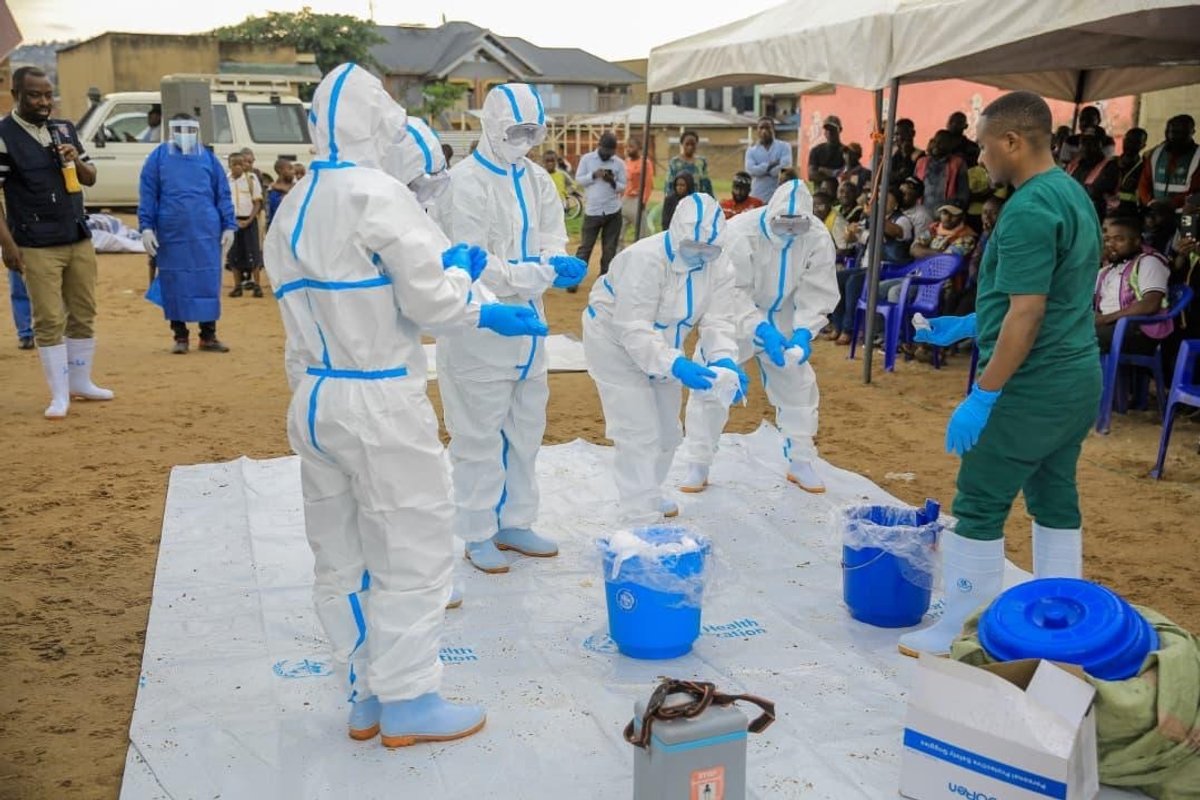
For Marie-Roseline Bélizaire, a typical day starts around 6 A.M. at a health center in the Democratic Republic of the Congo, where she pores over freshly confirmed Ebola cases that have come in overnight. From then on, the work is nonstop: she calls dozens of provinces, visits health centers, supervises contact tracing, trains emergency workers and woos donors—as well as any number of other urgent tasks—before she falls asleep and does it all again the next day.
Bélizaire, emergency director for the World Health Organization’s Regional Office for Africa, does not expect this work to let up anytime soon. She is on the front line, trying desperately to contain the current Ebola outbreak as it rages across central Africa.
“Our biggest concern right now is that the outbreak is still evolving, and we’re still having a lot of people dying in the community,” she says.
On supporting science journalism
If you're enjoying this article, consider supporting our award-winning journalism by subscribing. By purchasing a subscription you are helping to ensure the future of impactful stories about the discoveries and ideas shaping our world today.
This Ebola outbreak was declared in the DRC in May. By November 17, it had expanded to five countries, with more than 11,600 recorded cases and more than 5,600 deaths. The disease is being driven by a distinct species of virus called Bundibugyo. After a 2014–2016 outbreak of a different Ebola-causing virus in West Africa (in which Guinea, Liberia and Sierra Leone were the hardest-hit countries). This is the second-largest outbreak of the disease in history and the fastest-spreading ever.
Scientists know little about Bundibugyo and how to treat it clinically—but the public health crisis will take far more than medical measures to solve, experts say.
Bundibugyo is a rare species of Ebola-causing virus. It has seen only two previous outbreaks, in 2007 and 2012. Symptoms of Bundibugyo infection, as with other cases of Ebola, include fever, diarrhea, vomiting, headaches and difficulty breathing. Because experts have seen so little of this species of virus before and because the DRC is in social and political turmoil, it’s difficult to determine the exact death rate or how the strain might be evolving.
When virologists were developing vaccines for Ebola during the 2014–2016 outbreak, they did not include Bundibugyo. In primate studies, Bundibugyo appeared less lethal and did not act as fast as other strains, says Tom Geisbert, a virologist at the University of Texas Medical Branch at Galveston. Geisbert helped develop the Ervebo vaccine, which treats the Ebola virus (formerly the Zaire virus), a different species than Bundibugyo. Now, Geisbert says, Bundibugyo’s slow-to-appear symptoms mean that asymptomatic people may infect others for days before they are diagnosed themselves.
“We guessed wrong,” he says of the past vaccine effort. “There just wasn’t enough effort put on Bundibugyo to be ready for that.”
Research is now underway on potential Bundibugyo vaccines, including Ervebo, along with a vaccine from the University of Oxford that specifically targets Bundibugyo and an mRNA-based vaccine from Moderna. All three have been approved for a phase 2/3 trial that will test the shots on participants in the outbreak zone. Geisbert says he hopes to see a vaccine approved in the first quarter of 2027.
But many of the reasons for the outbreak’s rapid growth aren’t clinical—and the crisis will not end with the arrival of a vaccine.
Successful treatment for infectious disease relies on contact tracing: accurate tracking of whom a patient could have infected. Right now, about 65 percent of Ebola deaths are happening within community settings, rather than at well-equipped treatment centers. That makes it more difficult to track infected or exposed people’s movements. The DRC’s health ministry recently said that its tracing rate for known contacts had reached roughly 86 percent, but John Johnson, a vaccination and epidemic response adviser at Doctors Without Borders, says he’d be “shocked” if any of the 68 affected health zones in the country were able to track such a high proportion of the actual number of people exposed.
“From what I’ve heard, pretty much everybody says contact tracing is nearly nonexistent in most of these places, and that’s why we’re having so much community death,” he says.
Collecting data is difficult within extremely mobile populations affected by instability. The borders in central Africa are generally porous, and people are constantly traveling across them. The DRC is also facing severe insecurity marked by violent armed conflict across the country, which causes further displacement.
When just one infected person moves, it can start a new chain of transmission—and people are moving by the thousands, says the WHO’s Bélizaire. At the same time, there are more people living in dense urban centers, making the opportunity for spread even greater, she adds.
If and when responders can get a fast-acting vaccine and a handle on contact tracing—and those are big ifs, experts warn—they face communities hardened by years of insecurity and distrust, says Joanne Liu, an epidemiologist at McGill University and former international president of Doctors Without Borders.
Liu visited the DRC several times during a 2018–2019 Ebola outbreak and says she often heard from communities that they had bigger problems than the virus, including malaria, pneumonia, contaminated water and violent attacks. She calls the situation there a “mille-feuille context”—so full of layers and complexity that solutions must start and end with communities themselves.
“What they see is a massive mobilization of aid coming for one specific disease, when actually their challenge is all of the other infectious diseases, plus the insecurity, and nobody is paying attention,” she says.
Liu worries that amid distrust and constant movement, the outbreak could spread farther to places such as the Central African Republic and South Sudan, which have little to no international public health infrastructure, making vaccination campaigns even more challenging.
“It’s one thing to have a vaccine—it’s another thing that it transforms itself into a vaccination. A shot is only good once it’s in people’s arms,” she says.