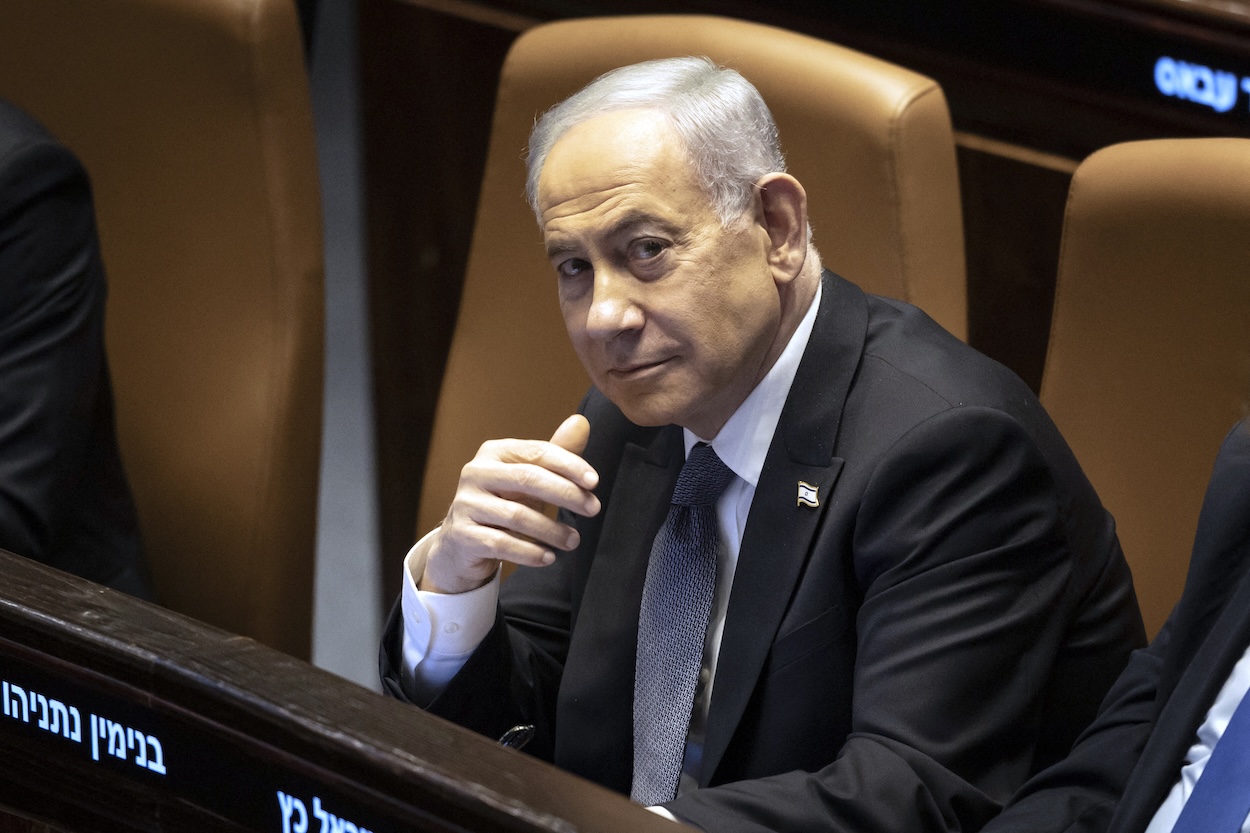
When it first swept to power in Israel in 1977, the Likud’s broad church saw old school liberals, right wing pragmatists, and ideological hard liners rubbing shoulders. Ministers debated politics and ideological points with a rigour and perceptiveness now unthinkable, while heavyweights in the party sparred over how to turn political dogma into praxis.
Party leader and prime minister Menachem Begin dismantled the old Israeli Labour political order, announcing the arrival of the Likud as a party of government. He brought with him an ideological outlook that stretched back to the early days of the 20th century and a programme for change tied to dogmatic political convictions.
Revisionist zionism, to which the Likud officially adheres, was formed by the early 20th century zionist firebrand Ze’ev Jabotinsky. He believed in maximising the territory of any Jewish state, armed militant self-defence and the cultivation of ‘Hadar’ – a word difficult to translate into English but encompassing dignity, chivalry and loyalty. It was a national-liberal outlook shaped by both 19th century Europe and the realities of living in the 20thcentury Middle East.
But crucially, while believing in the need for a Jewish majority, Jabotinsky also advocated for the civic, national and cultural rights of the Arab population. Today’s Arab-Israelis were to be equal citizens. Indeed, it was Begin in Israel’s Knesset who spent years advocating for the lifting of the military rule enforced on the Arab population of Israel since 1948. The Israeli Labour government finally capitulated in 1966.
The emptying out of Likud’s revisionist ideology has been remarkable. Today, Likud’s ranks are crammed with Netanyahu loyalists whose speeches in the Knesset often rely on shock value and offensive rhetoric to rile up their opponents. Loyalty to the boss, not ability, is the only guarantee of a top spot in the party and a ministerial portfolio.
Most popularThe National Trust is desecrating Britain’s great houses
This has not happened without a fight. In the last decade, Netanyahu has faced a number of internal revolts and defections. Benny Begin, Menachem’s son and a former minister in Netanyahu’s early governments, has clashed with the prime minister repeatedly on political and ideological points. In 2016, the younger Begin accused Netanyahu of passing laws contrary to international law, endangering Israel’s international standing and undermining the principles of equality for all citizens of Israel regardless of race or religion.
He was not the only critic. Gideon Sa’ar, a minister on the Likud right, ran against Netanyahu for the party leadership in 2019. He lost heavily and subsequently left the party in 2020 and set up his own party, ‘New Hope,’ which formed part of the brief anti-Netanyahu government in 2021. As with Benny Begin, Sa’ar accused Netanyahu of abandoning revisionism and claimed that the party had become merely ‘a tool for Netanyahu’s interests’.
While Sa’ar eventually returned to Likud, wooed back with the foreign affairs portfolio, Benny Begin and other defectors have remained outside of Likud, feeling politically homeless and adrift. Critics in the party have been purged or sidelined, with Netanyahu shaping the party in his image. Their replacements have largely been inexperienced and junior politicians without any deep revisionist beliefs who owe their rise to Netanyahu plucking them from mediocrity and obscurity.
Party loyalty has proved incredibly useful to a man who has been fighting several criminal cases in recent years. Although the Jerusalem District Court recently recommended that most of the corruption charges against the Prime Minister be dropped, legal challenges remain. Meanwhile, the opposition parties are keen to pass legislation that would mean an indicted politician could not serve as prime minister, effectively barring Netanyahu.
Likud ministers have come out repeatedly to defend Netanyahu. One Likud Knesset member, Tally Gotliv, even took to turning up to Netanyahu’s trial and heckling the judges until she was removed. Netanyahu has repeatedly attacked the courts and sought to limit the freedom of the judiciary in an attempt to exert control over them. Jabotinsky, a firm believer in the importance of institutional checks, would have been horrified, but loyal Likud ministers have no such qualms.
So deep is the loyalty to him from within the party ranks that back in 2022 a party activist created gold pendants with Netanyahu’s face in quarter turned profile with an Israeli flag in the background. Likud officially condemned the ‘loyalty necklaces,’ but that didn’t stop them being snapped up by Netanyahu supporters and party activists.
Unmoored by ideological constraints and facing opposition parties who refuse to work with an indicted prime minister, in recent years Netanyahu has turned to the Israeli religious far-right to prop him up in government.
When Netanyahu first came to power in 1996, such a thing would have been unthinkable. As a national-liberal party, Likud has historically excluded the far-right. In 1984, Shamir took the Likud into a coalition with the Israeli Labour movement to avoid having to form a coalition with the far-right Kach party headed by the American-Israeli Rabbi, Meir Kahane.
Today, Netanyahu champions those parties who look to Kahane as their ideological lodestar. The ‘Jewish Power’ Otzma Yehudit’s party leader Itamar Ben-Gvir has crowed about his plans to deport Arab citizens of Israel, including Arab members of the Knesset. Along with finance minister Bezalel Smotrich, Ben-Gvir has led a racist campaign to smear Arab-Israelis as traitors to the state, something Netanyahu has embraced fervently recently, labelling Arab-Israeli lawmakers ‘terrorist supporters.’
The ramping up of such rhetoric in recent weeks is no coincidence. Following elections which left Israeli-Arab parties with 19 of the Knesset’s 120 seats, Netanyahu fears that if the Jewish opposition bloc allies themselves with these parties, he will be out of power, perhaps for good. His attempts to make such a coalition impossible relies on delegitimising the status of Arab-Israelis and calling their loyalty to the country into doubt.
Netanyahu has all but abandoned any respect for the rule of law
With a party loyal to him and the support of the far-right, freed from ideological considerations, and with a need to hold onto power, Netanyahu may yet drag the country to the edge of civil strife in order to maintain his hold on the premiership. So far, his rhetoric against Arab lawmakers is working – the opposition parties have mostly vowed to form a government without the Arab-Israeli parties, making their path to power more difficult.
But the impact has been deeper polarisation and an increase in violent and toxic discourse in the public sphere aimed at Arab-Israeli citizens. Netanyahu has all but abandoned any respect for the rule of law, has embraced the far right, and rejected the idea that Israel’s Arabs should be equal citizens. Likud is now revisionist zionist in all but name, a party of Kahane rather than Jabotinsky. Such acts might just save Netanyahu from being unseated, but they will make Israeli society more fractured and violent than ever. With everything to lose and a pathological desire to hold onto power, Benjamin Netanyahu is more dangerous than ever.