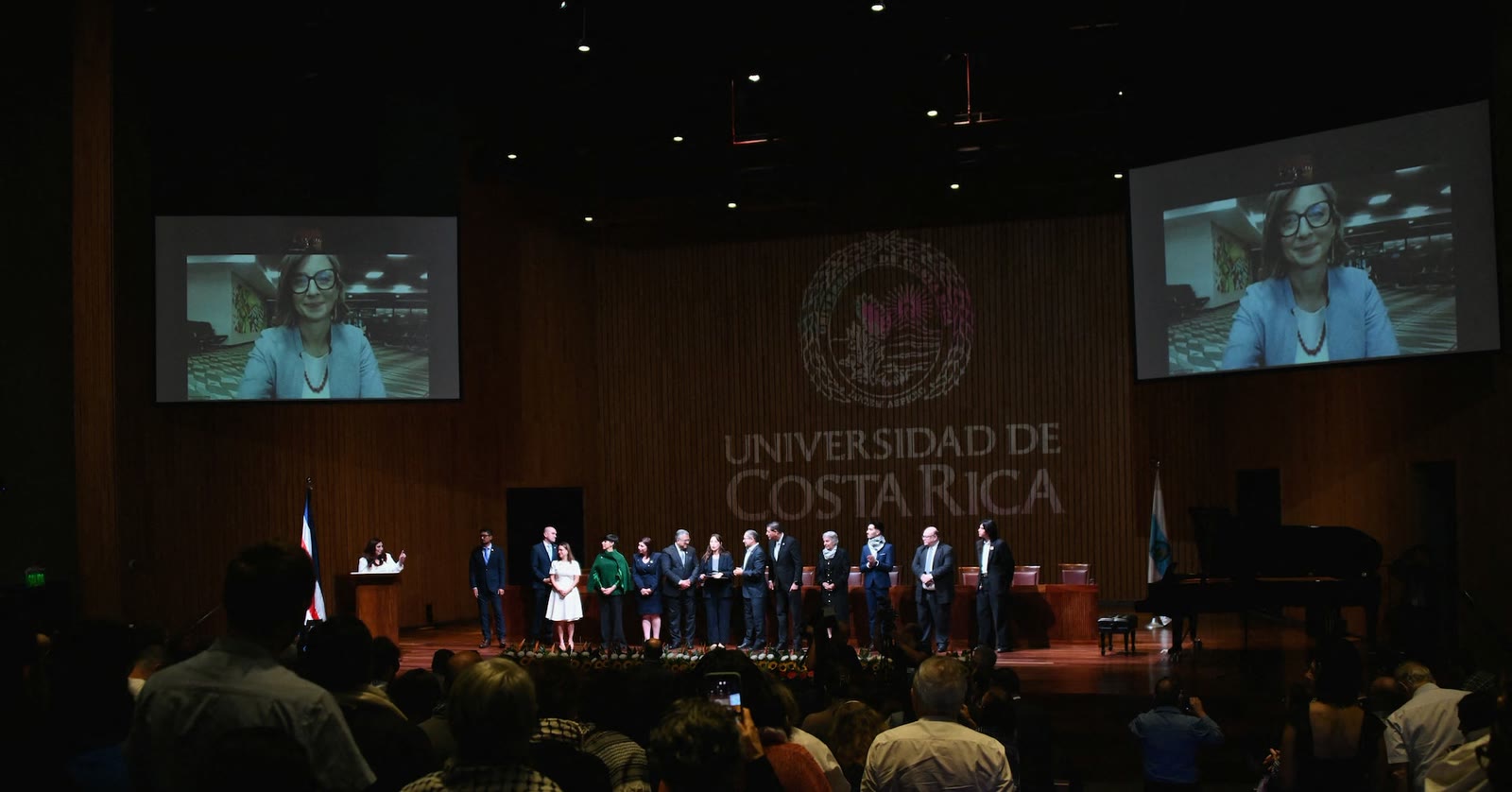
Item 1 of 2 Attendees applaud as UN Special Rapporteur Francesca Albanese joins by video call from Juan Santamaria International Airport, after being denied entry to Costa Rica, during a ceremony in which the University of Costa Rica awarded her an honorary doctorate, in San Jose, Costa Rica, November 27, 2026. Laura Rodriguez Rodriguez/Universidad de Costa Rica/Handout via REUTERS
[1/2]Attendees applaud as UN Special Rapporteur Francesca Albanese joins by video call from Juan Santamaria International Airport, after being denied entry to Costa Rica, during a ceremony in which the University of Costa Rica awarded her an honorary doctorate, in San Jose, Costa Rica, November 27,... Purchase Licensing Rights, opens new tab Read more
Nov 27 (Reuters) - Costa Rica denied entry to the United Nations special rapporteur on the occupied Palestinian territory, drawing criticism from UN human rights chief Volker Turk on Friday.
Costa Rica's move put the small Central American country's increasingly close alignment with Washington and Israel on security and foreign policy into the spotlight.
The Misinformation Monitor newsletter rounds up international misinformation narratives, with a "Real or Fake?" quiz in every edition. Sign up here.
Turk said he was "deeply concerned" by Costa Rica's decision to bar Francesca Albanese from entering the country and urged authorities to reconsider after she was stopped at Juan Santamaria airport, which serves the capital San Jose.
Albanese, an Italian national, had traveled to Costa Rica to receive an honorary doctorate from the state-run University of Costa Rica. A UN special rapporteur is an independent expert appointed by the UN Human Rights Council to investigate and report on rights abuses in a specific country.
The UN human rights office said on X that Albanese was denied entry on "claimed national security grounds." Costa Rica's migration office said it had acted after receiving an alert and that the decision was consistent with national security measures.
Albanese, who has been sanctioned by the United States under measures related to the International Criminal Court, said she hoped Costa Rica would reverse the decision and rejected what she described as efforts to link her to terrorism.
In a video call interview with journalist Ahmed Shihab-Eldin recorded from a gate at the airport, Albanese said authorities took her passport and that she was offered a detention room to sleep in that was so smelly she almost got sick.
"I was almost forced to board the plane to be shipped back to Paris. I said no, and I opposed it ... and they threatened to put me on the plane by force," she added.
Albanese has become one of the most outspoken international critics of Israel's conduct in Gaza, making her a frequent target of pro-Israel officials and governments. Israel's UN ambassador, Danny Danon, praised Costa Rica's decision in a post on X.
Costa Rica, under President Laura Fernandez, has deepened cooperation with the United States on security and has moved closer to Israel, a notable shift for a country long associated with support for multilateral institutions.
Reporting by Paolo Laudani and Alvaro Murillo, editing by Kylie Madry and Rod Nickel
Our Standards: The Thomson Reuters Trust Principles., opens new tab
Sicily-born and raised Paolo is currently based in Gdansk, from where he covers the twists and turns of German, Swiss and Austrian companies.
A curious reporter with a passion for markets and finance, he covers topics spanning from European defence companies to Swiss chocolate maker Barry Callebaut's latest strategic updates. A firm believer in visual learning, he will always try to show you why a story is interesting with a compelling chart.